
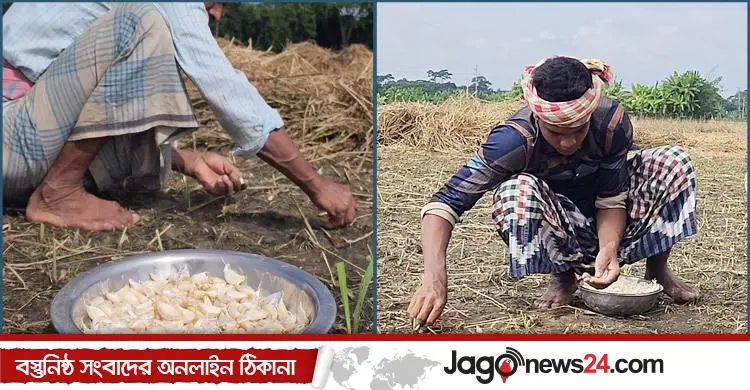
The aman paddy harvest has only just finished, and those same fields are now busy with garlic planting. Once the paddy is cut, the straw is cleared and garlic is planted in the same land without tillage. This zero-tillage method is becoming more popular in Shariatpur by the day, and with its low costs and early harvest, farmers are all turning to it. But rising prices of fertiliser and pesticides have put them in some difficulty, and they want government support.
According to the district Department of Agricultural Extension (DAE), garlic is grown to some extent in every upazila of Shariatpur, a district on the banks of the Padma. The sandy loam soil of the area gives good yields. Zajira and Naria upazilas grow the most garlic in the district. This season the district's target is 4,750 hectares of garlic, with a production target of 42,750 tonnes.
How the method works
Farmers say garlic used to be grown here on tilled land. Ploughing with bullocks required more labour and money, and tilled plots also needed more pesticides and fertiliser. Now zero-tillage garlic is spreading, mostly on aman land. The aman paddy is harvested after the monsoon water drains off the fields, and garlic cloves are pushed into the wet soil once the straw is cleared. The period from late October to mid-November is considered the right time for zero-tillage garlic.
To protect the planted garlic, the straw left in the field is spread over it as mulch. This helps keep the soil fertile and reduces insect attacks. And because zero-tillage garlic is planted at the start of the season, it can be harvested very early and sold at a good price.
Farmers count lower costs
Niranjan Mal, a farmer in Rajnagar union of Naria upazila, has planted garlic on 40 decimals of land this season using the zero-tillage method. He hopes to make at least Tk 50,000 in profit if the market price is good. "Zero-tillage garlic is more convenient for us," he said. "You plant it once and only have to pull it up at harvest. Before, we had to plough the garlic land to get it ready, then drag a kota [a farm tool fitted with iron teeth] over it to smooth the soil. That doubled our costs. With zero tillage, production costs are lower and yields are higher. We are making a profit with this method."
Mosharraf Hossain, a farmer from Jamtala in Zajira, said: "Zero-tillage garlic has caused quite a stir among us farmers. The crop comes home quickly and fetches a good price. But the main problem now is that fertiliser and pesticide prices keep rising, pushing up our costs. Our appeal to the government is to give us free seed and fertiliser."
Another farmer, Jamal Dewan, said: "Zero tillage is good for us. But if rain comes, some of the crop in low-lying land may be damaged. Once the garlic sprouts, though, there is not much trouble. And with this method of covering the crop with paddy straw and water hyacinth, the chance of loss is very small."
Mostafa Kamal Hossain, deputy director of the district DAE, said: "Zero-tillage garlic is very profitable for farmers. On the one hand costs are low, and on the other the crop comes in at the start of the season and fetches a good price. Mulching with straw also means the crop has few problems. We are always giving our farmer brothers advice and support."
Source: Jagonews24. First published in Bengali on The Agro News.
Comments
(0)