
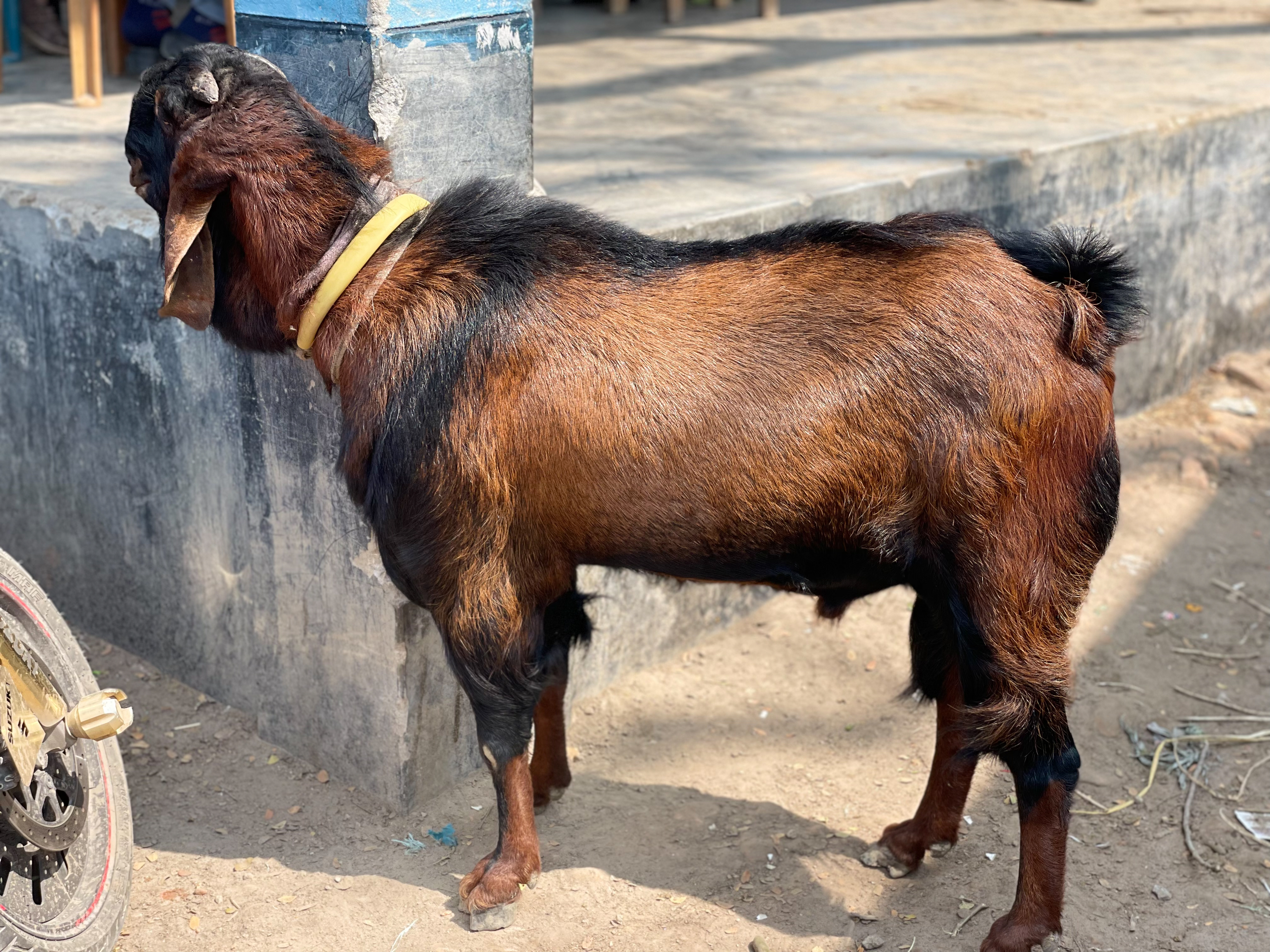
On the afternoon of Monday 25 May 2026, Kamrul Hasan brought a Totapuri goat to the Monohar Bazar cattle market in Shariatpur Sadar upazila to sell it ahead of Eid-ul-Azha. He had named the castrated male goat 'Sanchay', meaning savings. With its long drooping ears and brown, white and black coat, the large goat drew a crowd of buyers and onlookers. Kamrul Hasan was asking Tk 1.2 lakh for it. Jagonews24 carried the report from Shariatpur that afternoon, three days before Eid.
The Jagonews24 headline described the goat as weighing 'one and a half maunds' and said it would sell for 'one and a quarter lakh'. The body of the report, however, gives the asking price as Tk 1.2 lakh, and that is also the figure the owner himself gave. The report does not say whether the goat had been weighed on a scale.
A three-month-old kid from Natore, raised for two and a half years
According to the report, about two and a half years earlier Kamrul Hasan, who lives in the Domsar area of Shariatpur Sadar upazila, bought a three-month-old Totapuri kid in Natore. He paid Tk 20,000 for it. He then raised it with care over a long period until it was fit for sacrifice.
The name 'Sanchay' was Kamrul Hasan's own choice. Domsar, where he lives, is one of the eleven unions of Shariatpur Sadar upazila listed by Banglapedia. The report does not say from which farm or market in Natore the kid was bought.
Crowds at the market, but no buyer at the asking price
From the moment Kamrul Hasan led the goat into the Monohar Bazar market around midday on 25 May, people gathered round it. The report says many wanted their photograph taken with it or a closer look, and that curious visitors had been coming every day to see it.
A visitor named Maruf told Jagonews24: "I have never seen a goat like this. It jumps up on people. It is very attractive to look at. Since it was brought to the market, everyone has been coming to see it, and many are bargaining."
The owner, Kamrul Hasan, said: "I raised the goat with a lot of care and spared nothing on its food and upkeep. That is why I have asked Tk 1.2 lakh. But so far I have not found the buyer I hoped for. Everyone at the market praises it, but I am a little disappointed not to get the price I want." He said that if the goat did not sell at Monohar Bazar, he would take it to Dhaka to sell.
When the report was published the goat was still unsold. People were bargaining, but by the owner's account no offer had come close to his asking price.
The Totapuri goat: a large breed from Rajasthan
Sanchay's breed, the Totapari or Totapuri, is a native goat of the Indian state of Rajasthan. A study published in May 2025 in the Journal of Livestock Biodiversity, an Indian Council of Agricultural Research (ICAR) journal, describes its home tract as the Alwar and Bharatpur districts of Rajasthan. The researchers surveyed 36 villages in the two districts in 2023-24, working from a population of 10,070 Totapari goats and interviewing 176 goat keepers.
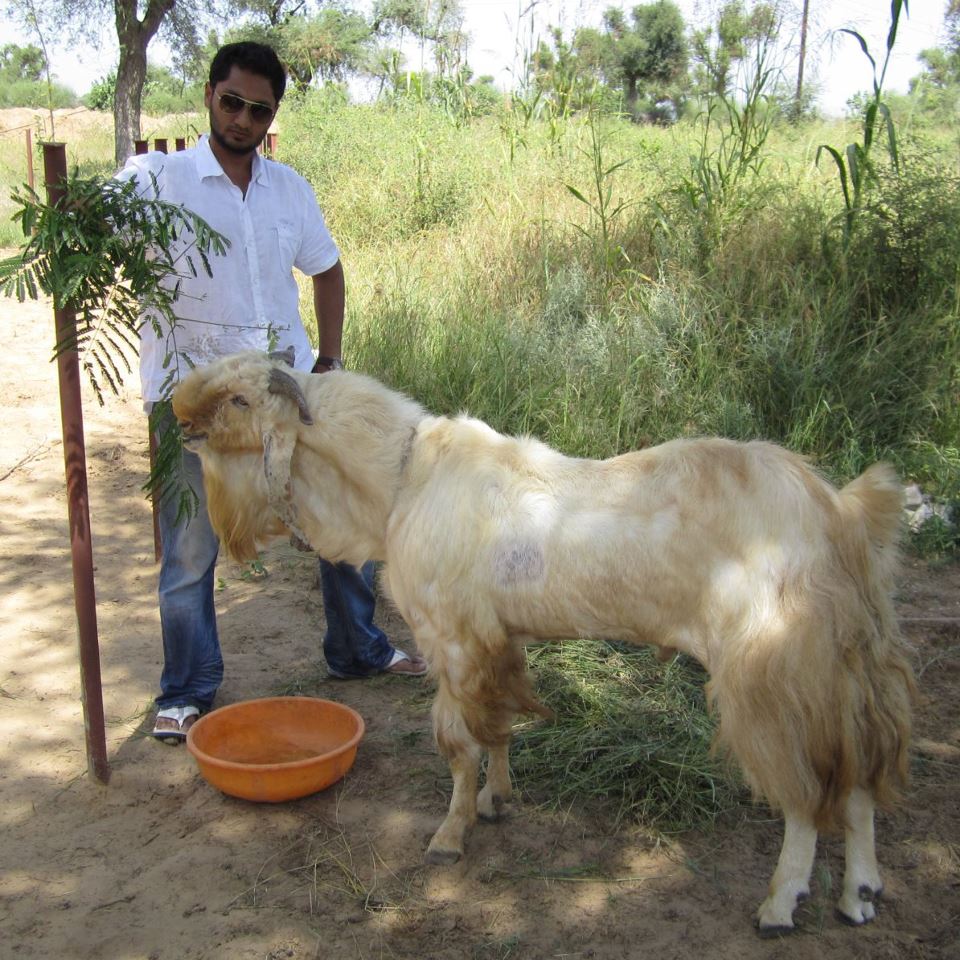
The paper describes the Totapari as typically large and says it is considered the second largest goat breed in India, after the Jamunapari. Its name comes from its face: a Roman nose with an inward-curving upper muzzle and nostrils gives it a parrot-like look (tota means parrot). The coat is usually white with small brown spots, or a completely pale-red colour on the head, neck and ears. The ears are long, flat and drooping, with an average length in the survey of 29.41 cm. The horns are of medium size and point backwards, and males carry a long beard.
The same study recorded body weights from birth to 18 months. Male kids averaged 3.65 kg at birth and 88.86 kg at 18 months; for females the figures were 3.43 kg and 64.54 kg. Does gave an average of about 988 g of milk a day over a lactation of around 283 days. First kidding came at an average age of 540 days, litter size averaged 1.98 kids, and the researchers recorded an average of 9.08 kiddings in a doe's lifetime. They describe it as a dual-purpose breed kept mainly for meat.
A second study, published online in the Indian Journal of Animal Research in March 2026, collected information from farmers keeping about 3,080 Totapuri goats in Rajasthan's Alwar, Dausa and Karauli districts between June 2023 and August 2024. It describes the breed as a large to medium-sized multipurpose native goat, mainly white with a small admixture of black and brown, named after its parrot-shaped nasal bridge. In that survey 71.57 per cent of keepers grazed their goats for six to nine hours a day, 90.38 per cent mostly on common land, and 83.16 per cent followed semi-stall feeding. Most supplemented the diet with a grain mixture (91.58 per cent) and mustard oil cake (87.36 per cent), and 65.26 per cent added minerals. The authors also describe the breed as prolific, with a high chance of twins.
The way Jagonews24 describes Sanchay, with long drooping ears and a brown, white and black coat, fits the Totapuri as these studies describe it. The report does not mention any check or certificate from the livestock department, however; the breed is given on the owner's word.
Bangladesh's goats: from the Black Bengal to the big breeds
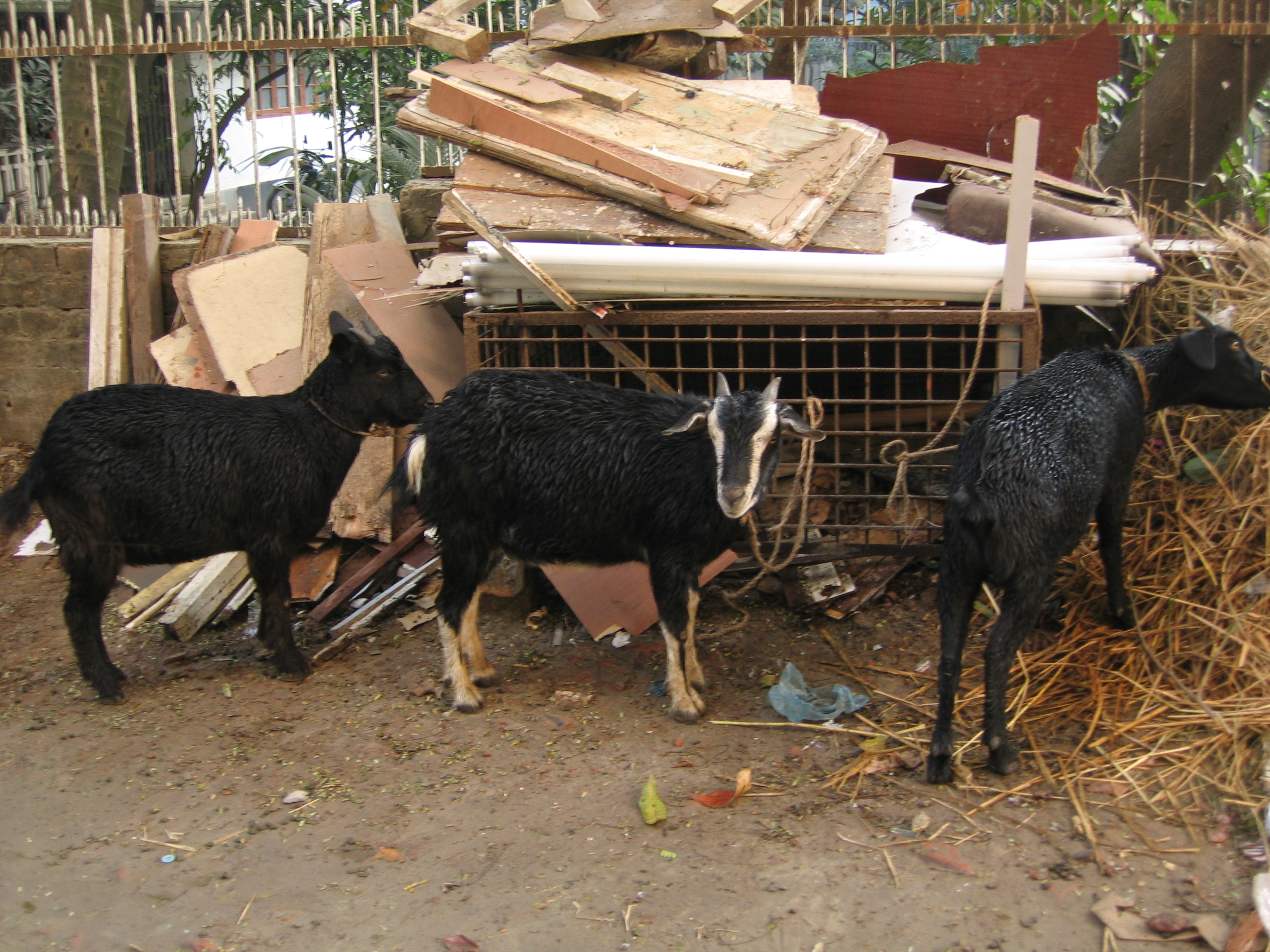
Most goats kept in Bangladesh are the native Black Bengal. Banglapedia's entry on the goat says the Black Bengal makes up more than 90 per cent of the country's goats, with the rest Jamunapari and their crosses. It is a small goat: an adult stands about 50 cm high, a male weighs 16 to 18 kg and a female 12 to 14 kg. It breeds early, first kidding at about 12 months, and a doe kids twice a year or three times in two years.
Banglapedia adds that more than 90 per cent of the country's goats are kept by rural people, most of them looked after by women and children, which keeps production costs low. They can live by grazing fallow land, the ridges between fields and roadsides. Goats supply about 28 per cent of the meat, 23 per cent of the milk and 28 per cent of the skins that come from the country's livestock.
The difference in size is clear when the figures are set side by side: in the Rajasthan survey an 18-month-old Totapuri male averaged 88.86 kg, while Banglapedia gives an adult Black Bengal male 16 to 18 kg.
The Department of Livestock Services (DLS) planning section's 'Livestock Economy at a Glance (2024-2025)', based on BBS data, puts the country's goat population in the 2024-25 fiscal year at 272.91 lakh, more than the number of cattle (251.71 lakh). Sheep numbered 39.81 lakh and buffalo 15.32 lakh that year. Ten years earlier, in 2015-16, there were 257.66 lakh goats.
By the same publication's provisional figures, Bangladesh produced 89.54 lakh tonnes of meat in 2024-25 against a demand, at 120 g per person per day, of 77.92 lakh tonnes. At constant prices livestock accounted for 1.81 per cent of GDP and 16.54 per cent of agricultural GDP. DLS puts the share of the country's employment that depends on the sector at 20 per cent directly and 50 per cent partly.
Qurbani 2026: animals ready and the expected demand
On the evening of 18 May 2026, after the National Moon Sighting Committee met in the Islamic Foundation's conference room at Baitul Mukarram National Mosque, it was announced that the crescent of Zilhaj had been sighted, setting Eid-ul-Azha for Thursday 28 May (Bangla Tribune). Sanchay therefore reached the Monohar Bazar market three days before Eid.
On 3 May the Ministry of Fisheries and Livestock held a briefing on the demand, supply and transport of animals for Eid-ul-Azha, at which the DLS figures were presented. According to The Business Standard and the Dhaka Tribune, the expected demand for sacrificial animals that year was 1,01,06,334, against 1,23,33,840 animals ready in the country, leaving a likely surplus of about 22,27,506.
Goats and sheep were the largest group among the animals ready, at 66,32,307. There were 56,95,878 cattle and buffalo and 5,655 animals of other species, including camels and dumba sheep. The Dhaka Tribune also gave the previous year's figures: at Eid-ul-Azha 2025, 1,24,47,337 animals had been available, 91,36,734 were sacrificed and the surplus was 33.10 lakh.
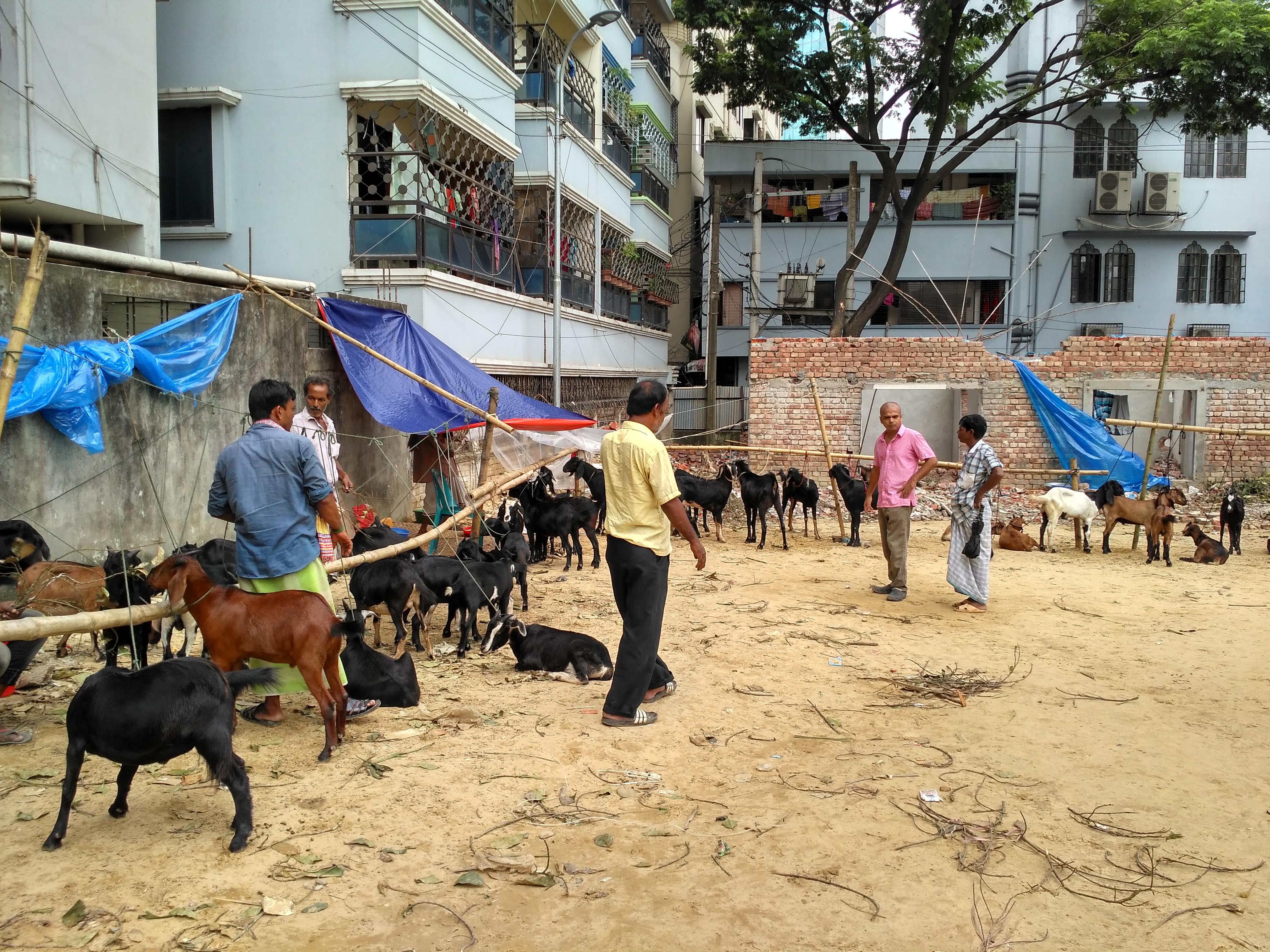
The briefing said more than 3,600 cattle markets would be held across the country. In the capital, 27 markets were fixed, 16 in Dhaka North City Corporation and 11 in Dhaka South, with 20 veterinary medical teams on duty at them around the clock. A policy decision not to hold markets near the border, to protect local farmers, was also announced. Animals bought online would carry no toll or market fee, and professional and amateur butchers had been trained so that hides would not be spoiled. These were the Dhaka markets Kamrul Hasan had in mind if Sanchay did not sell at home.
Other districts reported big goats that season too. On 20 May Prothom Alo wrote about three cross-bred goats on a farm in Satkhira weighing 76, 64 and 54 kg. Their owner said he planned to sell at Tk 800 a kilogram; before the report appeared, the brown one had already sold at Tk 700 a kilogram, for Tk 44,800 in all. He said the three goats' feed cost about Tk 300 a day.
Religious rules for choosing a sacrificial goat
Before every Eid, newspapers set out the Islamic rules for choosing a sacrificial animal. On the morning of 25 May 2026 the daily Ittefaq did so, as did Mufti Atikur Rahman in Desh Rupantor on 13 May. They wrote:
- The animals valid for Qurbani are camels, cattle, buffalo, goats, sheep and dumba; ducks, chickens and wild animals are not.
- Goats, sheep and dumba must be at least one year old, cattle and buffalo two years and camels five years; Desh Rupantor adds that a sheep or dumba of six months that looks as well grown as a yearling is acceptable.
- An animal that is clearly blind, clearly sick, lame or extremely weak is not acceptable, nor is one with more than half of an ear or the tail cut off or a horn broken at the root.
- Up to seven people may share a cow, buffalo or camel, provided, as Ittefaq puts it, that each intends worship and the money is lawfully earned.
Desh Rupantor's piece says a healthy animal is lively, eats well and chews the cud. By the Jagonews24 report Sanchay had been bought about two and a half years earlier at three months old, so it was well past the one-year minimum for a goat.
Shariatpur district and Monohar Bazar
Shariatpur is a district of Dhaka division, named after Haji Shariatullah (1781-1840), the Islamic reformer who founded the Faraizi movement. According to Banglapedia the district was formed on 1 March 1984 and covers 1,174.05 sq km. It is bounded by Munshiganj to the north, Barisal to the south, Chandpur to the east and Madaripur to the west. Its main rivers are the Padma, Meghna, Palong and Jayanti, and its six upazilas are Shariatpur Sadar, Naria, Zanjira, Bhedarganj, Gosairhat and Damudya.
The 2022 census counted 1,294,562 people in the district. Banglapedia, using the 2011 census, says agriculture was the main source of income for 61.66 per cent of households and commerce for 14.34 per cent. Most of the land is low-lying alluvium laid down by the Padma, and the north-east corner, near the confluence of the Padma and Meghna, holds several chars.
Shariatpur Sadar upazila covers 175.09 sq km. Banglapedia lists eleven unions, among them Angaria, Chikandi, Domsar, Palong and Tulasar, the Binodpur and Palong rivers, and paddy, jute and wheat as the main crops. The upazila has 12 hats and bazars, and Banglapedia records 25 dairy farms and 1,303 poultry farms there. Its population was 210,259 at the 2011 census, 59.58 per cent of them dependent on agriculture.
Monohar Bazar, in Sadar upazila, is known for more than its Qurbani cattle market. Desh Rupantor reported on 15 January 2026 that a traditional fair of paired hilsa is held every year on the first day of the month of Magh on the Kali temple ground at Monohar Bazar; that year it ran from 5 am to 2 pm. Locals put the fish sold at Tk 20 lakh to Tk 25 lakh, and one of the organisers said the fair had been held for about 200 years. Hindu families buy a pair of hilsa and a pair of aubergines on the first of Magh, and Muslim buyers also come for hilsa and other goods.

Earlier reports of big goats and big prices
Asking more than a lakh for a large goat at a Qurbani market was not new. On 19 August 2018 Jagonews24 reported from the temporary cattle market at Kamalapur in Dhaka, where a seller from Bogura was asking Tk 1.2 lakh each for two large black-and-white goats. He said each weighed two maunds and that they ate Tk 200 to Tk 250 worth of rice and bran a day. He had brought them to Dhaka hoping for a better price than he was offered at home, but by that day no one had offered what he expected.
The same report showed that ordinary goats sold for far less. A seller who had brought 20 castrated goats from Narayanganj to the Aftabnagar market was asking Tk 15,000 to Tk 50,000 depending on size. A buyer at Kamalapur said that, unable to afford a cow, she had bought two goats for Tk 27,000 excluding the market fee. One seller blamed higher prices on rice and bran costing Tk 8 to Tk 10 more per kilogram.
Eight years later, at Monohar Bazar in Shariatpur, Sanchay's owner described much the same situation: crowds came to see the goat and praised it, but no buyer met his price, and he was weighing a trip to the Dhaka markets.
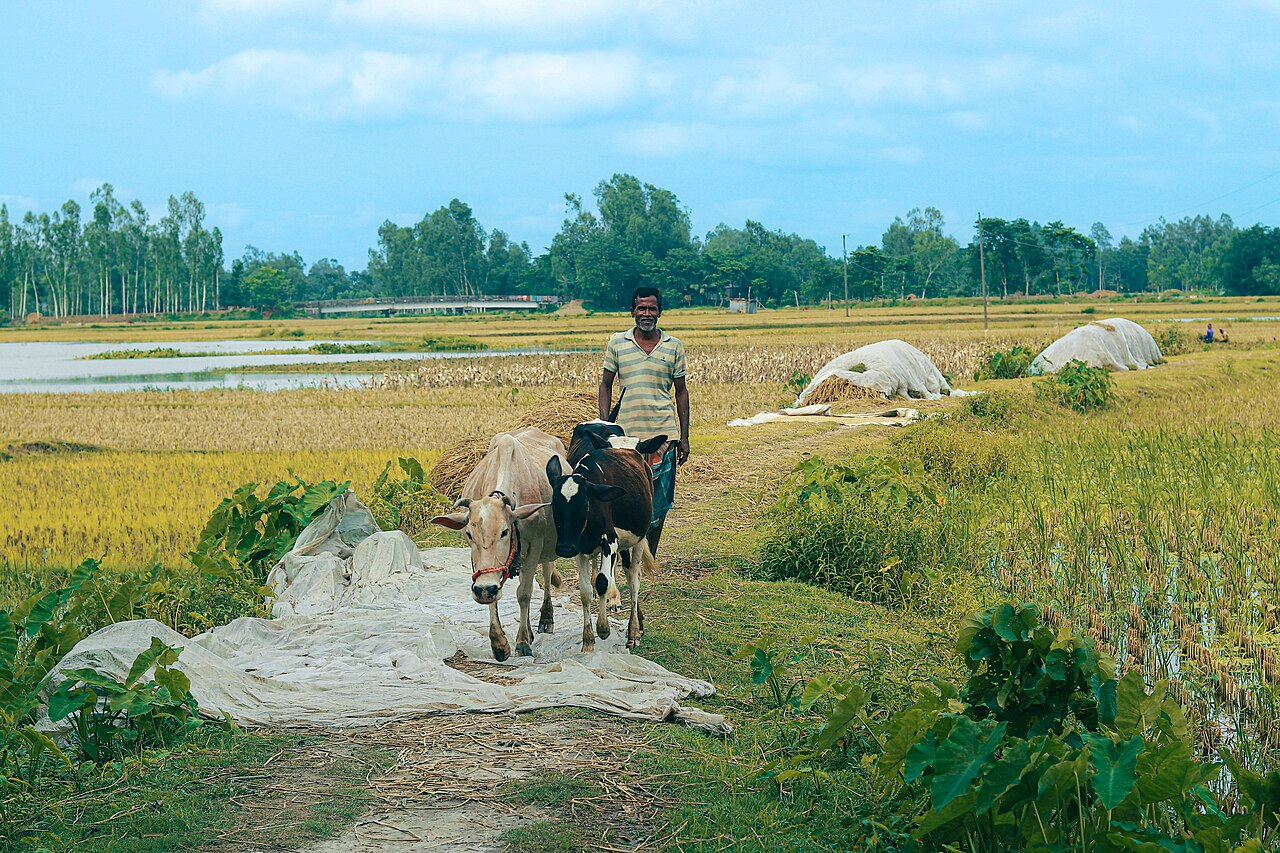
Photo: Nafiz6167 / Wikimedia Commons (CC BY-SA 4.0)
Sources: Jagonews24, Journal of Livestock Biodiversity (ICAR), Indian Journal of Animal Research, Banglapedia, Department of Livestock Services, The Business Standard, Dhaka Tribune, Bangla Tribune, Prothom Alo, The Daily Ittefaq, Desh Rupantor, Wikipedia
Comments
(0)