
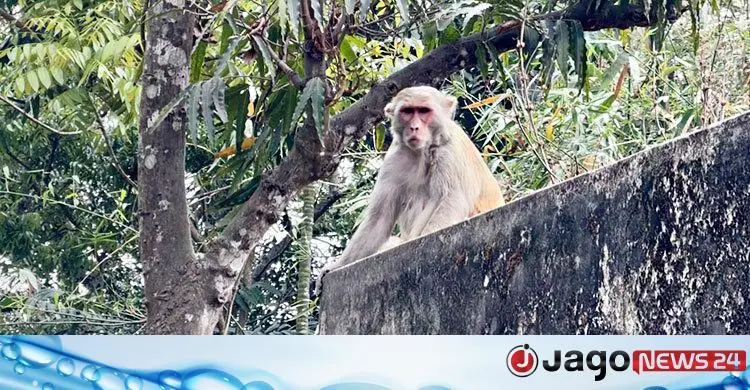
They arrive as soon as dawn breaks. Sometimes they raid homes in groups; sometimes a stray one snatches food straight from people's hands. Their behaviour is driven by nothing more than the need to survive.
For several years, hungry troops of monkeys searching for food have become a nuisance to villagers. With no other option, the villagers have learned to live with them and give them what food they can afford. But they are now demanding that the animals be fed by the government.
Fewer fruit trees, more hunger
Local inquiries show that at least six thousand monkeys live in the Palpara, Madhupur and Pachalia areas of Dingamanik Kartikpur, in Naria and neighbouring Bhedarganj upazilas of Shariatpur. Because the areas are naturally well wooded, the monkeys have made their home here for 50 years, living among trees and around old buildings. There were once plenty of fruit trees, and the monkeys lived on their fruit. In recent years, however, timber trees have come to outnumber fruit trees.
Natural disasters and the spread of human settlement, among other causes, are also clearing the trees, and fruit trees bear less than before. The monkeys' food shortage has become acute. Unable to find enough to eat, they often raid homes, taking food left to dry in courtyards, food kept in kitchens and even food in children's hands.
Plagued by the monkeys, people are forced to keep their doors and windows shut at all times. Some feed the animals out of compassion, but what they give is meagre. As a result, the monkeys are on the way to disappearing from the area.
On a recent visit to Kartikpur, troops of monkeys were seen sitting in trees and on roofs very close to people, trying to get into houses through doors and windows whenever they could. Others were searching the undergrowth for food. In some homes, people were seen giving the monkeys bananas and puffed rice.
What residents say
Basudeb Pal, a resident of Kartikpur Palpara in his sixties, said: "At first the monkeys' harassment felt very bad. They would get into the house and wreck things, throwing out the rice and lentils. We used to chase them with sticks to scare them. But they are voiceless animals too, and they feel hunger. Now we give them as much food as we can."
Sandip Das, from the same area, said: "We have lived with monkeys since childhood. There used to be lots of mango, jamun, jackfruit and banana trees here, and they ate from those. Now that the trees don't fruit as before, they face a food crisis. They come into our homes for food and snatch it from our children's hands. What we give is little. We want the government to feed the monkeys."
Local shopkeeper Mir Hossain Sardar said: "At least five thousand monkeys live in our area and a few neighbouring areas. They have been here for at least 50 years. But so far no one from the administration has looked into the monkeys. We villagers feed them. When the food shortage becomes acute, they come into our homes and shops. If the government arranged food for them, their hunger would ease somewhat."
Officials respond
District forest officer Habibur Rahman said: "We have learned through you that there are monkeys in two upazilas of Shariatpur. We will look into it and inform higher authorities, and act on their instructions."
Naria Upazila Nirbahi Officer (UNO) Abdul Kaiyum Khan said the monkeys' food shortage has arisen as settlements grow day by day, which is why they often raid homes.
He said the upazila administration has decided to preserve the monkeys. "So that they do not suffer from hunger, we will take up a project for them. If necessary, we will create a safe habitat by planting a forest on khas (government) land and relocate them there."
Source: Jagonews24. First published in Bengali on The Agro News.
Comments
(0)