
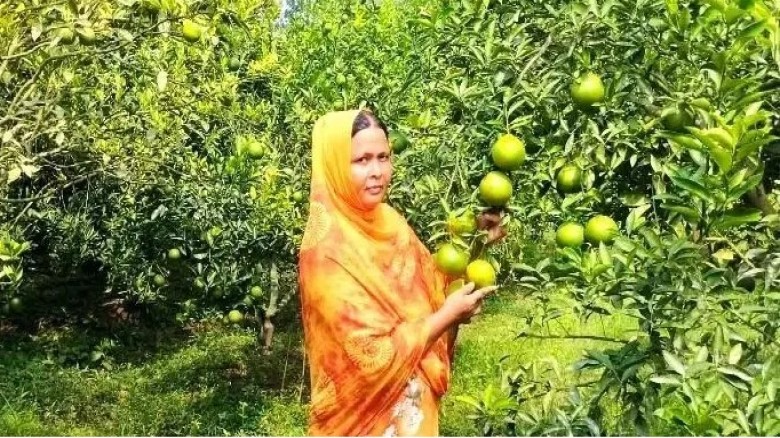
It looks much like a medium-sized apple, with the same colouring — green and pale yellow overlaid with red — turning vermilion when ripe. It tastes very sweet. It can resemble the BAU kul, but it is in fact the Kashmiri apple kul.
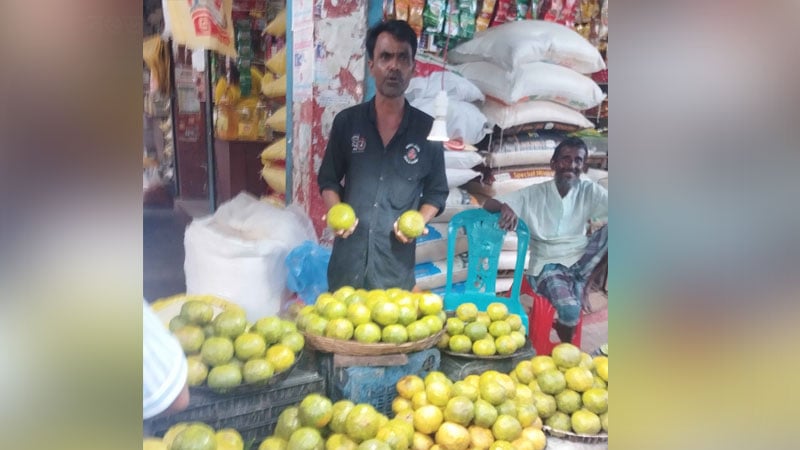
Apple kul is grown in Bangladesh, but this new Kashmiri apple kul is being grown in Shariatpur for the first time. Awlad Hossain Fakir, a grocer from Swarnaghosh village in Ward 8 of Shariatpur municipality, has succeeded with it on his first attempt and harvested a bumper crop.
Ten months to fruit
The Shariatpur Department of Agricultural Extension (DAE) and local sources say Kashmiri apple kul saplings were brought to Bangladesh in 2017. Farmer Awlad Hossain of Swarnaghosh village brought saplings of the variety to Shariatpur from a nursery in Chuadanga in 2018. In March that year he planted 150 Kashmiri apple kul saplings on 30 decimals of land. Within 10 months the plants matured and flowered, and the trees fruited in January this year, bearing 50–60 kg each. No other farmer in Shariatpur had planted an orchard of this variety before.
Awlad Hossain Fakir said: "Inspired by farming reports on YouTube, I decided to grow Kashmiri apple kul. I got 150 saplings from a nursery in Chuadanga and planted them on 30 decimals. They fruited within 10 months, and I have started selling in the market. Each tree will produce 50 to 60 kg. The vermilion-coloured kul are very tasty. Setting up the orchard cost Tk 50,000 at first. I hope to make a profit of a lakh taka after costs."
He said Shariatpur's soil would give bumper crops of Kashmiri apple kul, as it had for him. "The soil here is very good. Anyone can grow it easily and become self-reliant."
Officials encourage farmers
Amir Hamza, deputy director of the DAE in Shariatpur, said Awlad had shown success for the first time by growing the new Kashmiri apple kul in Shariatpur's soil. Kul gives a good yield in a short time, and the soil in the area suits it. Farmers here are being encouraged to grow it, and the agriculture office will help anyone who wants to plant and grow the fruit in future.
Source: Jagonews24. First published in Bengali on The Agro News.
Comments
(0)