
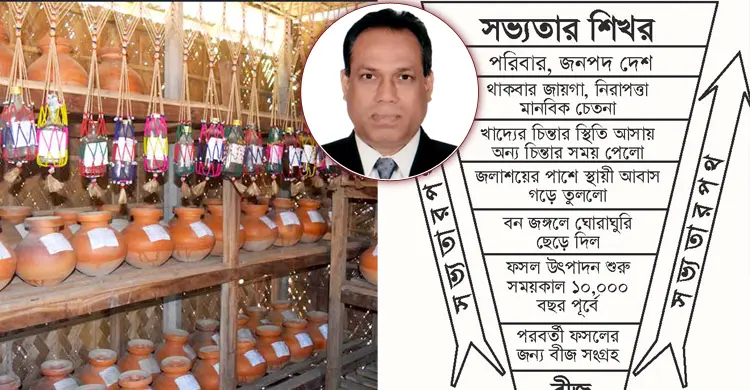
Crops need seed. With the discovery of this truth, human civilisation, which had been slowly making its way through ups and downs, seemed to step onto an escalator of progress. Like a boat that surges ahead when wind fills its sail, it began to move swiftly. The advance of civilisation became faster and easier.
The day tired people, living an insecure life of hunting, kept seed to grow their next crop, they discovered a great path to human welfare. The bond that seed formed with people and with the progress of their civilisation continues to this day, growing ever closer, and will keep growing. The exact time when people discovered this truth, or first kept seed to grow the crops they needed, cannot be pinned down. Analysis of various data shows that farming began on Earth about 10,000 years ago. So the bond between seed and human civilisation can be taken to have begun some time around 10,000 years ago.
Having learned to farm and produce their own food using seed, people became civilised almost overnight. With food they grew themselves, they stopped roaming the forests and settled beside water. Freed from constant worry about finding food, they had time for other thoughts, and from those began civilisation's rise from one stage to the next.
From settlement to society
Once food was secure, people thought of a place to live. They marked out a spot, fenced it and roofed it, and so built houses. They thought of security and strengthened their homes. They marked the boundaries of their farmland. Gradually families formed; from families, settlements; and finally countries. Society arose to manage them. It can be assumed that civilisation advanced through such a process, which began with the discovery of seed.
Farming and civilisation probably began with cereal crops, when people learned that sowing the seed of a kind of grass produced many seeds, which could be eaten and saved for later use. They then stopped wandering in search of food and settled down. All the great civilisations in human history were built on cereals grown from such grasses, because cereals have high food value and are easy to store.
So the Mesopotamians grew wheat in the basin of the Tigris and Euphrates rivers. The Chinese began growing rice in the basins of the Huang He and Yangtze. The Maya grew maize on the dry plains of the Yucatán region. Seed was, and still is, the main source of human food production. Without seed, farming could not have begun, nor could it have been made stable. The development of civilisation would have been disrupted and slowed by unstable farming. As civilisation has developed, the importance of seed has been felt ever more deeply, and its use keeps widening.
The importance of seed
The inherent power of seed and its many uses have made it a unique and essential commodity. The following gives an idea of the dimensions of its importance.
Existence: Let us think for a moment about something impossible. Suppose there were no air on Earth, or all the air were polluted, or the Earth's temperature suddenly rose or fell slightly, or all the water vanished or were polluted. If any of these happened, our existence would be threatened, and if such conditions lasted long, we and all living things would disappear.
Now think about seed. Suppose there were no seed on Earth, or all seed died. What would happen? Plants would vanish from the Earth. The abundance of air, heat or water never makes us think such things could happen, and the same is true of seed. Plants produce seed in abundance, so it never seems that seed could run out. But if anything went wrong with seed, our existence would suffer. So neglecting seed is the same as neglecting our own existence.
Starting cultivation: Just as farming could not begin without seed in the past, today too, anyone who wants to start cultivating must think of seed. Only once seed or seedlings are obtained can cultivation begin.
Spreading technology: Seed does not just produce seedlings or crops; it carries many technologies from research. Research makes seed high-yielding or resistant to disease and pests, or develops seed that can be sown early or late to fit a local cropping pattern. When seed with these qualities reaches farmers, they receive not only seed but the results of laboratory technology, and so technology spreads.
Making other inputs effective: Fertiliser, irrigation and pesticides are used to raise yields. But if the seed is not high-yielding, however much fertiliser, water or pesticide is used, high yields are impossible. Using more of other inputs without high-yielding seed brings no benefit and only wastes money. High-yielding seed is essential for other inputs to pay off.
Uses of seed
The qualities and characteristics of seed have made it important. Seed performs countless essential functions for the plant and animal world, so its importance to both is immense.
Propagation: Seed is the main means by which plants reproduce. Without producing seed, a plant could not leave descendants. Seed protects the embryo from natural hazards, feeds it at the right time and turns it into a seedling that becomes a plant. It keeps the embryo alive until the next growing season, and many seeds stay alive for a long time. Without seed, plants would have disappeared from the Earth, and the animals that depend on them would have been threatened too.
Food: Seed is the main food of animals and birds, and cereal seed is the most important human food. Plant seeds supply more food than any other plant or animal product. Wheat ranks first as food and rice second. The seeds of maize, barley, sorghum, millet, pulses and oilseeds feed people and animals. In our country, cereals, especially rice, supply three-quarters of the body's energy; everything we do, all our movement and work, comes from rice.
Plant breeding: Seed is a history of plant improvement. People have kept seed from good varieties and grown crops from it, and selecting good varieties through seed began in the past and continues today. It is often said that varieties are improved through seed. New varieties have also arisen through mutations in vegetative cells and survived through vegetative propagation, but that meant waiting a long time, with uncertain results. On the other hand, when a good trait is seen in a variety, it is introduced into the desired variety by crossing, and seed is produced to improve the variety. Because of the structure and viability of seed, breeders can store small amounts of many plants' varieties under controlled conditions. Seed is kept in these controlled places, gene banks, and later used for breeding. In this way seed keeps helping people develop better varieties.
Crop production: Growing crops without seed is unthinkable; crop production starts with seed. If seed does not germinate well, there will be fewer plants in the field and a smaller harvest. If seed is not high-yielding, high yields cannot be had even with fertiliser, irrigation and control of diseases and pests, so other inputs waste money. Put simply, without seed most crop production would be impossible.
Raw material: Seed is used as a raw material for industrial goods. Oilseeds are widely used in the cosmetics industry. Cereal seed and oilseeds are raw materials for many chemicals. Wheat, barley and rice are used to make alcoholic drinks. Seed is a main ingredient of many medicines.
Beauty: The size, shape and colour of seeds are very beautiful, and each seed has its own form. Tobacco seed and true potato seed are very small; amaranth (data) seed is a little bigger. Coconut and palmyra palm seeds are quite large. In shape, some are round, some flat and some oval. Colour makes seed a thing of beauty; with its mix of colours, a seed is like a lovely picture painted by an artist. The beauty of seed feeds the human mind.
Source: Jagonews24. First published in Bengali on The Agro News.

Comments
(0)