
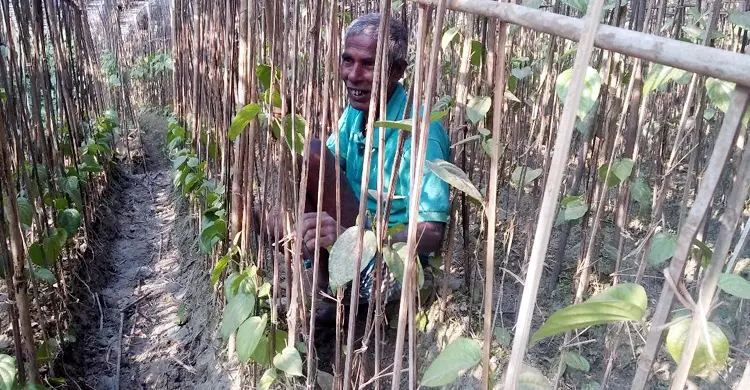
On Sandwip, guests and relatives who visit are first welcomed with betel leaf (paan). Weddings and pujas cannot take place without it. People on Sandwip once believed that if a guest left the house without having eaten anything, misfortune would fall on the household, so at the very least a betel leaf had to be offered.
Sandwip once exported large quantities of betel leaf and was famous for producing it. Its betel leaf went to Noakhali, Feni and Chattogram city. But the population has grown, and now the island cannot even meet its own demand; betel leaf comes in from Chattogram city and Barishal instead. An island that exported betel leaf has become one that imports it.
Many betel vineyards (baroj) have grown up in the Sandwip thana area, Musapur Pandit's Hat, Hindupara Dham and Haramia. Sandwip has betel vineyards on 15-16 hectares. Growers say they are going through hard times and make little profit from selling leaf. The number of vineyards is falling, and with too few new ones being set up, Sandwip's traditional betel farming is at risk of disappearing.
Rising costs, no support
Because betel farming is labour-intensive and expensive, growers have lost interest. Skilled workers for such complex and demanding cultivation are hard to find. Yet in the area betel is more profitable than rice or vegetables, so the crop has great economic potential.
Growers say bamboo is expensive, fertiliser and pesticide prices are high and transport costs have risen, so they are being forced to abandon their forefathers' tradition. Mustard oil cake, one of the main feeds for a vineyard, costs Tk 70-80 a kg. It has to be brought home, ground by hand in a mortar or a dhenki, applied to the base of the vines once a month and covered with soil brought from outside.
Each vineyard must also be fenced on all sides like a house and roofed to protect the leaf from sun, rain, fog and birds. Hardship, disasters and rising production costs are driving farmers away. When rot, whitefly and black sucking insects strike the vineyards in the rainy season, no help comes from the agriculture office, so many are leaving the family tradition for other work to make a living.
College student Abdul Kader Pranto told Jago News: "I always have to buy betel leaf for my grandmother. She tells me to bring local leaf, meaning Sandwip leaf, because it tastes good. We used to see traders carrying leaf from the vineyards on bicycles to sell, but that sight is gone now. Betel farming on Sandwip is gradually declining."
Nitai Chandra Das, who farms betel on land he sharecrops, said: "Our forefathers grew betel, and I still grow it to keep that going. A worker cannot be found for under Tk 500, and the inputs cost a lot. I don't get back even most of what I spend on the vineyard. I'm thinking of giving up betel farming."
Jabed Hossain, a vineyard owner who works as a marketing officer for a pharmaceutical company, told Jago News: "There is no profit like before. I keep farming to hold on to my forefathers' tradition. We get little help or advice from the upazila agriculture office, and no organisation comes forward with training. Without government patronage and credit, betel farming on Sandwip is heading for extinction."
Acting upazila agriculture officer Abdul Bayes Sabuj told Jago News: "Betel farming on Sandwip has great potential. I have repeatedly asked for government help and patronage for it. Proper patronage and support alone can bring back the past glory of Sandwip's betel leaf."
Source: Jagonews24. First published in Bengali on The Agro News.

Comments
(0)