
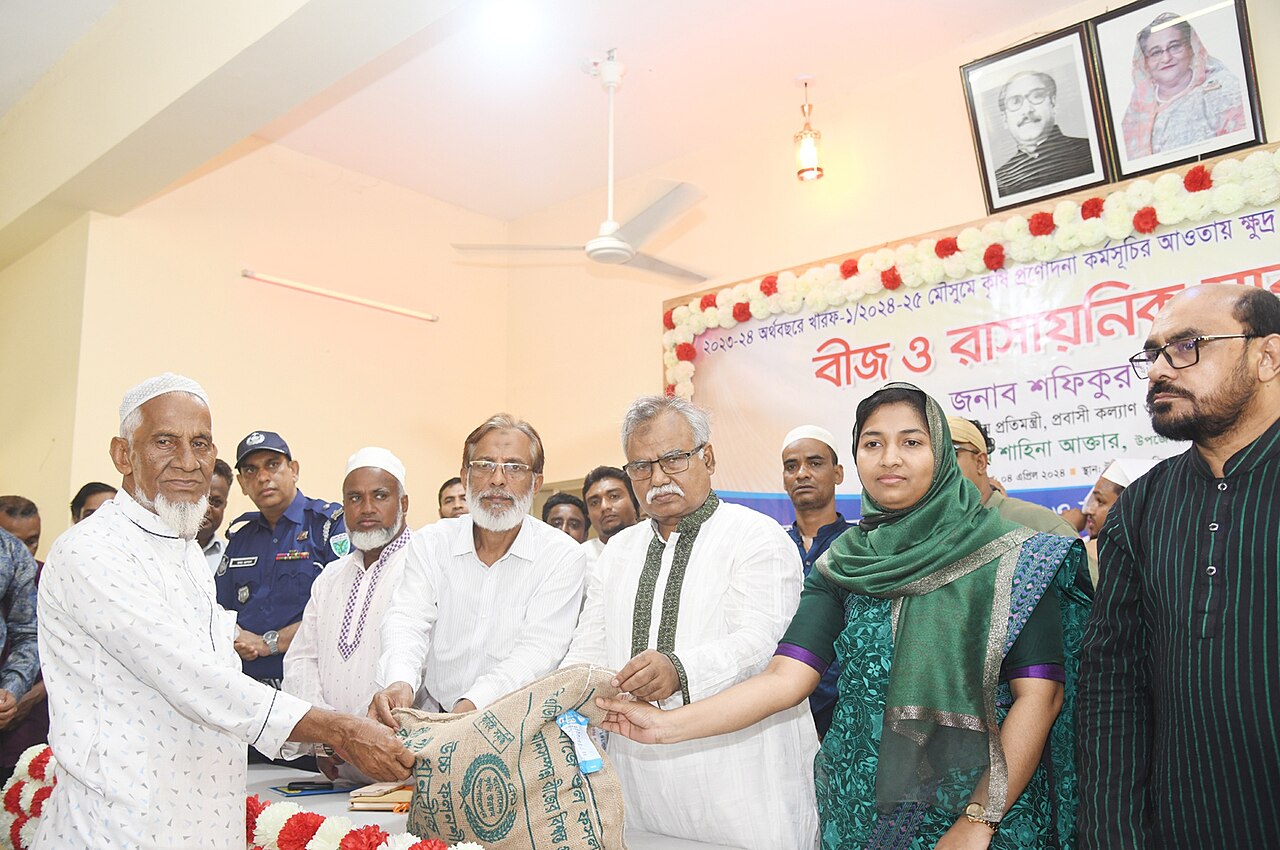
The government has set aside Tk 17,000 crore for fertiliser subsidies in the 2026-27 financial year, but how much of that money reaches the farmers who need it is in question. Robiul Islam, a farmer at Char Narayanpur in Chapainawabganj Sadar, fears that if fertiliser prices do not fall, farming will become hard, and that high prices could one day push him to give it up. The concerns are set out in an analysis by Dhaka Mail.
Total demand for chemical fertiliser this year is put at 5,805,000 tonnes. Domestic factories are expected to produce 1.2 million tonnes, leaving 4,605,000 tonnes to be imported, so about 79 per cent of demand depends on imports. Urea demand is 2,620,000 tonnes, of which 1,620,000 tonnes must be imported; DAP demand is 1,485,000 tonnes, with an import target of 1,385,000 tonnes; 65,000 of the 75,000 tonnes of TSP is imported; and all 950,000 tonnes of MOP is imported because none is made in the country.
Farmers say that because missing the time to apply fertiliser damages the crop, they buy at higher prices when they cannot get it at the set price. Mainul Hasan, who farms at Godagari in Rajshahi, says crops needing several doses see costs rise most, and many farmers apply less than needed to cope, which risks lower yields. The government has set a dealer commission of Tk 3 a kilogram on urea, DAP, TSP and MOP, due to take effect on 1 July 2027, with the farm-gate price unchanged. Agriculture Minister Mohammad Amin Ur Rashid has also spoken of plans to supply fertiliser and quality seed at fair prices directly through digital farmer cards.
By the World Bank's estimate, Bangladesh uses about 6.6 million tonnes of fertiliser a year and imports more than 85 per cent of it. Gas shortages and problems at factories are holding back domestic output, raising both imports and the cost of subsidies. In 2018-19, 63 per cent of the agriculture ministry's budget went on subsidies; from 2022-23 it has been about 80 per cent. Subsidies took 41.5 per cent of total food and agriculture spending against just 4.2 per cent for research, roughly Tk 10 of subsidy for every taka spent on research.
Only 5 per cent of Bangladeshi farmers use fertiliser in balanced doses, the World Bank says, and a weakly supervised distribution system leaves room for black-marketing and overcharging. It advises adjusting prices gradually, with advance notice, rather than raising them suddenly, because cash-strapped small farmers may cut fertiliser use. Registering real cultivators, sharecroppers included, with records of their land, crops and soil would allow direct support matched to need. "Modernising the design and delivery of fertiliser subsidies has created a big opportunity for Bangladesh," said Monsur Ahmed, a senior economist at the World Bank.
"A large share of the fertiliser subsidy goes to well-off and large farmers," Professor A S M Golam Hafeez Kennedy, an agricultural economist and member of the Public Service Commission, told Dhaka Mail. Because everyone pays the same price, he said, the small and marginal farmers who need the subsidy most benefit least, and farmer cards could be used to identify real beneficiaries and target support. Mustafa K Mujeri, a former director general of the Bangladesh Institute of Development Studies, said keeping prices low is not enough: fertiliser must also reach farmers when they need it.
This report is based on an analysis by Abdul Hakim of Dhaka Mail.
Photo: Press Information Department / Wikimedia Commons (public domain)
Source: Dhaka Mail

Comments
(0)