
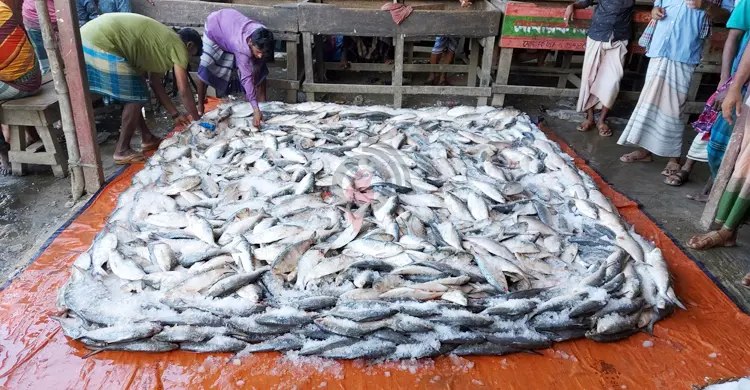
Hilsa is being exported to India in the greater interest by a decision taken at the highest level, Finance and Commerce Adviser Dr Salehuddin Ahmed has said. The amount being exported is not even one day's hilsa at the Chandpur ghat, he said. The decision was taken after much thought, and there is no use in talking emotionally.
He said this in reply to journalists' questions at the Secretariat on Sunday, 22 September. The government has decided to export 3,000 metric tonnes of hilsa to India for the upcoming Durga Puja.
'Less than a day at Chandpur ghat'
The Ministry of Fisheries and Livestock has said the export decision was not theirs and that the Commerce Ministry took it despite their objection. When journalists drew his attention to this, the commerce adviser said: "Whatever they say, 3,000 tonnes of exports have been mentioned. Look, 530,000 metric tonnes of hilsa are produced. Three thousand tonnes is less than one day's amount at the Chandpur ghat."
Dr Salehuddin said: "We have friendly relations with India. There is commercial benefit in exporting hilsa. Foreign currency comes in. If we don't export, it gets smuggled. I have been praised for exporting hilsa to India. There is a greater interest in exporting too."
The commerce adviser said: "We have a commercial benefit as well. If we export, we will get some foreign currency. Otherwise it is being smuggled out here and there anyway, and you get nothing from that. So fine, let them talk. Every decision has to be made with everyone... The decision was taken after much consideration, and I have been praised for it. Many quarters have said it was a good decision."
'A bigger responsible quarter'
Many things had been said by responsible quarters, including that hilsa would not be sent. Asked about this by journalists, the commerce adviser said: "One person from a responsible quarter said so; a bigger responsible quarter said it could be sent."
Asked whether exporting hilsa to India would raise prices at home, Salehuddin Ahmed said: "Traders raise prices anyway. Why would they raise them because of this? In any case, I think the decision was made in the greatest interest. Yes, some people are having problems, but I do not think it is hugely harmful. We want to remain as neighbours."
He said: "Their (India's) onions are not coming cheaply? Then refuse, say you won't eat their onions. These are emotional words; there is no use saying them. They have cut the duty on onions. Onions are coming."
Source: Jagonews24. First published in Bengali on The Agro News.

Comments
(0)