
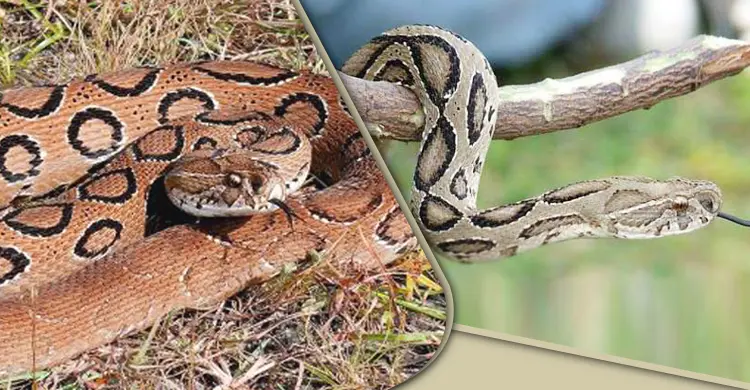
The Russell's viper, once almost extinct in Bangladesh, has lately been seen in farmland too, worrying farmers. Government officials say at least five people have died from Russell's viper bites in the past three months in parts of Manikganj, close to Dhaka. So care is needed while working on farmland, and people need to be able to recognise the snake.
In Bangladesh the Russell's viper is known as "chandrabora" or "ulubora". Of the snakes seen in Bangladesh, it is the most venomous. A member of the Viperidae family, it is one of the most venomous snakes of the Indian subcontinent and one of the subcontinent's four deadly snakes.
Body and head
The Russell's viper has a stout body and a short, slender tail. Adults are usually about 1 metre long; a maximum body length of up to 1.8 metres has been recorded. Its head is flat, triangular and distinct from the neck. The snout is blunt, rounded and raised. The nostrils are large, each set in the middle of a single large nasal scale. The lower edge of the nasal scale touches the nasorostral scale. The supranasal scale has a strong crescent shape and separates the nasal from the nasorostral scale in front. The rostral scale is as high as it is broad.
The Russell's viper's body, including the tail, grows up to a maximum of 166 cm (65 inches). On the Asian mainland it averages about 120 cm (47 inches). On islands it is usually somewhat smaller. It is slimmer than most vipers. Measurements given are:
- Total length 1.24 metres (4 ft 1 in)
- Tail length 430 mm (17 in)
- Girth 150 mm (6 in)
- Head width 51 mm (2 in)
- Head length 51 mm (2 in)
Behaviour and breeding
The chandrabora is extremely aggressive. Other snakes move away quickly after biting a person, but the Russell's viper does not want to leave the spot. Where other snakes try to avoid people, this snake does the opposite. So every year many people die from its bite alone. Because of the speed of its strike and the strength of its venom, it is also known as a "killing machine".
Instead of laying eggs, the Russell's viper gives birth to live young, so its young have a better chance of survival. It breeds at any time of year, but most in the three months from May. A female gives birth to 20 to 40 young after pregnancy, though some have been recorded giving birth to as many as 80.
Habitat and range
The Russell's viper usually lives in grass, scrub, forest, mangroves and crop fields, especially open grassy and somewhat dry low-lying land. Though a land snake, it can move quickly in water, so in the monsoon it can drift long distances with water hyacinth. It is nocturnal and eats rats, small birds, lizards and frogs. Because food is plentiful around homesteads, it often comes into settlements looking for food.
The Russell's viper is called a rare snake of West Bengal and Bangladesh. It is a major cause of fear in most districts of West Bengal, especially in villages in Nadia, Bardhaman, North 24 Parganas and Bankura. In Bangladesh it was once seen only in the Rajshahi region, so it was known as a snake of the Barind area. It is now spreading along the Padma basin into many southern districts, and has been seen in Rajshahi, Rajbari, Faridpur, Kushtia, Manikganj, Chandpur, Hatiya and Bhola.
Source: Jagonews24. First published in Bengali on The Agro News.

Comments
(0)