
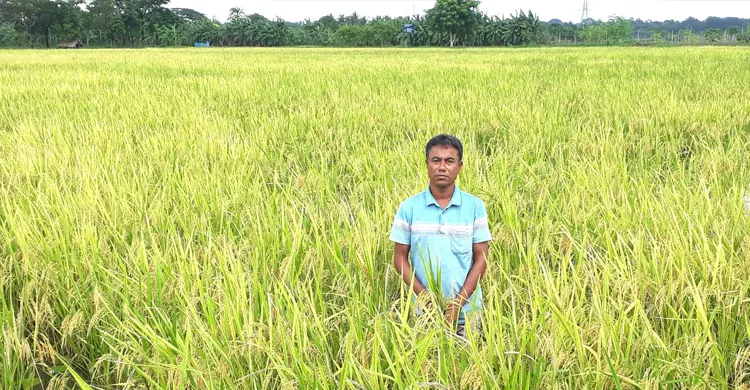
Farmer Sultanur Rahman has caused a stir in Rupsha, Khulna, by producing paddy from seed that fell from harvested ears, without any tilling or transplanting. Seeing his success, other farmers in the area are keen to farm the same way. Upazila agriculture officials have given him full support.
In the Jabusa beel of the upazila there is no ripe paddy anywhere; it is not the time for ripe paddy. As far as the eye can see, the field is full of green transplanted seedlings. But at one edge of the beel, the golden paddy on Sultanur Rahman's land is catching the eye of farmers and ordinary people alike. Hearing the news, farmers are coming from far away to learn the secret of his crop.
Last year, Sultanur Rahman of Jabusa village grew a high-yielding variety on 10 acres in the Boro season. A few days after the ripe paddy was harvested, seedlings sprouted on the land from the fallen grain, and in time they also bore paddy. Without any tilling or care, he got 90 maunds of paddy that year. That raised his hopes, and this year too his 10 acres have given a bumper crop from shed grain.
How he did it
"Last year, after harvesting in the Boro season, seedlings sprouted from the shed grain. Without tilling or care I got about 90 maunds of paddy from that land. When I discussed it with the upazila agriculture officer, he assured me of full support," Sultanur Rahman said.
"This year, on the advice of agriculture officer Fariduzzaman and under the overall supervision of sub-assistant agriculture officer Himadri Biswas, I scattered another two maunds of seed paddy on the land along with the shed grain. The seedlings came up nicely. Then I had some weeds cleared and spread a little fertiliser. In all it cost about Tk 50,000 on the 10 acres. Without any tilling or extra cost, a yield about equal to the Boro season's is expected this time too," he said.
"I hope to get at least 350 maunds of paddy this year, worth Tk 3.5 lakh at market prices. On top of that, about Tk 1 lakh worth of straw will be sold," he added.
Sultanur Rahman said the high-yielding BRRI dhan99 was developed by the Bangladesh Rice Research Institute (BRRI), and he got the new seed through the upazila agriculture office, along with two other varieties, BRRI dhan92 and BRRI dhan67. "But anyone who follows my method will have to grow the high-yielding BRRI dhan99. That will give a good yield," he said.
Officials back the method
Upazila sub-assistant agriculture officer Himadri Biswas said: "Last season, when we heard that seedlings had sprouted from shed grain, we came to the field and saw it could bear a crop. We then planned how to get an even better yield from shed grain the following year. On that basis, this year we advised the farmer to scatter some more seed paddy and fertiliser along with the shed grain and to clear the weeds. The crop from this method is no less than in the Boro season."
Upazila agriculture officer Krishibid Md Fariduzzaman said paddy had been produced on farmer Sultanur Rahman's land by a simple method, without any tilling or extra cost. The high-yielding BRRI dhan99 grown on his land was developed by BRRI scientists two years ago. The variety is salt-tolerant, can be grown on high or low land and yields as much as a hybrid, he said.
"Hearing about Sultanur Rahman's shed-grain paddy, farmers from various areas are contacting us for advice. If farmers follow his method, in the Aus season they will profit from a good yield at low cost, and the country's food needs will also be met," he said.
Upazila nirbahi officer (UNO) Kohinur Jahan said the ministry in charge is working through various projects and agencies to develop agriculture, and Rupsha upazila's farm sector has developed a great deal as a result. The crop Sultanur Rahman of Jabusa has produced from shed grain adds a new dimension to agricultural development, she said. If other farmers adopt this method instead of leaving land fallow, they will profit and the country's food deficit will be met.
Source: Jagonews24. First published in Bengali on The Agro News.
Comments
(0)