
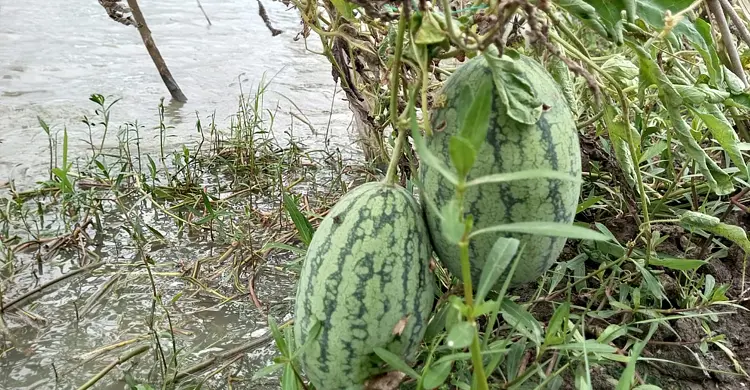
Cross the Rupsa river, which flows past Khulna city, and you reach Rupsa upazila. Paddy is grown in some areas at a set time of year, but because of salinity large amounts of land lie fallow for the rest of the year, and salinity is always high because the area is surrounded by rivers. Overcoming that salinity, farmers here have turned to growing off-season watermelons and various vegetables. They farm fish in enclosures and grow vegetables on the dykes, and increasingly off-season watermelon too. Though they did not succeed at first, they are gradually moving towards success. Farmers in Jabusa and several other areas of the upazila no longer wait for rain and have turned to growing watermelon at low cost.
Farmers say watermelon is less risky and more profitable than vegetables, which is why they are now turning to coloured watermelons.
A farmer's first season
Md Hafiz Sheikh, a farmer from Jabusa Uttarpara in Rupsa upazila, said he sowed okra, red amaranth, Indian spinach, beans, yardlong beans and bottle gourd on the dykes of his ten-bigha enclosure and got a fairly good yield. To make more use of the dyke land, he grew coloured watermelon on the advice of the upazila agriculture office.
He said that although the yield was not very good at first because of salinity, he will now profit well from selling off-season watermelon. Because the off-season crop did well, he has already prepared the land to sow again.
Encouraged by the agriculture office, he took training in climate-smart technology from the Khulna agricultural region's climate adaptation project and grew watermelon for the first time this year. He received seed, fertiliser and other inputs from the project. Colourful watermelons hang from the trellises in his field. He has already sold about 50 kg and hopes the melons in his field will bring in about Tk 50,000.
Liton, a farmer from Notundia village, said he has grown off-season watermelon again this year after a good yield and profit last year, and hopes for a bumper harvest.
Dipankar De has started growing watermelon after seeing Md Hafiz Sheikh. He said farmers of all kinds have become interested because the crop was very profitable last year. Watermelon is a seasonal fruit, usually available from February to May, but it is no longer only seasonal and is now found in the market all year. Because supply is relatively low out of season, farmers can sell at higher prices.
How it started
According to the Rupsa upazila agriculture office, most farmers in the upazila's villages usually grew vegetables such as cucumber, bottle gourd, sponge gourd and bitter gourd in summer, but never got fair prices. In 2020, during the coronavirus period, the agriculture office for the first time gave farmers free seed, fertiliser and other inputs and training.
That year off-season watermelon farming succeeded for the first time, and fair prices encouraged farmers to take it up. Since then the area and output of off-season watermelon have grown every year, and many farmers have become self-reliant by growing coloured watermelons.
Sub-assistant agriculture officer Himadri Biswas said parts of the upazila are very saline, but farmers are overcoming this to grow vegetables and watermelon. The office visits the fields regularly to give advice, and colourful watermelons are hanging from trellises in enclosures across the upazila, he said.
Each watermelon weighs two to four kg depending on the variety. Fruit starts to set from flowers about 40 days after sowing and ripens 30 to 35 days after setting.
The varieties grown most here are Tripti, Yellow Dragon, Rongdhonu, Rongila, Black Baby and Sweet Dragon Pakiza. The melons have started reaching the market and are selling at Tk 80 to Tk 100 a kg at retail.
Upazila agriculture officer Md Fariduzzaman said this is a safe and tasty watermelon. Many farmers were not interested the first time, but those who grew it early made good profits, and as a result the area has grown to about 100 bighas this year. Because it pays more than other vegetables and fruit, farmers have turned to off-season watermelon, and colourful watermelons are giving farmers hope of becoming self-reliant.
Source: Jagonews24. First published in Bengali on The Agro News.
Comments
(0)