
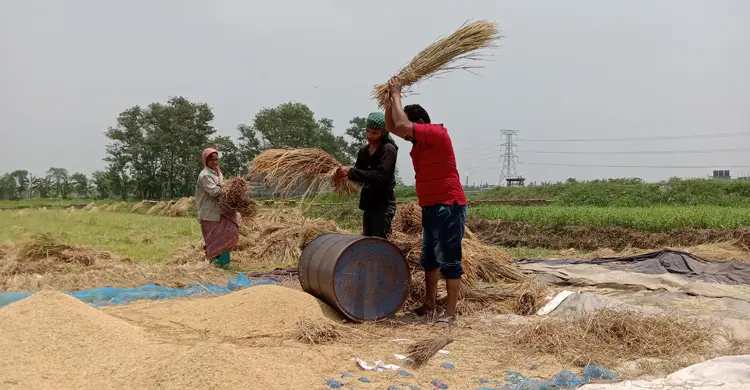
Favourable weather has given Rupganj in Narayanganj a bumper boro crop this season, and farmers are busy bringing in the new paddy. But despite the good yield, a shortage of labourers and high wages have left them in difficulty. Even paying extra, they cannot find workers, and their joy has faded.
According to the upazila agriculture office, the boro target for Rupganj this year was 5,400 hectares, while 5,050 hectares were planted. The upazila has had a bumper crop, and farmers are busy in the fields with enthusiasm.
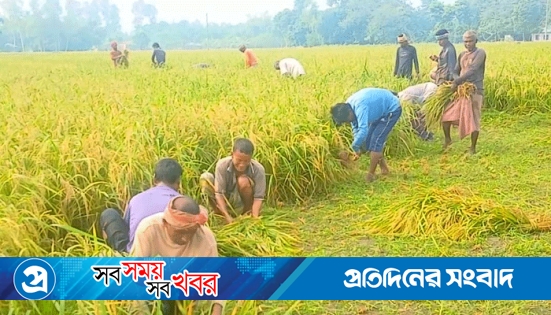
Seasonal workers from the north and other districts come to Rupganj and harvest paddy for farmers on daily wages or contract. Every year at this time labour markets at Bhulta, Gausia and elsewhere in Rupganj are busy. This year, unable to find enough workers at the upazila's labour markets, many are hiring from the Madhabdi labour market in Narsingdi.
Wages rise with shortage
Farmers say wages shoot up when labour is short. In a shortage a farm worker's daily wage reaches Tk 1,000-1,200, falling to Tk 500-700 when workers are easy to find. With harvesting and threshing under way at every household at once, demand for labour has risen. With a shortage of workers and high wages this boro season, farmers are anxious about bringing in the crop and cannot make their profit-and-loss sums add up.
At Banshinagar in Tarabo municipality, private employee Indrajit Biswas was seen bringing in paddy from his own land on his day off with his son and daughter-in-law because of the labour shortage and high wages.
"Two days ago I had two people cut the paddy at Tk 1,000 a day," he said. "For two days I have not been able to find labourers to bring it home, so I am doing it with my son and daughter-in-law."
Abul Hossain Bepari, a farmer from Gajarbhita in Murapara union, said: "The fields are full of ripe paddy now. There is so much demand for labour everywhere that you cannot find workers even at higher wages. Yesterday I had four people cut paddy at Tk 1,000 each. Today they got higher wages elsewhere and left the paddy in the field. Now I have to thresh it and take it home with my own family."
He said he had been to Madhabdi market in Narsingdi to check labour rates, and hiring workers at such high prices would leave no profit from the crop.
Shafiulla, a farmer from Haulipara in the upazila, said growing BRRI dhan28 and BRRI dhan29 cost Tk 9,000 to 9,500 a bigha this year, with a yield of 20-22 maunds a bigha expected. But if high wages for harvesting push up costs there will be little profit, and in the end paddy could rot in the fields for lack of workers.
Tofazzal Hossain, who came from Mymensingh to sell his labour, said harvesting and threshing have started across the country at the same time this boro season, when labour is in demand and wages are good, so he came to Rupganj hoping to earn a little extra.
Cyclone Mocha fears
Rupganj upazila agriculture officer Fateha Noor told Jagonews that paddy was planted this year almost in line with the target, and the yield has been quite good. Most of the boro harvesting and threshing in the upazila is already done. But fear of rain from Cyclone Mocha made farmers rush to bring in their paddy, causing some labour shortage.
She said the upazila agriculture office has served farmers at all times, supplying high-yielding (HYV) paddy seed to 350 farmers and hybrid paddy seed to 500. The yield is quite good, and farmers are expected to bring in their crop on time.
Source: Jagonews24. First published in Bengali on The Agro News.
Comments
(0)