
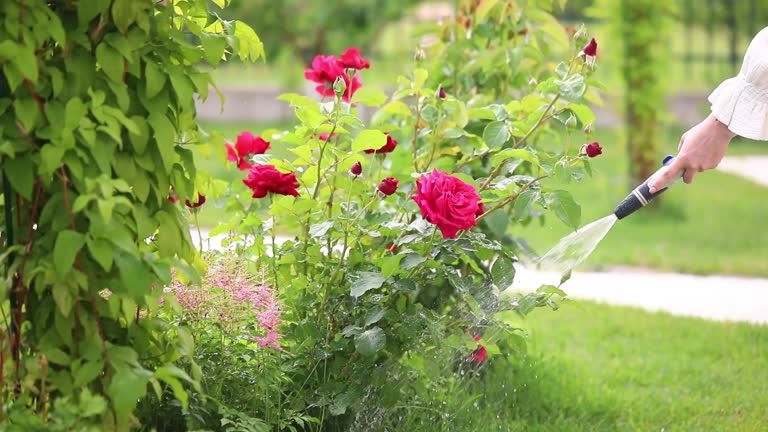
Water is the most essential need of a rose plant, and it must be neither too much nor too little. Water the base of the plant every day, but make sure excess water does not collect in the pot and that the soil around the base does not dry out.
In winter, plant roses where they will get seven to eight hours of sun. Without good sunlight the plant will not flower well. Make sure the plant gets sunlight from all sides; otherwise it will grow only towards the light. If that happens, it is good to turn the plant, pot and all, from time to time.
Fertiliser
For good flowers, fertiliser must be applied regularly from the start of winter. Organic fertiliser gives good results. Apply organic fertiliser at least twice a month, and once a month give water in which mustard oilcake has rotted. Bone meal can also be applied at the base.
For more flowers, rose soil needs to be acidic. So every so often, water the base with powdered dry tea leaves or water in which alum has been soaked. This increases flowering and also makes the flowers bigger. Alternatively, the guide says, one spoonful of powdered lime can be dissolved well in each litre of clean water, strained through a thin cloth and applied every three months. For 15 days after giving lime water, give only water and no other fertiliser.
To give the plant a proper shape and bring flowers to every branch, prune the rose once a year in October or November. This stops the plant wasting energy on dead and weak parts, so new branches grow and produce better flowers.
Fertiliser should be given from time to time as the plant needs. It should be applied once at pruning time in October and again at the end of winter in March. The guide also says that better results come from applying fertiliser 10 to 12 days after pruning rather than at the time of pruning.
Before pruning, apply 2 to 3kg of dried cow dung, 50g of TSP and 50g of potash per plant. Remove the top 10cm of soil from the bed, loosen the soil beneath a little, and mix the fertiliser carefully into the soil so the roots are not damaged.
The droppings of ducks, chickens or pigeons are an excellent fertiliser for roses.
Plants take up chemical fertiliser very quickly. Liquid fertiliser applied to dry soil can be too strong and harm the plant, so liquid fertiliser should be given when the soil is wet: fertiliser dissolved in water should be applied to moist soil, and the plant watered afterwards.
Sometimes, even though the soil has enough fertiliser, the leaves do not freshen or the plant does not grow properly after pruning. In such cases, applying fertiliser through the leaves gives good results.
Pruning
Old rose branches do not flower for long. Every year new shoots come from the base or from old branches, and pruning lets these new shoots grow properly. October, before the flowering season, is the best time to prune.
Pruning is needed to make the flowers bigger, to help new branches spread well, and to remove wounded and diseased branches. It should be done with sharp secateurs or a special kind of knife. Take care that the branch is not crushed when cut, as this can let in fungal disease.
There are generally three kinds of pruning: light, moderate and hard. Cutting a third off long branches, or cutting away dead and sick branches, is light pruning. Pruning to leave 30 to 35cm above the soil is moderate pruning, and pruning to leave branches 14 to 20cm above the soil is hard pruning. Which kind to use depends on the surroundings, the plant and the type of soil.
Repeated hard pruning in sandy soil can kill the plant. But if the soil is good and big flowers are wanted for exhibition, hard pruning is suitable. Otherwise, moderate pruning should be used. Moderate pruning does not produce very big flowers, but it gives more of them.
After pruning, "pruning paint" should be applied to the cut ends; otherwise insects may attack through the cut, followed by fungus. For local (deshi) roses, cow dung on the cut is best. The formula for pruning paint is one part Pyrifos or Pyriban, four parts copper carbonate, four parts red lead and five parts linseed oil.
Pests and their control
Termites: they destroy the old roots of a cutting before its new roots emerge. Control: if termites are likely to be in the soil, treating the soil with Pyrifos or another suitable insecticide prevents attack.
Red spider mites: they live on the underside of leaves and suck the sap, so the plant becomes weak. They can be identified by pinprick marks on the upper side of leaves and fine webs on affected leaves and branches. In heavy attacks the green colour fades and the leaves curl, and sometimes the plant dies. Control: mites must be controlled while their numbers are small, or they get out of hand. Spray any one of Kelthane-42, Thiovit-80 or Ethion 46.5 EC, mixed with water at the prescribed rate, on the underside of the leaves. Spraying plain cold water forcefully can also control them.
Chafer beetle: this insect is large and reddish. At night it eats the leaves full of holes, eats the petals and pollen, and badly harms the growth of seedlings. Attacks are worst in the rainy season. It lays eggs in the soil, and the larvae damage rose roots. Control: treating the soil with Pyrifos, Pyriban or another suitable insecticide kills the larvae. The beetles can also be picked off by hand at night and killed.
Caterpillars: they damage the plant by eating the leaves. Control: if they are few and large, they are easy to pick off and kill. But if they are small and numerous, spray Ripcord 10 EC at 1.1ml per litre of water, or any contact poison. If one spraying does not work, spray again after two or three days, this time also spraying nearby plants and grass.
Digger wasps: after pruning they sometimes tunnel into the cut ends of branches and nest inside. The plant becomes infected with fungus through these wounds, and dieback symptoms later appear. Control: applying pruning paint to the cut ends after pruning prevents them.
Scale insects: brown scale insects often attack the bark of old branches. They carry a hard scale covering, and their young settle permanently and suck sap, weakening the plant. Control: spraying insecticide when the young appear around the month of Chaitra, and after pruning, controls them. If there are only a few plants, rubbing the affected branches with a brush dipped in methylated spirit removes them. Pruning and burning affected branches also reduces their spread.
Thrips: they attack in hot, dry weather from March to April. They come in swarms and quickly do serious damage by sucking sap from flower buds and immature shoot tips. Flowers then open shrivelled or fail to open at all, and the leaves of young shoots curl. Adult and immature thrips can be seen on affected tips and flowers. Control: cut and burn affected tips and flowers, and spray Mipcin 75 WP at 2.0g per litre of water once a week two or three times, then regularly once every two weeks.
Aphids: in January and February aphids damage the plant by sucking sap from leaves, young shoots and flowers. Control: spray 2ml of malathion per litre of water every seven to ten days.
Diseases
Roses suffer from fungal diseases and from diseases caused by nutrient shortage. The fungal diseases and their remedies are as follows.
Dieback: the branches or stem of a diseased plant turn black and start dying from the tip. The symptom gradually moves through the stem to the roots and the whole plant dies. Control: once dieback starts, cut the diseased part well below the affected area and apply pruning paint to the cut end, burn the removed parts, and wipe the secateurs or knife used on the infected plant with spirit before cutting another plant.
Powdery mildew: towards the end of winter, white powder-like patches appear on the leaves. These are fungal organisms. In severe cases the young leaves and tips of affected plants are completely covered by them, and buds do not open but rot. Control: pick off and burn diseased tips and leaves, and spray with Hexaconazole 5 EC, Dithane M-45 or Indofil M-45.
Cutting the flowers
For immediate use, rose buds should be cut when half open. For use a few days later, cut them once they reach the bud stage. For cut flowers, cut long flower stalks with a few leaves using a sharp knife. Flowers should be cut very early in the morning or late in the afternoon.
Source: Online Desk. First published in Bengali on The Agro News.
Comments
(0)