
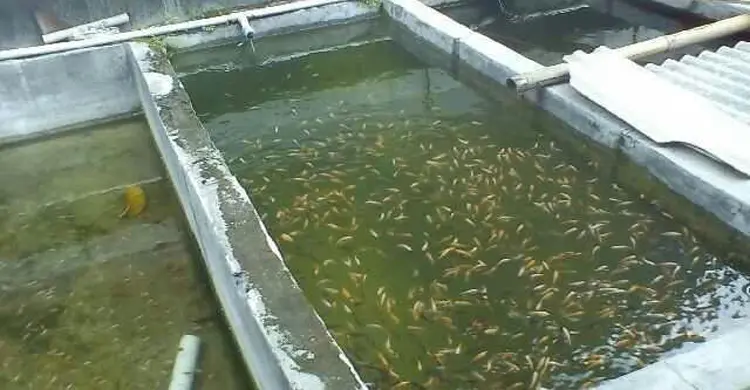
Many people now raise fish on their rooftops. Some meet their family's needs and earn extra income by selling the surplus. Fish farming can supply daily needs and also make a household financially self-reliant, and it does not require a fish enclosure or pond. Farming fish in drums or tanks indoors, in the yard or on the roof can be more than three times as profitable as conventional methods, and agricultural researchers in Bangladesh are trying to spread the practice.
The modern technology is called biofloc. A team of researchers from the Aquaculture Department of Sher-e-Bangla Agricultural University is studying it, and a biofloc laboratory has been set up on the roof of the university's Faculty of Agriculture for the research. The work is led by the department's chairman, Dr A M Sahabuddin.
"Biofloc is a combination of protein-rich organic matter and various micro-organisms. The micro-organisms are used as fish feed. Essentially, beneficial bacteria are used to maintain a high carbon-to-nitrogen ratio in the water, converting harmful ammonia into microbial protein," said Dr Sahabuddin, who heads the research team.
How the system is set up
The researchers described the process. First, the tank is filled with water and oxygen is supplied for a week, so that any iron or other heavy matter collects at the top. Then iodine-free common salt is added at 1 kg per 1,000 litres. If total dissolved solids (TDS) are above 1,200, lime is added at 10 grams per 1,000 litres. Molasses, 50 to 100 grams, is added as a carbon source. Oxygen must be supplied at all times.
After two weeks, biofloc (bacteria, protozoa, algae and diatoms) forms in the tank. Fish can be released once 30 to 40 centimetres of biofloc has formed in the water. The system needs a source of beneficial bacteria, regular testing of water quality, temperature control and an uninterrupted electricity supply.
Species and yields
Dr Sahabuddin said shing, magur, pabda, gulsha, koi, tilapia and other species can be farmed with biofloc, with production three times that of traditional methods. Because disease outbreaks are fewer, fish can be stocked at about ten times the usual density. He said the technology could open a new horizon for small and medium entrepreneurs.
On taking the technology to farmers, he said fish production could rise several-fold if it were spread across the country.
You too can try farming fish on your rooftop.
Source: Jagonews24. First published in Bengali on The Agro News.


Comments
(0)