
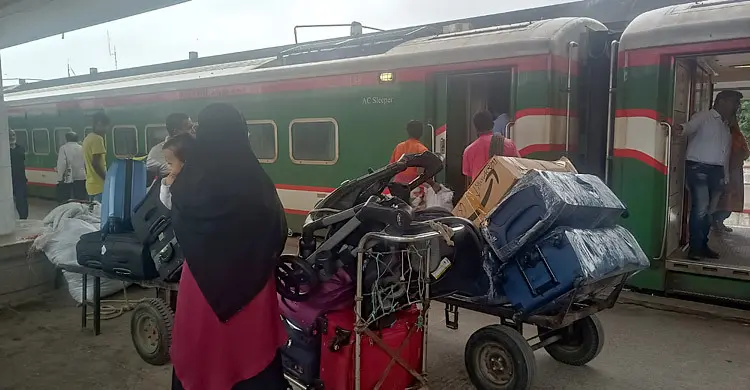
A "farm produce special train" has been launched to carry vegetables, flowers and other farm produce from the northern region to Dhaka. On its first day it left Rohanpur without any produce. The train set off from Rohanpur railway station at 9.15am on Saturday (given in the report as 25 October). On the Rohanpur-Dhaka route it carried only 150 kg of crates.
Train, schedule and fares
According to Bangladesh Railway West Zone, the special train has seven luggage-van coaches, one air-conditioned and six ordinary. Besides fruit and vegetables, the modern luggage vans have refrigerated space for frozen fish, meat and milk. There are at least 20 seats so that vegetable growers, farmers and traders can travel to Dhaka free of charge with their produce. The train will leave Rohanpur for Dhaka once a week, every Saturday morning, and has a capacity of 10 tonnes.
It leaves Rohanpur station in Chapainawabganj at 9.15am and reaches Tejgaon station in Dhaka at 5.20pm. The transport cost is Tk 1.30 per kg of produce; from Rajshahi to Tejgaon it is Tk 1.18 per kg.
The train halts at 13 stations on its way to Tejgaon, stopping at Nachole, Amnura Junction, Kakonhat, Rajshahi, Sardah Road, Arani, Abdulpur, Azimnagar, Ishwardi Bypass, Chatmohar, Baral Bridge and Joydebpur.
The distance from Rohanpur to Dhaka is 346 km, and running the train costs Tk 8,96,432. But on the first day it carried only 150 kg of crates and earned just Tk 360, a loss of Tk 8,96,072.
No bookings along the route
No vegetables were booked at Rohanpur, Rajshahi, Sardah Road, Arani, Abdulpur, Azimnagar, Ishwardi Bypass or Chatmohar.
Mamun Ali, assistant station master at Rohanpur, said the special goods train arrived at Rohanpur at night and left at 9.15am with no farm produce; nobody sent any vegetables on it.
Rajshahi station manager Shahidul Alam said the train was inaugurated that day. No vegetables were booked from Rajshahi, but 150 kg of crates were sent.
Ishwardi Bypass station master Pavel Hossain said no farm produce was booked there. The station masters at Sardah Road, Arani, Abdulpur, Azimnagar and Chatmohar said the same.
The railway authorities say no vegetables came on the first day because farmers and Dhaka traders had not coordinated and because of bad weather.
Farmers and traders
Arafat Rahman, a resident of Rohanpur, said the train fare is lower than a pickup's, but porters and separate transport from field to station and from station to market push the cost above Tk 3 a kg, while carrying goods by truck costs Tk 2 to Tk 2.5 a kg.
Another farmer, Shafiqur Rahman, said the morning timing raises worries about selling. "Our vegetables mostly go to Dhaka by road. We set off in the evening and sell as soon as we reach Dhaka at the time of the Fajr call to prayer. But this train runs in the morning, so when will we sell?"
Faizul Islam, president of the Rajshahi Metropolitan Wholesale Kitchen Market Association, said the train would be good for them and useful if they could use it. "But we did not know the train would start. Nobody told us how or when it would start. If we had known, we might have sent some goods."
Railway officials
Speaking to journalists at Rajshahi station at the launch, AKM Ruhul Alam, assistant commercial officer of Bangladesh Railway West Zone, said the farm produce special train started from Khulna on the 22nd, then from Panchagarh, and now from Rajshahi. "It has only just started and will take time. We will certainly carry produce in future."
On the lack of vegetables, he said they had publicised the service everywhere, including talking to traders at Muladuli market two days earlier, who gave assurances. Vegetables are only now reaching the market, and 50 to 60 trucks go to Dhaka every day. On the first day, though, no vegetables were found up to Rajshahi; 150 kg of crates went from Rajshahi to Dhaka, for which Tk 360 was collected. "We hope it will get a good response."
Sujit Kumar Biswas, chief commercial officer of the West Zone, said they had run grassroots publicity for several days, including through agricultural marketing and agriculture officials. "Mainly, farmers and Dhaka traders are not coordinated. If they take goods without talking to each other, they will run into trouble. The weather has also been poor for several days, so farmers may not have been able to harvest. If farmers can coordinate with Dhaka and the system continues, we will get a response."
Source: Jagonews24. First published in Bengali on The Agro News.

Comments
(0)