
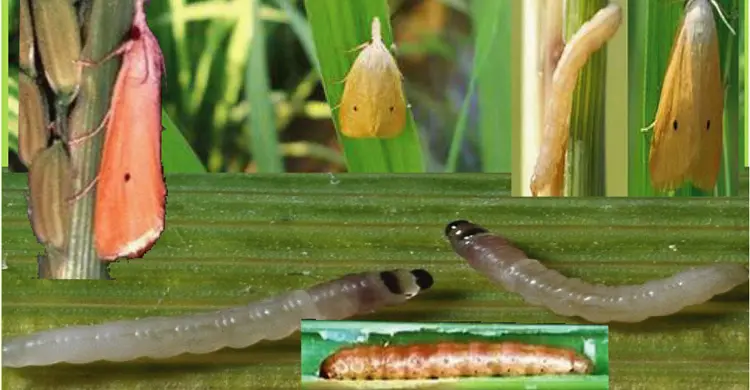
Stem borers are very harmful to rice. The pest enters the stem of the rice plant and destroys it, reducing the yield by 13 to 26 per cent, and by 30 to 70 per cent in a severe attack. Controlling it is therefore vital for rice farming, and the Agricultural Information Service (AIS) has given advice on how to do it.
The AIS says there are three species of stem borer: the yellow stem borer, the dark-headed stem borer and the pink stem borer. To protect the crop:
Control measures
- Set up perches by planting branches in the field so that birds sit on them and eat stem borers and moths. When adult moths appear, set up light traps beside the field to collect and destroy them.
- Inspect the field regularly and collect and destroy moths and eggs with a hand net.
- Stem borers can also be destroyed naturally. Lady bird beetles, mirid bugs, long-horned grasshoppers, crickets and other insects eat stem borer eggs.
- Birds, fish, frogs, damselflies and dragonflies eat the moths. Parasites such as Trichogramma, Telenomus and Tetrastichus attack and destroy stem borer eggs.
- If the parasites cannot control the pest, pesticides may be used. Because the stem borer lives inside the stem, systemic pesticides are needed. Use approved doses of insecticides in the cyantraniliprole + lufenuron, flubendiamide + thiacloprid, cartap 12% + acetamiprid 3%, carbofuran, chlorpyrifos, acephate, carbosulfan, cartap, fipronil, flubendiamide and thiamethoxam + chlorantraniliprole groups.
- Better results come from using insecticides of different groups rather than the same group in turn or every season against the same pest.
- In areas attacked every year, the pupae can be destroyed after the aman harvest by ploughing in or burning the stubble.
Precautions
Farmers are advised to take some precautions. Insecticides of the cypermethrin, alpha-cypermethrin, lambda-cyhalothrin, deltamethrin and fenvalerate groups must not be used, not even mixed with approved insecticides.
Insecticide can be used when two to three female moths are found per square metre or 10 to 15 per cent of tillers are damaged, and in some cases even when 5 per cent of tillers are damaged.
Source: Jagonews24. First published in Bengali on The Agro News.


Comments
(0)