
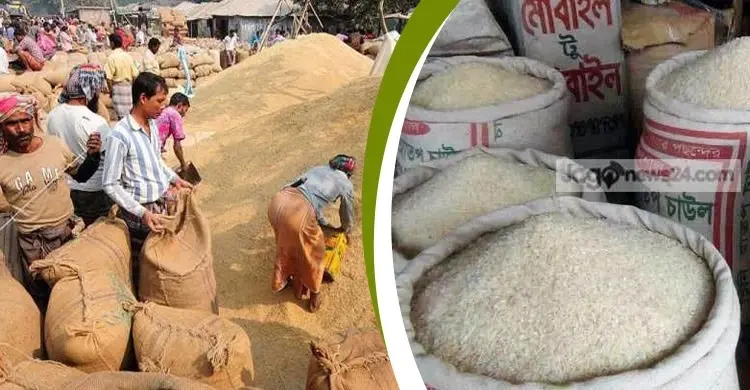
A law is being made that will make it compulsory to print the paddy variety on rice sacks and will set how much rice can be polished, Food Minister Sadhan Chandra Majumder has said.
He said there is no such thing as Miniket. "If people knew where Miniket came from, they would not use this name. At one time we brought fine rice seed from India in mini (small) packets. That was the minipack. From that seed we named it Miniket rice. This has been said many times. The consumer rights directorate can carry out drives to remove the Miniket name. We do not have that power."
The minister was speaking at the "BSRF Dialogue" at the media centre in the Secretariat on Tuesday (13 September), organised by the Bangladesh Secretariat Reporters Forum (BSRF).
Brand names allowed, variety required
The food minister said the ministry has sent a law to the cabinet, and it is now being vetted by the law ministry. It says that whatever brand name millers use, be it Rajanigandha, Golapful, Jorina or Sokhina, they must give the name of the paddy variety.
He said they have also fixed a ratio for how much rice can be polished. Excessive polishing wastes part of the rice, and that loss is a share of the whole country's output, so this has been fixed as well. "Once this (law) is passed, many will be straightened out."
Sadhan Chandra Majumder said people would then be able to eat the old kind of rice, packet rice would stop, and there would be no more eating such fine rice; rice would be coarser. "Red rice costs more now. If everyone moves that way, it all evens out."
Rice prices and websites
Asked what the government is doing about rice prices rising again, the food minister said he had warned mill owners at a conference a few days ago. They still say they have not raised prices at the mill gate. They have been told to open a mill-gate website and post each day what each kind of rice costs.
He said he would also urge wholesalers to open websites and report the day's wholesale price in line with the mill gate, so that prices can be kept consistent. "I think this is extremely urgent. If it can be coordinated, consumers will benefit greatly."
The minister said traders in the country are as unstable as its nature. There are adequate rice stocks in the country. When India imposed a 20 per cent duty, it was not on all rice but on atap (unboiled) rice, and seeing that, traders started raising prices. "The aus output at this moment is something I have not seen in the last 10-20 years. From that point of view, I think a price rise is unjustified."
When his attention was drawn to the commerce ministry's move to fix the prices of nine products including rice, the food minister said he did not know how the commerce minister had said it, as it had not been shared with him. "But I can say this much: in a free-market economy, whether he can hold it by fixing prices... it depends on our production, and if we see a crisis we also import."
He said the commerce minister had said it is possible to fix the prices of imported products. But for what is produced in the country, where farmers, production and transport costs and the price of fuel are involved, farmers must get their price and it must also be bearable for consumers. The government already has plans for low-income consumers, he said.
The minister added that if necessary, the government will certainly import rice and run OMS (open market sales) all year. Those who eat very good packet rice do not bargain, he said, and chasing after that is hard for everyone.
BSRF president Tapan Biswas presided over the event, and general secretary Masudul Haque moderated it.
Source: Jagonews24. First published in Bengali on The Agro News.
Comments
(0)