
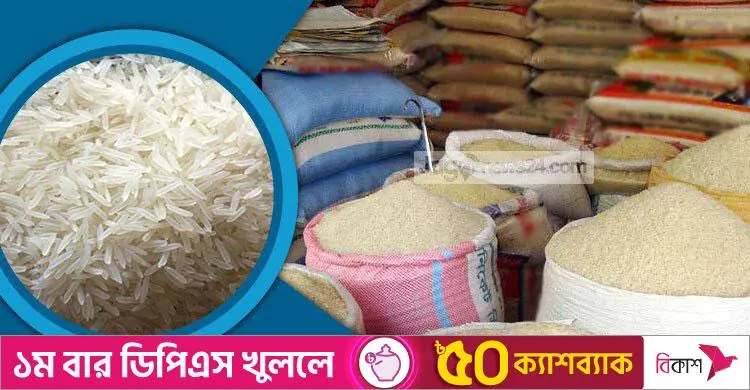
Rice prices have risen by Tk 2-6 a kg. A rice agency says mills are not supplying rice; millers say they had to raise prices because paddy became dearer; and the food secretary says propaganda has destabilised the market.
Rice imports are open, trade with India is normal and the Aman season is at its peak. There is no visible crisis, yet rice prices are rising without reason. Hoarding by farmers and middlemen, rumours that "prices will rise further" exploiting the country's instability, and misinformation from millers have not stopped. From retailers to farmers, the whole chain's manipulation has left the rice market unbridled.
From farmers to millers, a quarter has spread word that rice prices will climb further in future. This has increased the tendency to hoard paddy and rice, and those involved are profiting by keeping supply low and raising prices. The practice has gone on in the country for a long time, and prices rise through the manipulation of these rings.
This picture emerged from talks with farmers, millers, middlemen, wholesalers, retailers and government officials. The highest levels of government say rice imports from India are entirely normal; in fact India's rice traders have written asking to supply more rice to Bangladesh. Imports from other countries are also gradually under way at government and private level, so there is no reason for the rice market to be unstable.
Prices in Dhaka
In Dhaka's markets, although new Aman rice has arrived, prices have risen by two to six taka a kg over the past two weeks. No rice is available at retail below Tk 62 a kg, and at that price only coarse Swarna and Paijam, both new Aman-season rice, are on offer.
Farid Hossain of Cumilla Rice Agency in Malibagh told Jagonews that prices have risen because of a supply shortfall, as mills are not supplying rice. Depending on quality, the price of a sack of rice has risen by Tk 150 to Tk 300 in the past 10-12 days, he said. "Aman rice is only just reaching the market, so there is actually no shortage of paddy or rice. Yet prices have been raised by cutting supply. Dishonest traders are hoarding paddy and rice, creating an artificial crisis and raising prices every day."
Meanwhile, wholesale prices rose further over the last two days, and sellers say rice prices in Dhaka will rise further.
Millers blame paddy prices
Rice mill owners, as usual, say they raised rice prices because paddy prices rose. Farhad Chakdar, general secretary of the Naogaon rice mill owners' group, told Jagonews that there is no paddy at the mokams, the wholesale hubs. Paddy prices have been high from the start this season, rising by Tk 70 to 80 a maund in the past week to week and a half, so rice prices naturally had to rise.
At the country's big rice mokams of Khajanagar in Kushtia, Naogaon and Dinajpur, Swarna paddy is selling at Tk 1,420 to Tk 1,470 a maund, up Tk 50 from last week. Over the same period the price of a sack of rice has risen by Tk 200 to 250, with a 50 kg sack selling at Tk 2,600 to Tk 2,700.
Hazrat Ali Sajib of Alima Traders in Dinajpur said paddy supply at the mokams is low and farmers do not want to sell, which is why prices are rising and millers are in difficulty.
Madhail Bazar in Patnitala upazila is one of Naogaon's biggest paddy mokams, with trading every day of the week. Some traders say that 30,000 to 35,000 maunds of paddy used to arrive daily on 60 to 70 trucks of 500 maunds each, but arrivals are now 7,500 to 10,000 maunds. They say arrivals have fallen by about a third.
Several paddy wholesalers said mill owners come to buy paddy and go back empty-handed because supply is low, and prices have risen as supply falls short of demand. Supply is also reported to be low at Chaubaria haat in Naogaon. Farmers around these haats said they expect rice prices to rise and have cut back their paddy sales.
A farmer named Bidarul Islam said paddy prices have not risen over the past year in line with other goods, so there is reason for them to rise, and if rice does not come from India, paddy prices in the country will naturally go up.
Rumours about India
Nirodh Baran Saha, a veteran food trader and president of the Naogaon District Paddy and Rice Wholesalers' Association, told Jagonews that paddy is being held at farmer level and the rest is being stockpiled at the mills. Uncertainty in the country and the relationship with India have affected paddy prices this time, he said. "There is widespread talk in rural areas this time that India will not supply paddy and rice, that it will stop. So farmers and middlemen are also buying and stockpiling paddy. Some traders are also spreading rumours that prices will rise so they can sell at a better price later."
Kawsar Alam Khan, vice-president of the Bangladesh Rice Merchants Association, told Jagonews that the government has not been able to import rice as it should. Although imports are open to the private sector, traders are not bringing in rice because world prices are high. Food inflation is rising while rice prices had until now been comparatively low, so most traders assume rice prices will naturally rise. Some traders also said that many mill owners were backed by the fallen government and are trying to push up the market.
'No strain with India'
Food Secretary Masudul Hasan told Jagonews: "The tendency to raise the market by creating panic about a crisis is not new, but it is unethical. I do not know why it is being done. But there is no strain with India over rice imports. Those spreading propaganda on this have specific reasons for destabilising the market."
He said 73,000 tonnes of rice have arrived from India at private level, the government is currently unloading a ship carrying 24,800 tonnes, and the next ship will bring 22,000 tonnes, with rice arriving in stages. In fact, he said, the Indian Rice Federation, the organisation of India's rice exporters, has written asking Bangladesh to buy more rice at competitive prices.
He said farmers have given the government more rice than the target this Aman season: the plan was to buy 1.5 lakh tonnes, and procurement has passed 2.65 lakh tonnes. So it is also not true that farmers are not selling rice, he said.
Source: Jagonews24. First published in Bengali on The Agro News.
Comments
(0)