
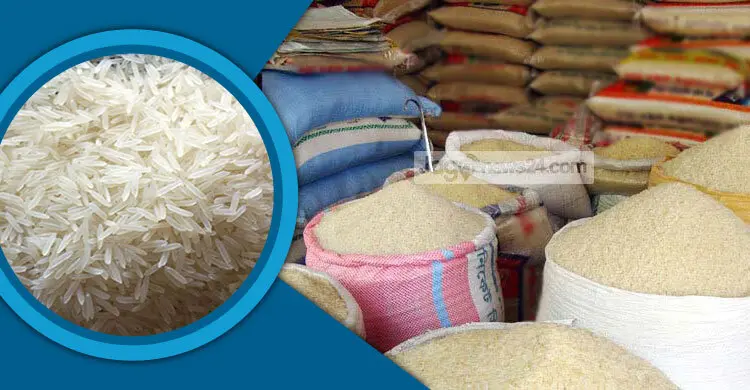
The government has claimed for several years that Bangladesh is self-sufficient in food, and paddy production sets a record every year, even though there is a large gap between the figures of the agriculture ministry and the Bangladesh Bureau of Statistics (BBS). Rice production keeps succeeding: this year's Boro season has also brought a bumper harvest, already exceeding the target of 2 crore 15 lakh 337 tonnes. Yet it has had no effect on the market, and consumers are paying high prices for rice.
Data show that the country's annual demand for rice is slightly more than 3 crore tonnes, while statistics from various government and private bodies show production about 1 crore tonnes higher than demand. Last year (2022), total rice production over three seasons was 4 crore 4 lakh tonnes, which the agriculture ministry claims is a record for a single year. Rice production has grown by 29 per cent in the past 14 years. Although production exceeds demand, several lakh tonnes of rice are imported every year for various reasons, and prices still keep rising. So the question naturally arises: where is the surplus rice going?
Market statistics show that the average retail price of rice in January this year was close to 50 per cent higher than in January 2020.
Conflicting data
Agricultural researcher and economist Jahangir Alam Khan told Jago News that the agriculture ministry and its Department of Agricultural Extension often give figures on rice production and demand that do not add up, and there is a large gap between their figures and those of the BBS. The data given are inconsistent, he said.
The amount of rice said to be produced may not actually be produced, he said. Despite repeated calls to clarify the matter, it has not been done. Traders are taking advantage of this data confusion, and the government cannot plan properly. That is why rice has to be imported at the end of the year despite claims of huge production, and consumers pay more.
No effect on market prices
In the capital's retail and wholesale markets, the arrival of new Boro rice has had no effect on prices. Miniket sells for Tk 67 to Tk 70 wholesale and costs consumers Tk 75 at retail. Coarse rice has become even dearer: Swarna and Paijam sell wholesale for Tk 50 to Tk 52 a kg, Tk 2 more than before, and for Tk 55 to Tk 60 at retail.
Rubel Hossain, owner of Janapriya Rice Agency at Babubazar, the capital's largest wholesale rice market, told Jago News that rice prices had not changed since Boro paddy arrived. Instead, coarse rice had gone up by another Tk 2.
He said supply had increased with the new rice, but prices had neither fallen much nor risen much. "Rather, I hear a lot of old rice was left in the mills, and that is now being released onto the market."
The cost of growing paddy has risen somewhat this year. According to the Bangladesh Rice Research Institute (BRRI), the cost of producing a kilogram of rice this Boro season rose by Tk 3 to about Tk 41, and the cost of producing paddy rose from Tk 28 to about Tk 31. In other words, production costs for paddy and rice have risen by 10 per cent.
Boro costs rose because diesel, electricity and fertiliser cost more than last year, so rice prices should be somewhat higher this year. But the extra cost has fallen on farmers, because Boro paddy has been bought and sold at last year's prices despite the higher costs. A maund of paddy is still selling for Tk 1,200 to Tk 1,300.
Millers blame the retail market
Layek Ali, former general secretary of the rice mill owners' association, told Jago News that the market for everything was now out of control, so why should rice be an exception? Rising prices of other goods were affecting rice too. "If those who sell rice don't get a price, how will they live?" By that measure, he said, rice prices could be called stable compared with other essentials.
He said paddy prices were under control this year. "In fact there is no problem from the farmer to the mill. The problem is in the market. There is a huge gap between the mill-gate price and the retail price. We keep saying this, yet nobody controls the retail market. All the blame falls on millers. Neither farmers nor millers are profiting. Whether prices are low or high, the sellers take the profit."
Prof Dr Rashidul Hasan of the Department of Agribusiness and Marketing at Sher-e-Bangla Agricultural University told Jago News that it was true that the cost of producing rice had risen. But since paddy prices had not risen accordingly, farmers had to bear the extra cost; it had not affected the mill or sales level.
He said the gap between the mill and the consumer was Tk 12 to Tk 15 a kg, which was abnormal, and both consumers and farmers were losing as a result.
The government must play a strong role in controlling the market, Dr Rashidul Hasan said, and should also reduce farmers' extra costs through subsidies.
Source: Jagonews24. First published in Bengali on The Agro News.


Comments
(0)