
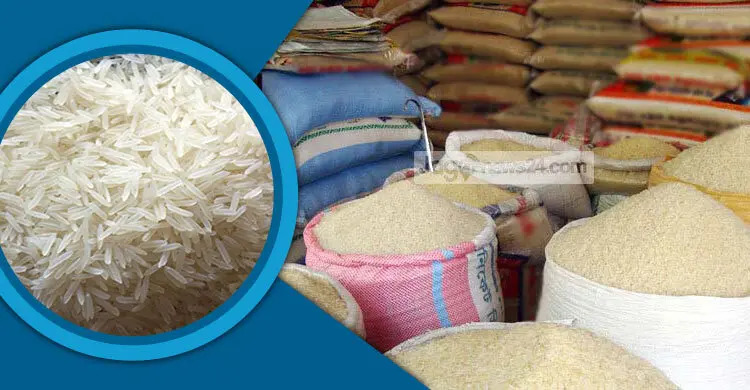
Rice prices shot up during last month's election, rising by as much as Tk 6 at retail. The food minister called traders in and gave them four days to bring prices down. They agreed but did not keep their word: depending on the variety, retail prices have fallen by at most Tk 2. Neither the minister's warning nor regular consumer-rights drives have brought the rice market under control, and buyers have been worsted by the traders' tricks.
- Up Tk 6, down Tk 2
- Traders in two regions blame each other
- Retail prices do not match mill-gate prices
- Minister's warning and consumer drives fail to bring prices down
Since the food minister's instruction on 17 January, the Directorate of Food has been running anti-hoarding drives in Dhaka and across the country. Every day more than a hundred businesses are fined lakhs of taka. Illegally hoarded paddy and rice has been seized and sold at auction, and the food minister himself sometimes joins the drives. Yet ordinary consumers are not seeing the benefit and are still buying rice at the old prices.
Traders claim the drives have brought paddy and rice prices down somewhat in some places. In reality, the already high prices have fallen only slightly: rice rose by Tk 6 during and a few days after the election, but after the drives it has fallen by Tk 1.50 to Tk 2 a kg at the mill markets and wholesale, and this small fall has had no effect on retail.
Buyers feel fooled
Sohag Hossain, a student, came to Malibagh bazaar to buy rice. He is responsible for food costs and shopping in the mess where he lives, so he has been buying rice regularly for months. He told Jago News: "Look, the fall in rice prices has become like a film story. First traders raised prices by Tk 5 to Tk 6. Then the government made a show of action. Then prices fell by Tk 1 or 2. The traders are happy and so are the foolish buyers."
He said: "The traders make fools of us and take advantage, and they get indulgence from the government, because the market is not monitored properly; what is done is for show. When there is a drive prices fall, and when it ends things go back to how they were."
Khaled, owner of Cumilla Rice Agency in the same market, said: "The wholesale rice market is still high. We have heard prices have fallen at the mills, but in reality they are more or less where they rose to during the election. So retail prices haven't fallen. If wholesale prices fall, retail will fall."
Up Tk 6, down Tk 2
A visit to several Dhaka markets found that the already high prices have fallen only a little. Miniket rice rose by Tk 6 a kg but has fallen by at most Tk 2 at retail.
In the big markets, Miniket now sells at Tk 68 to Tk 72 a kg, against Tk 65 to Tk 66 a month ago; after the election it sold at Tk 71 to Tk 72. At retail, Miniket still sells at Tk 72 to Tk 75.
Similarly, BRRI-28 rice rose from Tk 55 to Tk 60 a kg and is now selling at Tk 58, while Swarna rose from Tk 50 to Tk 55 and now sells at Tk 53 to Tk 54.
Rice traders say prices have begun to fall at the mill markets and in wholesale, and retail will feel the effect within a few days.
Sahidur Rahman Patwari, vice-president of the Bangladesh Auto, Major and Husking Mill Owners Association, told Jago News: "Prices are not what they were. They have fallen a lot. But wholesale and retail traders are not cutting prices to match. They are more inclined to take bigger profits."
Nirod Baran Saha, president of the Naogaon District Paddy-Rice Aratdar Association, said: "Although it is the peak season, farmers have no paddy now. At the start of the season a class of hoarders bought and stocked paddy. They pushed prices up by cutting supply. But over the past three weeks, because of various drives across the country, the supply of paddy in the market has increased."
Two regions blame each other
Most of the rice sold in the country comes from Kushtia and the north, and traders in the two regions are now blaming each other for the price rise. Abdur Rashid, a rice mill owner and trader in the Kushtia region, said: "Kushtia's mill owners don't raise prices at will. Some corporate rice traders in the north raised the price. No mill owner in this region makes even one taka a kg in profit."
In the north, Nirod Baran Saha, president of the Naogaon District Paddy-Rice Aratdar Association, told Jago News: "It is Kushtia's traders who have unsettled the market most. That is why at the meeting with the food minister they said 'yes sir' about cutting prices. But prices at their mills still haven't fallen properly."
He said: "Rice prices can vary between regions because of transport costs. But this doesn't really affect the market, because wholesalers who buy from the mills take that cost into account and buy wherever it is cheapest."
The tendency among traders to blame one another for the rise continues. Mill owners blame paddy traders, while rice traders put the blame on mill owners. Some also accuse corporate companies of raising rice prices.
So many drives and fines, little effect
On 18 January the upazila food controller and law enforcers raided a mill called Oriental Agro Product in Biral upazila, Dinajpur, and found 225 tonnes of paddy stocked in excess of the permitted amount. The government seized the hoarded paddy.
The upazila administration also filed a case against the mill owner under the Special Powers Act, 1974, and the seized paddy was sold on the spot at an open auction.
This is not only happening in Dinajpur. Every day across the country, cases are filed and fines imposed for illegal hoarding, for lacking a food grain licence and other required papers, for not displaying price lists, and for selling paddy and rice at higher prices. The food ministry reports fines of lakhs of taka on several hundred businesses every day. Even so, the rice market is not stabilising.
Minister says prices have fallen
Food Minister Sadhan Chandra Majumder has claimed that the drives against illegal hoarding have brought rice prices down at every level from the mill gate to retail. He made the claim last Tuesday afternoon in the food ministry's conference room, with Agriculture Minister Md Abdus Shahid and State Minister for Commerce Ahsanul Islam Titu present.
But he also said traders at every level are now very inclined to take profits. Retailers want to make Tk 4 to Tk 5 a kg, and there is a wide gap between mill-gate and retail prices.
He told the meeting that, to stop artificial price rises through hoarding, the government has decided that the price of rice must be printed on the sack. The mill-gate price, the paddy variety and the production date must be shown on the sack, so that buyers can know the mill-gate rate.
Sadhan Chandra Majumder also said work is under way on framing rules for the Food Products Production, Storage, Movement, Transport, Supply, Distribution and Marketing (Prevention of Harmful Activities) Act, 2023. It will be implemented soon, and this will curb traders' tendency to make excess profits on rice, he said.
Source: Jagonews24. First published in Bengali on The Agro News.


Comments
(0)