
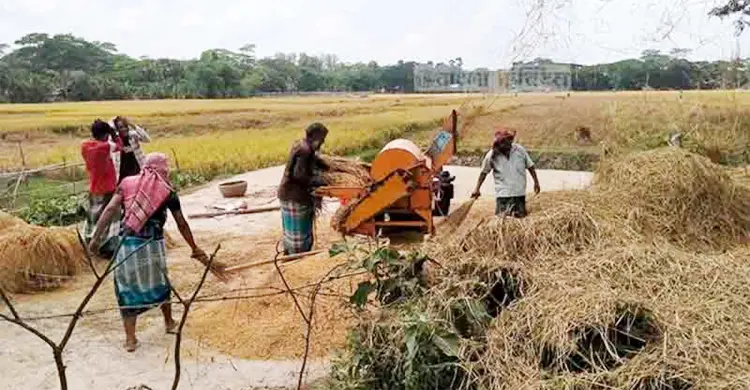
In seven of the eight districts of Rangpur division, the food department could not buy a single chhatak of paddy. The paddy procurement target for the eight districts was set at 62,344 metric tonnes, but only 3 metric tonnes were collected.
On the other hand, rice procurement passed the target of 121,254 (1 lakh 21 thousand 254) metric tonnes, with an additional 43,767 metric tonnes collected. The food department succeeded with rice but failed completely with paddy. The food department says, however, that the government's aim has been achieved.
Farmers say market prices for paddy are higher than the government price, and supplying paddy to the warehouses involves many hassles, so they are not interested in giving paddy to the warehouses.
District targets
According to the office of the Rangpur Regional Food Controller, the targets in the eight districts were: Rangpur, paddy 9,034 and rice 15,830 metric tonnes; Gaibandha, paddy 7,254 and rice 11,986; Kurigram, paddy 6,593 and rice 9,678; Lalmonirhat, paddy 4,700 and rice 6,035; Nilphamari, paddy 6,076 and rice 9,118; Dinajpur, paddy 14,417 and rice 47,688; Thakurgaon, paddy 8,370 and rice 13,942; and Panchagarh, paddy 5,891 and rice 6,977 metric tonnes. The purchasing drive, at Tk 42 a kg for rice and Tk 28 a kg for paddy, began on 17 November last year and ran until 7 March this year.
For the rice procurement drive, the food department signed agreements with 3,558 mill owners in the division's eight districts. When the rice target was met ahead of time, an extra 47,109 metric tonnes was allocated to the eight districts. By 7 March the food department had managed to buy 43,767 metric tonnes of this additional allocation.
The total paddy allocation for the eight districts was 62,344 metric tonnes. Of this, only 3 metric tonnes was bought, in Dinajpur alone. In the other seven districts the food department could not buy a single chhatak of paddy.
Farmers cite hassles
Khairul Islam, a farmer in Madati union of Kaliganj upazila, Lalmonirhat, said the price of paddy is higher in the open market than at the warehouse, and selling to the warehouse involves all kinds of hassle. "That is why I was not interested in supplying paddy," he said.
Mostafizur Rahman, a farmer in Madhupur union of Kaunia upazila, Rangpur, said the government's paddy purchase system is somewhat complicated for farmers. First a farmer must register on a mobile app, then apply by mobile. A lottery is held among registered farmers through the app, and the selected farmers must deliver paddy to the warehouse within a set time. When delivering, a farmer must bring photocopies of his voter ID card and farmer card. The money is then paid into the farmer's bank account, for which he must open an account by giving the bank a photo and voter ID card. It is mainly because of these various hassles that farmers are reluctant to give paddy to the warehouses, he said.
Delwar Hossain, a farmer in Dimla upazila of Nilphamari, said that even if the open-market price of paddy is Tk 2–4 a kg lower than the government rate, it is still more profitable to sell in the market than to the warehouse, because giving paddy to the warehouse involves so many hassles.
Rangpur Regional Food Controller Ashraful Alam told Jagonews that although rice purchasing succeeded, farmers did not bring paddy to government warehouses because paddy prices were higher in the open market.
He added that the aim of the government's paddy and rice purchases is to build up stocks to ensure stock security and to make sure farmers get fair prices. "Even though farmers did not sell paddy to the government, they got fair prices outside. That is the success," he said.
Source: Jagonews24. First published in Bengali on The Agro News.
Comments
(0)