
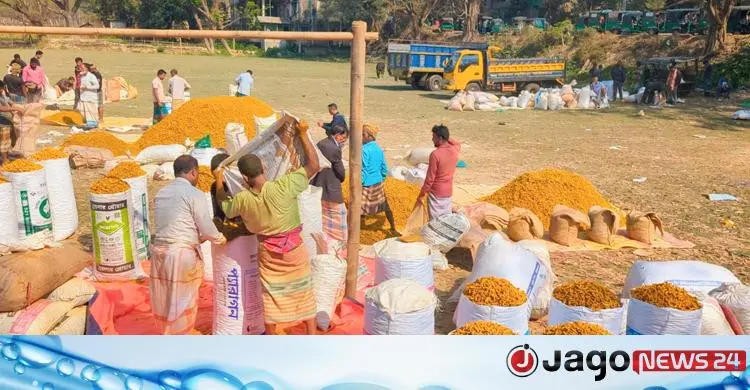
Farmer Azim Uddin grows turmeric on about one and a half acres of hill land. He harvested it in February, but because of the weather, falling soil fertility and disease, the yield fell short of his hopes this year. Prices are also poor, far lower than last year, and this marginal farmer believes growers may turn away from turmeric out of frustration.
Azim Uddin lives in Atarkachhara village of Langadu upazila in Rangamati district. He has grown turmeric and ginger for about 10 years. With no paddy land of his own, he earns his living growing turmeric and ginger on hillocks. He also buys turmeric from other farmers, dries it and sells it at local markets and at the big market in Khagrachhari. That income supports his family.
"Turmeric production is falling day by day. The soil is not as fertile as before and there is more disease now. You can no longer make a profit from it," he said. "Prices are very low this year. A maund of dried turmeric is not going above Tk 6,000 to Tk 6,500, though in some markets it reached up to Tk 7,000. Last year I sold the same turmeric for Tk 8,500 to Tk 9,000. To raise production and meet demand, farmers need government incentives."
Production costs versus market prices
Local turmeric trader Khalil Jomaddar said traders give farmers advance money (dadon) at the start of cultivation, when raw turmeric is valued at Tk 1,000 to Tk 1,200 a maund. After boiling, sun-drying and sorting, producing a maund of dried turmeric costs Tk 5,500 to Tk 6,000, and transport is added on top to bring it to market. "Taken together, there is no profit between the production cost and the selling price. This year traders will lose more than farmers," he said.
In Rangamati, turmeric is mostly grown on jhum (shifting cultivation) hills, and hill dwellers also grow it on small hillocks. The soil here is well suited to turmeric, but farmers say fertility has declined after years of cultivation on the same land.
Another grower, Provu Ranjan Chakma, said production is not what it used to be and a jhum hill cannot be farmed for long. Wholesale turmeric markets sit every week at Subalong, Chhoto Harina and Mainimukh in the district. Prices there are somewhat better, at Tk 7,000 to Tk 7,200 for a maund of dried turmeric, but transport costs eat up the difference, and village markets pay much less. Farmers would gain more if they could take their produce straight to the big markets, he said, adding that turmeric once changed the fortunes of many growers.
Porandhan Chakma, a jhum farmer in a remote part of Bhushanchhara union in Barkal upazila, said hill yields have dropped and producing with good varieties while controlling disease is getting harder. A maund of turmeric has to be carried on the head over long distances down the hills, costing Tk 300 to Tk 400 a maund. "Prices seem low this year. If farmers do not get a fair price, they will lose interest," he said. He has dried about 300 maunds of raw turmeric from his own land into 50 maunds of dried turmeric but has not sold it yet because of the low prices.
Losses late in the season
With prices still not rising near the end of the season, Rangamati's turmeric growers face losses. Prices are about Tk 1,500 to Tk 2,000 lower than last year, with a maund selling for at most Tk 7,000; at retail it sells for Tk 150 to Tk 180 a kg. Because the hill soil and climate are well suited to spices, turmeric is grown widely across Rangamati's hills. Turmeric planted in Chaitra-Baishakh yields in 10 months, and the crop has a low production cost and gives good returns for little labour.
Traders say turmeric from the Chittagong Hill Tracts, including Rangamati, is of very good quality, which is why they come to buy it, and it is in strong demand.
According to the Department of Agricultural Extension (DAE) in Rangamati, turmeric was grown on 3,000 hectares in the district this year. For the first time this year, 300 farmers in the district were given 100 kg of turmeric seed and 10 kg of chemical fertiliser as an incentive. Production stood at 10,000 tonnes, close to the district's target of 10,500 tonnes, which has a market value of about Tk 200 crore.
Md Moniruzzaman, deputy director of the DAE in Rangamati, said there is huge potential for spice crops on fallow hill land in the hill district. Expanding turmeric on such land would reduce dependence on imports, save money for the country and enrich the local and national economy, he said.
Source: Jagonews24. First published in Bengali on The Agro News.

Comments
(0)