
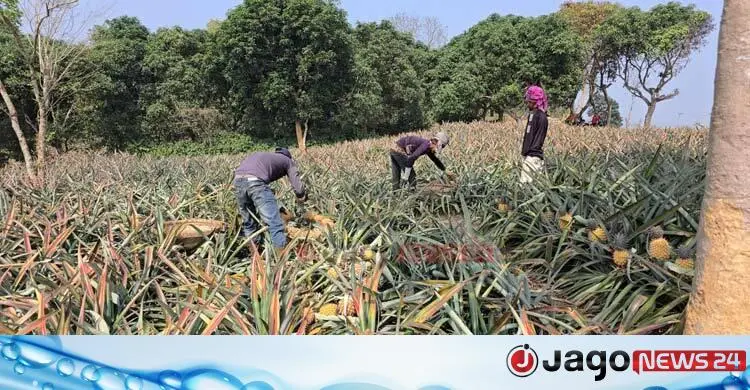
The hill slopes are a sea of green, and through that green comes the scent of juicy pineapples. These are not ordinary pineapples but the famous "Honey Queen", or "Madhu Rani", variety of the hill district of Rangamati. True to its name, it tastes like pure honey.
This season Rangamati's hills have seen a bumper harvest of Honey Queen pineapples. After meeting local demand, the fruit is now satisfying fruit lovers in Dhaka, Chattogram and across the country. Around this pineapple, the fortunes of hundreds of jhum farmers and ordinary families in the hills are changing, opening a new horizon of economic self-reliance.
Visits to several upazilas of Rangamati found pineapple gardens laid out in rows on the sloping land. Harvests have been especially large this year in Rangamati Sadar, Naniarchar, Kawkhali, Langadu and Baghaichhari upazilas.
Two varieties, one favourite
According to the Department of Agricultural Extension (DAE), Rangamati's weather and soil are very well suited to pineapple. Two varieties are mainly grown: Giant Kew, which is quite large and somewhat sweet-sour, and Honey Queen. Honey Queen is in greatest demand for its unique, sweet and fragrant taste. It is somewhat smaller and lighter, but its flesh is deep yellow and full of juice.
Suresh Chakma, a pineapple farmer in the Burighat area of Naniarchar upazila, said: "With favourable weather this time, both the size and the sweetness of the hill Honey Queen have been excellent. Alongside jhum we are now growing pineapple commercially, and we are getting better prices than last year."
With the season in full swing, Naniarchar, Ghagra bazar in Kawkhali, Samata Ghat in Sadar and the Kaptai Rastar Matha area are packed. Every day from dawn, farmers bring pineapples from distant hills to local markets, wrapped in banana leaves, in bamboo baskets (hallong) and by the boatload.
Md Ismail Hossain, a wholesale fruit trader from Chattogram, said: "Demand for Rangamati's Honey Queen in the Dhaka and Chattogram markets is sky-high. When you cut one, the whole house fills with its scent. We buy directly at the ghat by size and take them away by truck. Every day pineapples worth crores of taka go from the Naniarchar gardens alone to different parts of the country."
Profits for hill families
The people of the hill districts once depended solely on traditional jhum farming for their livelihood, but over time jhum farmers have turned to fruit, pineapple among them. By growing Honey Queen, hundreds of hill families are now leaving poverty behind.
Farmers said it costs about Tk 50,000 to Tk 60,000 to grow pineapples on an acre of hill land, and in good weather the crop can be sold for Tk 1.5 lakh to Tk 2 lakh, a return of two or three times the investment in a single season. With this income farmers are paying for their children's education, building brick houses and raising their living standards.
Storage and roads the main problems
Despite the bumper crop and good prices, Rangamati's pineapple farmers have some long-standing grievances. The main problems are the lack of cold storage and poor communications.
Farmer Anwar Hossain said pineapple is a highly perishable fruit and rots if it is not marketed within three or four days of ripening. With no cold store in Rangamati, farmers are often forced to sell cheaply to wholesalers, and they lose out.
Another farmer, Suman Chakma, said transport costs for bringing pineapples from remote hills to the main road or the ghat are very high. If Rangamati's internal roads were improved, farmers would earn more, both growers and wholesale buyers would benefit, and fresh fruit would reach consumers faster.
Subimal Chakma, an agricultural entrepreneur in Rangamati, said there is no juice factory or fruit processing centre there. If one were set up by the government or the private sector, surplus pineapples could be made into juice, jam or jelly and even exported.
Record area under pineapple
According to the Rangamati district DAE office, pineapple was grown on 2,660 hectares in the district in 2025-26, with an estimated yield of 34 tonnes a hectare. Total output this year was 90,439 tonnes, up 24,865 tonnes on the previous financial year. The area under pineapple grows every year, and this year it reached a record, most of it Honey Queen.
Agriculture officials said they are training farmers in modern, scientific pineapple cultivation, especially encouraging "organic" pineapple free of hormones and harmful chemicals, and teaching a special lining method to prevent soil erosion when pineapples are grown on slopes.
Moniruzzaman, deputy director of the agriculture department in Rangamati, said: "Rangamati's Honey Queen pineapple is a brand of this region. So that farmers get the right price, we are trying to link local growers with large chain shops and corporate buyers. A proposal has also been sent to higher authorities to set up a mini cold store in the hills."
Source: Jagonews24. First published in Bengali on The Agro News.

Comments
(0)