
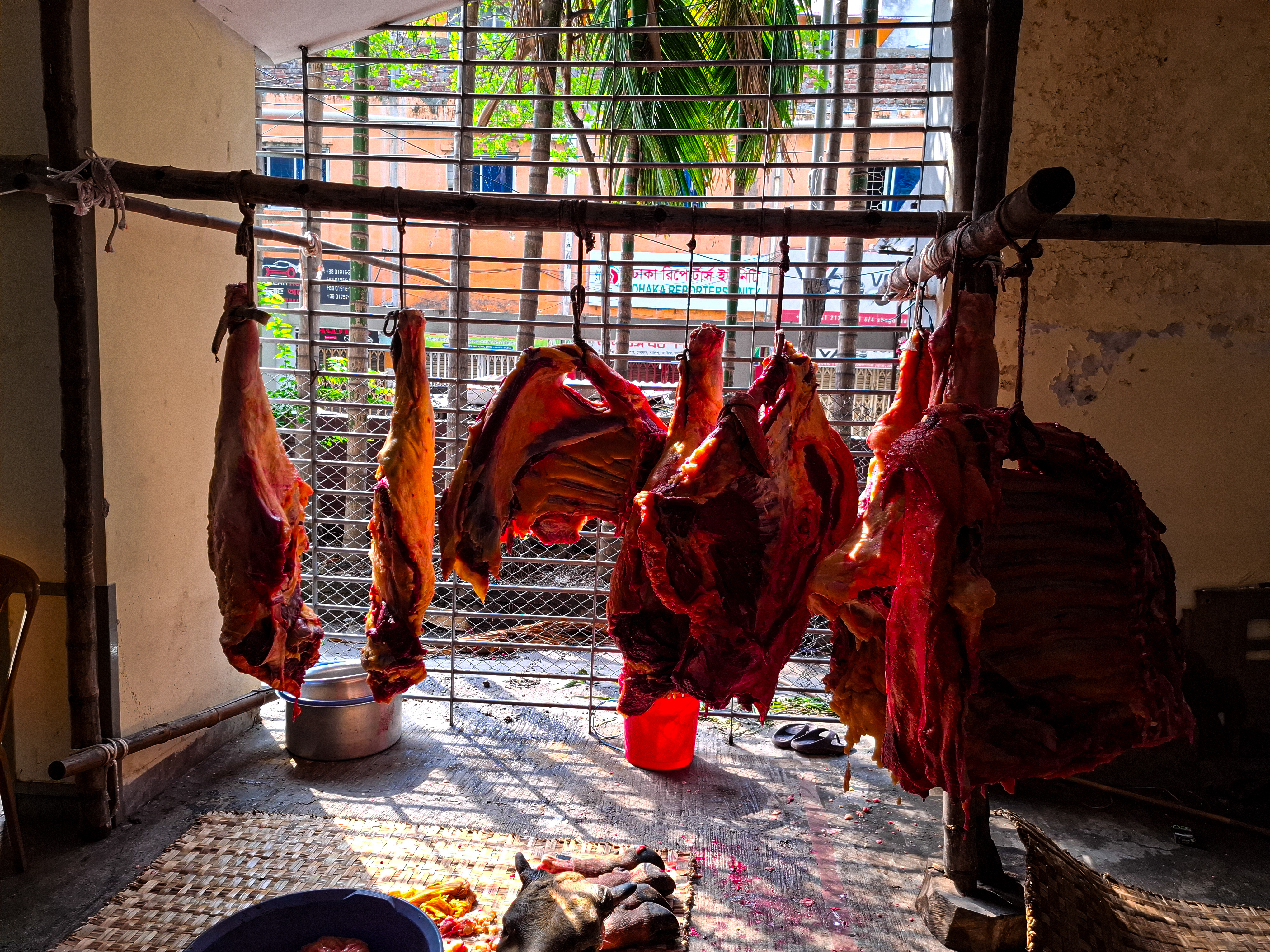
On the afternoon of Thursday 28 May 2026, the day of Eid-ul-Azha, a small makeshift market selling trimmed beef (chhat) sprang up on the Rampura bridge in Dhaka. While sacrificial meat had reached many homes, the market became a lifeline for some low-income residents who could not afford to offer Qurbani themselves. Rickshaw pullers, day labourers and garment workers bargained there for anything from half a kilo to several kilos of meat. Jagonews24 reported on the market from the spot that afternoon.
An Eid afternoon market on the bridge
That afternoon several traders were selling trimmed meat from plastic sheets spread on the bridge. There was meat still on the bone, head meat, fatty cuts and some relatively good-quality meat, all laid out in small portions. Buyers bargained and bought half a kilo, a kilo or more, according to what they could afford.
Traders were asking Tk 350 to 400 a kilo for the trimmed meat, but after requests and bargaining some sold for a little less. They said the meat had been gathered from various sources after the sacrifices and cleaned before it was put on sale.
According to the sellers, most of the meat had been brought by butchers: the trimmings they had collected while cutting sacrificial cattle in different parts of the city. Some good meat is mixed in with the trimmings, and everything was cut up together and sold in portions.
The Rampura area
Rampura is a densely populated neighbourhood in the east of Dhaka. Rampura Thana was established in 2009 and covers wards 22 and 23 of Dhaka North City Corporation and part of the Banasree residential area. The thana covers about 2.8 square kilometres. The 2022 census counted 160,812 people living there in 41,308 households.
Rampura is bordered by Gulshan and Badda thanas to the north and by Tejgaon Industrial Area thana to the west. The headquarters of Bangladesh Television, built in 1975, stands in Rampura. The Rampura canal is the main drainage channel of eastern Dhaka, and DIT Road links the area with the neighbouring thanas.

What the buyers said
Rickshaw puller Minarul Islam said: "Beef is very expensive. I can't afford to buy good meat, so I came here and bought two kilos. The children can eat a little meat on Eid day; that's my comfort." The sellers had been asking Tk 400 a kilo, he said, and after bargaining he bought two kilos for Tk 550.
Another rickshaw puller, Md Alam, said he had lived in Dhaka with his family for four years. "What I earn isn't enough to give Qurbani, and at market prices it's hard even to buy meat. So I came here to buy it. With the money for one kilo at the market you can buy three or four kilos here."
Md Alam said he had first bought meat at the spot the year before and had got good meat then, which is why he came back. If you choose carefully you can find good meat here, he said, although the sellers were asking more this time; after bargaining it could still be bought a little cheaper.
Garment worker Aleya Begum, who had come with her young daughter, said: "On Eid day everyone eats good meat, but people like us can't. A kilo of good meat at the market costs over Tk 800. We can't buy meat at that price, so I came here to buy it cheaper." She said she had bought two kilos for Tk 600, which would feed the family for a few days.
Aleya Begum added that her family could not give Qurbani, nor could she go from house to house asking for meat. In her experience, people in Dhaka who offer Qurbani distribute very little door to door; most give meat to those who come and stand in front of their houses. Because she cannot do that, she buys what trimmed meat she can afford.
What the sellers said: butchers' trimmings in small portions
Seller Ariful said he had been hired to cut four cows on Eid day. He had brought some of the trimmings and some good meat from those animals to sell on the bridge; the families whose cattle he cut had also given him some good meat. He cut it all together for sale. His customers, he said, were mostly low-income people, day labourers and rickshaw pullers.
"Not everyone can buy good meat at once, so we sell good and trimmed meat mixed," Ariful said. "Even the trimmings are good meat." Some customers bought half a kilo, some a kilo and some three or four kilos, he said.
Another seller, Md Kalam, said: "Our meat isn't only trimmings; there is head meat, fat and some good cuts too. Everyone takes as much as they can afford." He had cut two cows himself and had brought part of their meat to the bridge, and he had also bought some meat from two other people. He was selling it all mixed together.
The butchers' Eid season
Many of the sellers on the bridge had spent Eid morning cutting sacrificial cattle. Five days before Eid, on 23 May, Prothom Alo profiled Md Amjad, a 42-year-old butcher at Karwan Bazar in Dhaka. According to the report, he had cut 14 cattle at the previous Eid and was taking on at least 10 this time, cutting back because of the physical strain of the work.
The same report described how Eid butchers are paid. Md Amjad said that on Eid morning the fee is Tk 200 for every Tk 1,000 of the animal's price, falling to Tk 100 per Tk 1,000 as the day wears on; in the morning everyone is in a hurry, so skilled butchers are in greatest demand. His team has six people: three skilled workers who slaughter, skin and make the first cuts, and three helpers who portion and clean the meat. He came to Dhaka from Sonargaon in Narayanganj at the age of seven or eight and learnt the trade from his uncle at Karwan Bazar.
Before Eid, on 3 May, the Ministry of Fisheries and Livestock said it had arranged training for professional and non-professional butchers and workers so that hides from sacrificial animals would be handled properly and not wasted. On Eid day many seasonal butchers work alongside the professionals in Dhaka, and as the sellers on Rampura bridge described, part of the trimmed meat from that work reaches the street market.
Eid-ul-Azha and the custom of sharing the meat
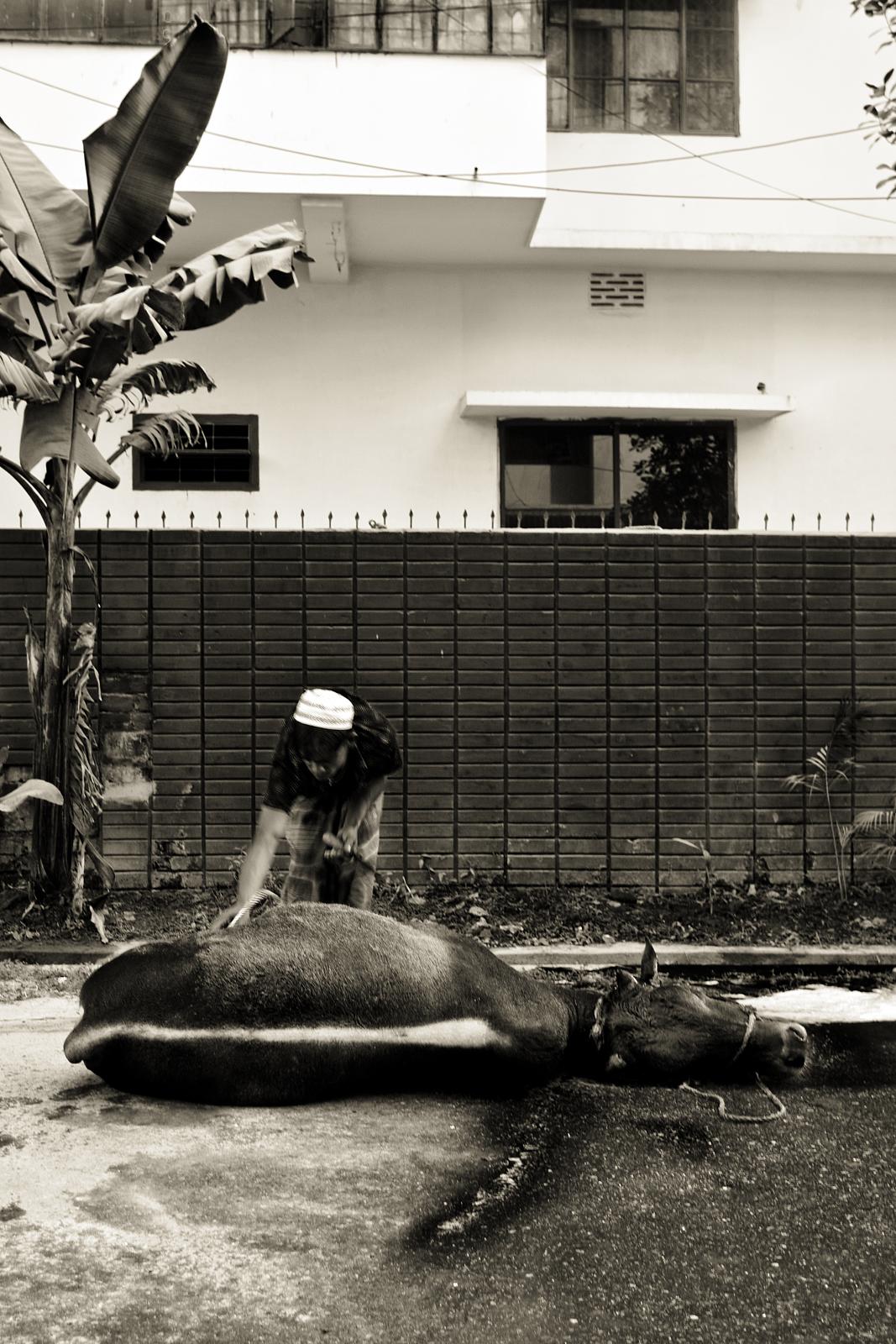
On the evening of Monday 18 May 2026, the National Moon Sighting Committee met in the Islamic Foundation's conference room at Baitul Mukarram, the national mosque. It announced that the crescent of Dhul Hijjah had been sighted, so Eid-ul-Azha would be celebrated across the country on Thursday 28 May, the 10th of Dhul Hijjah. As Bangla Tribune's report explained, Eid-ul-Azha commemorates the sacrifice of Prophet Ibrahim, his wife Hajera and their son Ismail, and through the sacrifice of an animal Muslims recall the lesson of giving up greed and selfishness.
On how the meat is shared, an article in Prothom Alo's religion section on 27 May, the eve of Eid, said the recommended (mustahab) practice is to divide the meat into three equal parts: one for the family, one for relatives and neighbours, and one for the poor and needy. Where several people share one animal, the article said, the meat must be weighed when it is divided; dividing it by estimate is not permissible, though parts such as the head, feet and liver may be shared by count or estimate.
This custom is why crowds gather in front of houses across the city on Eid day to receive meat. The buyers on Rampura bridge described the other side of it: some of those who cannot, or will not, go from door to door asking for meat choose instead to buy what they can afford.
Sacrificial animals and cattle markets this year
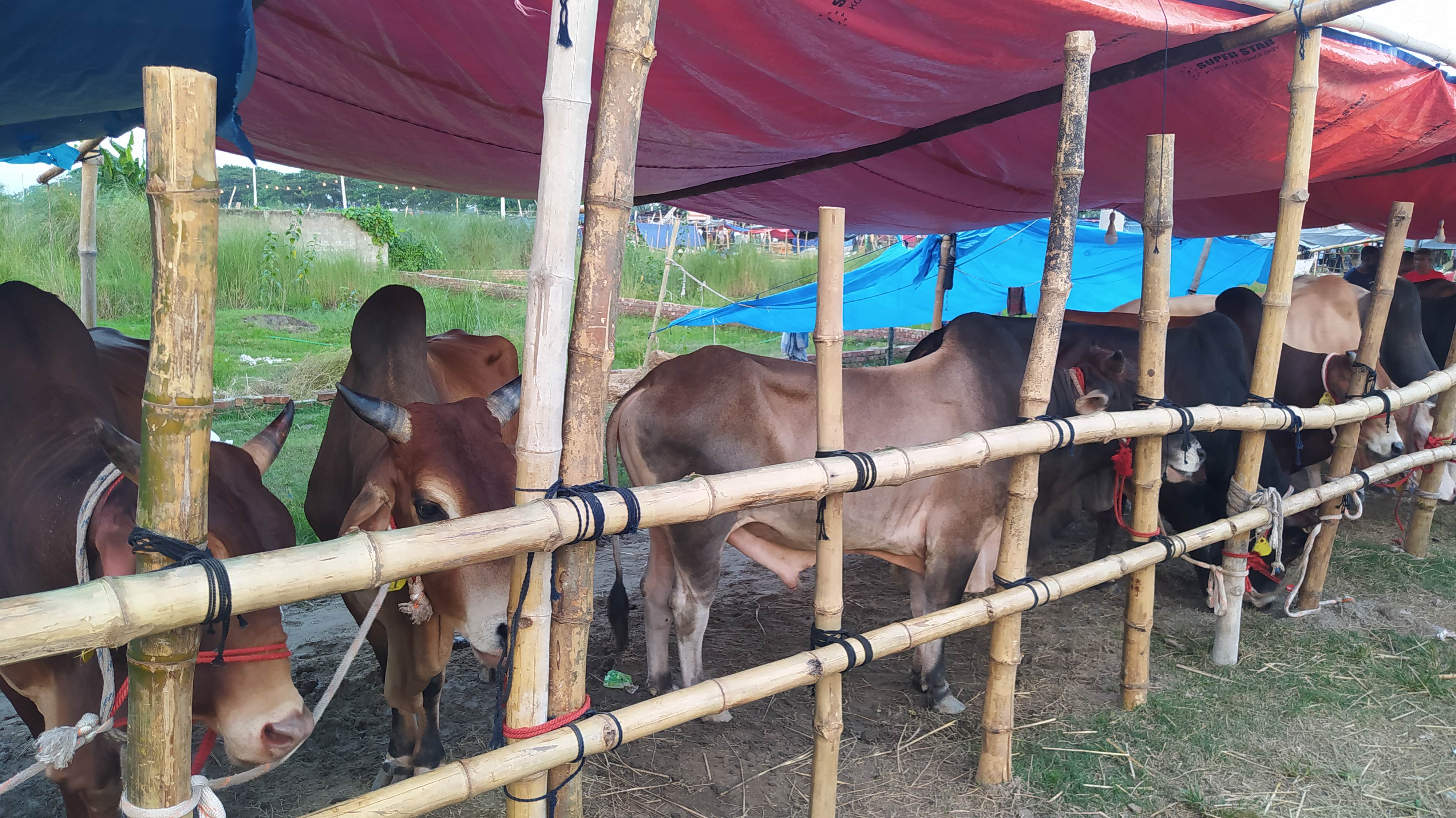
About four weeks before Eid, on 3 May 2026, the Ministry of Fisheries and Livestock gave its figures at a press conference. By the Department of Livestock Services' estimate, demand for sacrificial animals that year was 10,106,334 head, while 12,333,840 animals were ready for sacrifice. The Business Standard reported that the ministry expected a surplus of about 2,227,506 animals once demand was met.
The animals ready included 5,695,878 cattle and buffaloes, 6,632,307 goats and sheep, and 5,655 animals of other species. According to Desh Rupantor, the previous year, 2025, there had been 12,447,337 animals available for sacrifice, with a surplus of 3.31 million left after Eid.
The ministry also said that more than 3,600 cattle markets would be held around the country. In Dhaka, 27 markets were designated: 16 in the North City Corporation and 11 in the South City Corporation. Twenty veterinary medical teams were to be on duty at these markets around the clock, and animals could be bought and sold online without any fee or tax.
Beef prices and falling numbers of sacrifices
The buyers on the bridge returned again and again to the price of meat. A Prothom Alo report published on the morning of Eid, 28 May, citing the Trading Corporation of Bangladesh (TCB), said a kilo of beef was then selling for Tk 780 to 850 in Dhaka's markets. According to the Department of Agricultural Marketing, the average price of beef in 2014 had been Tk 275 a kilo. Mutton was selling at Tk 1,200 to 1,300 a kilo, Tk 50 to 100 more than a year earlier.
Citing the Department of Livestock Services, the same report said the number of animals sacrificed was falling. In 2019, 10.6 million animals were sacrificed. In 2020, the year of the coronavirus pandemic, the figure fell by 1.164 million from the year before. In 2023 about 10,042,000 animals were sacrificed, and in 2025 the number fell to 9.136 million. The report noted that in April 2015 India ordered its border guards to stop cattle from entering Bangladesh altogether, and cattle prices in Bangladesh have risen steadily since.
The report gave the example of a farming family in Uzirpur upazila of Barishal that used to offer a sacrifice every year but had not managed to for three years; even one share in a jointly sacrificed animal then cost around Tk 20,000. Analysts quoted in the report said the pandemic in 2020, high inflation from 2022 onwards and the slowdown in the economy had put people under financial pressure, and that many who once sacrificed a whole animal were now taking a share instead.
Professor A.H.M. Saiful Islam of the Department of Agricultural Economics at Bangladesh Agricultural University told Prothom Alo: "The ability to offer animal sacrifice is closely tied to people's economic capacity." Mohammad Shahzaman Khan, acting director general of the Department of Livestock Services, said in the same report that Qurbani depends on people's economic situation. The market price Aleya Begum quoted on the bridge, over Tk 800 for a kilo of good meat, matches the range TCB recorded.
Meat production and demand in Bangladesh
According to the Department of Livestock Services' Livestock Economy at a Glance (2023-2024), Bangladesh produced 9.225 million tonnes of meat in fiscal 2023-24, against a demand of 7.621 million tonnes calculated at 120 grams per person per day. On the same basis, per capita availability of meat was 143.77 grams a day. The figures were based on an estimated population of 175.8 million in July 2023.
The same publication put the country's livestock in 2023-24 at 25.013 million cattle, 1.524 million buffaloes, 27.117 million goats and 3.903 million sheep. At constant prices, livestock contributed 1.80 percent of gross domestic product and 16.33 percent of agricultural GDP. The publication says 20 percent of the population depends directly, and 50 percent partly, on livestock for employment.
National availability is an average; it does not show how much meat any one household can buy. The buyers on Rampura bridge made that gap plain: although national production exceeds the estimated demand, they said market prices put good meat out of their reach.
Earlier makeshift meat markets in Dhaka
Makeshift meat markets of this kind on Eid-ul-Azha are not new in Dhaka. A report in Prothom Alo's English edition on 13 August 2019 said that at that year's Eid, besides the market at the Malibagh railway crossing, makeshift beef markets were set up in Rampura, Badda, Mirpur, Natun Bazar and Moghbazar. The sellers included poor families who had collected sacrificial meat door to door, seasonal traders and butchers' assistants. Sellers in that report quoted Tk 200, Tk 300 and Tk 500 a kilo, and one buyer said he had bought 5 kg of beef for his family for Tk 2,000.
On 29 June 2023, the afternoon of Eid-ul-Azha that year, The Daily Star's Bangla edition reported on a similar market in front of the Shia mosque in Mohammadpur. Many of the low-income people who collect meat distributed by those offering sacrifice were selling it in the open market, some because they needed money and some because they had nowhere to store it. Lower-quality meat mixed with bone and head meat was selling for Tk 400 a kilo, somewhat better meat for Tk 500 and fresh meat for Tk 800.
On 7 June 2025, Jagonews24's English edition described such markets at the Malibagh railway crossing and the Wireless railway crossing in Moghbazar. Beef sold there for Tk 500 to 800 a kilo depending on quality, while head meat, bones and mixed cuts went for Tk 500 to 520. Many of the sellers, the report said, were poor themselves or had helped with the slaughter; a woman selling there said she helped with the cutting and sold the meat she received for it. On Rampura bridge in 2026, too, the sellers were mostly offering trimmings and good meat mixed together from their own butchering work.
Keeping and cooking the meat safely
Many families who buy meat at street markets during Eid eat it over several days, as Aleya Begum said she would. The U.S. Department of Agriculture's Food Safety and Inspection Service (USDA FSIS) gives this guidance on keeping raw beef safe:
- Take the meat home straight away and refrigerate it at 4.4 degrees Celsius (40 degrees Fahrenheit) or below.
- Cook refrigerated raw beef within 3 to 5 days; ground beef and variety meats such as liver, kidneys, tripe and tongue within 1 to 2 days.
- To keep it longer, freeze it at minus 17.8 degrees Celsius (0 degrees Fahrenheit); beef kept frozen continuously stays safe.
- Cook steaks and roasts to an internal temperature of at least 62.8 degrees Celsius (145 degrees Fahrenheit) and let the meat rest for at least three minutes; cook ground beef and organ meats such as heart, kidney, liver and tongue to 71.1 degrees Celsius (160 degrees Fahrenheit).
- Do not leave cooked beef out for more than two hours, or one hour if the air temperature is above 32.2 degrees Celsius (90 degrees Fahrenheit); eat refrigerated cooked beef within 3 to 4 days.
USDA FSIS also notes that beef is perishable, which is why it is kept cold throughout distribution to slow the growth of bacteria.
Photo: S.M.M.Musabbir Uddin / Wikimedia Commons (CC BY-SA 4.0)
Sources: Jagonews24, Prothom Alo, Bangla Tribune, The Business Standard Bangla, Desh Rupantor, The Daily Star Bangla, Department of Livestock Services, USDA Food Safety and Inspection Service, Wikipedia
Comments
(0)