
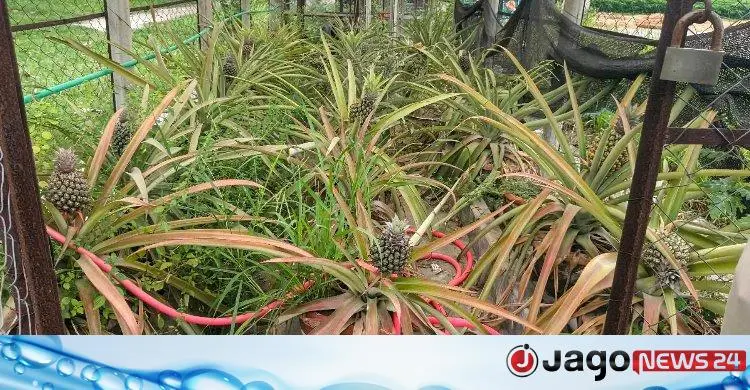
Researchers in the Department of Agronomy and Agricultural Extension at Rajshahi University (RU) have succeeded in growing Honey Queen pineapples using the crown tissue method. The research was carried out under two MSc students and one PhD student, turning tissue into plantlets and then, with care, into full-grown plants. The mature pineapples were harvested at the university's Agro Technology Lab on 19 May.
Dr Md Gias Uddin, a teacher of the department, said: "We have a tissue culture unit and a net house at the Agro Technology Lab. We carried out tissue culture from a mother plant of the Honey Queen variety and are maintaining it here. The germplasm is now going into its second year."
"Last year we harvested three pineapples and this year 21," he said. "One advantage is that it can be grown on arable land, on rooftop gardens or anywhere in Bangladesh. It does not need much care. It has a drip irrigation tunnel and takes nutrients and water from a pipe through self-watering strips. We started it from the crown."
From a small crown to plantlets
On producing the plantlets, he said: "We made seedlings using suckers. We start from tissue of the small crown inside the pineapple, one to one and a half centimetres in size. From that, direct and indirect regeneration takes place. The regenerated plantlets are very small, and one piece gives 50 to 100 of them. When they grow a little, we transfer them to separate pots."
He added: "In Bangladesh it is grown in hilly areas where rainfall is high and soil pH is low. If we can maintain the soil pH and keep the conditions right, pineapple can be grown everywhere in Bangladesh. When our research is finished we will seek help from the authorities concerned for commercialisation, so that they support its diversification."
Pro-vice-chancellor praises the work
The university's pro-vice-chancellor (academic), Professor Dr Md Farid Uddin Khan, said: "This pineapple is fully organic, with no harmful germs and no effect of unsafe farming. Because it is produced in a controlled environment, its taste is also exceptional. There is a clear difference in taste and quality between this and the pineapple usually found in the market."
"Outstanding research has been done," he said. "We visited the lab and saw how plantlets are being produced through tissue culture. They will later be kept in a controlled environment and supplied to the market. It is a very good initiative. If this kind of pineapple can be grown commercially, there will be opportunities to export it abroad too. Its quality is truly excellent."
Source: Jagonews24. First published in Bengali on The Agro News.

Comments
(0)