
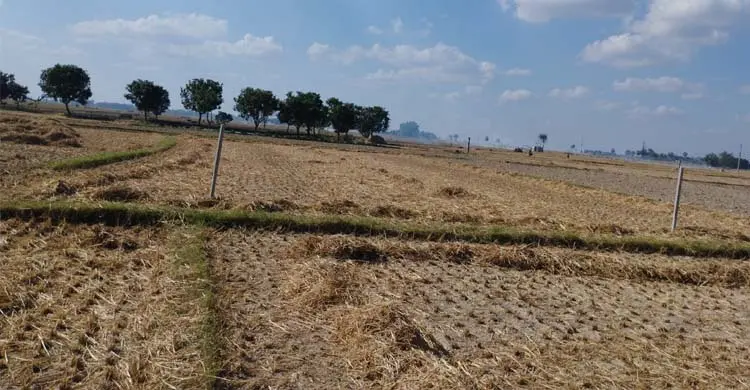
A heatwave is under way in Rajshahi. Although the moderate heatwave has eased to a mild one, the sun is still blazing, and with rising power cuts alongside the heat, people are suffering greatly.
Because of the power cuts, farmers cannot irrigate their land properly. To get water, they have to stay up all night beside the deep tube wells. With too little water, land has cracked in many places, leaving farmers in the north worried about their boro paddy.
On Sunday Rajshahi recorded a maximum temperature of 36.7°C and a minimum of 27°C. The day before, Saturday, Rajshahi recorded the season's highest temperature of 39.7°C, when power cuts added extra strain to the scorching heat.
According to the Rajshahi divisional office of the Department of Agricultural Extension (DAE), boro has been grown on 3,72,000 hectares in Chapainawabganj, Naogaon, Natore and Rajshahi districts.
Fields cracking
With boro starting to flower, the DAE said in a notice that farmers should keep 3-4 inches of water in their fields to protect the crop from the heatwave. But farmers complain that because of repeated power cuts they cannot irrigate their boro fields even once a week, although boro fields need irrigation every two days.
Mehedi Hasan, a farmer from Shekherpara village in Godagari upazila of Rajshahi, said they were very worried about their boro fields as there was no electricity for up to 14-16 hours. He said that, with cracks already appearing in the land, farmers in the area have to spend nights at the deep tube wells to get their turn to irrigate their boro fields.
Jiaur Rahman, a farmer from Balanagar village in Bagmara upazila, said he had installed a semi-deep tube well of his own, from the Barind Multipurpose Development Authority, to irrigate five bighas of boro land. But power cuts have made running the tube well difficult. He said that with power going for two hours each time after a break of seven to nine minutes, he had not been able to run the tube well for even two hours since Saturday morning.
Moshiur Rahman, a BMDA deep tube well operator in Durgapur upazila of Rajshahi, said power had gone and come back 10-12 times a day for the past week, so he has had to run the pump for 24 hours. The power went five times on Friday night. "With the water in the fields drying up in the extreme heat, frequent power cuts have made it difficult for me to manage the queue," he said.
Professor Mostafizur Rahman of the Faculty of Agriculture at Rajshahi University said holding water in boro fields at flowering is essential. If water cannot be held and cracks appear, it can hurt boro production.
Shared power lines
Asked about load-shedding, Zakir Hossain, chief engineer of the Northern Electricity Supply Company (NESCO) in Rajshahi, said Rajshahi city's power demand is 90 megawatts and it is getting 90 megawatts. But in Rajshahi division there is 15 megawatts of load-shedding in NESCO's area and 60 megawatts in the Palli Bidyut area.
"India has dedicated lines; we do not. Homes, irrigation and mills are all on one line. If it were irrigation alone there should be no problem, but we do not have that, which is why the problem is happening. Demand is rising mainly because of the weather, Ramadan and the IRRI season. It will be solved, but I cannot say when. My higher authority knows that," he said.
Source: Jagonews24. First published in Bengali on The Agro News.
Comments
(0)