
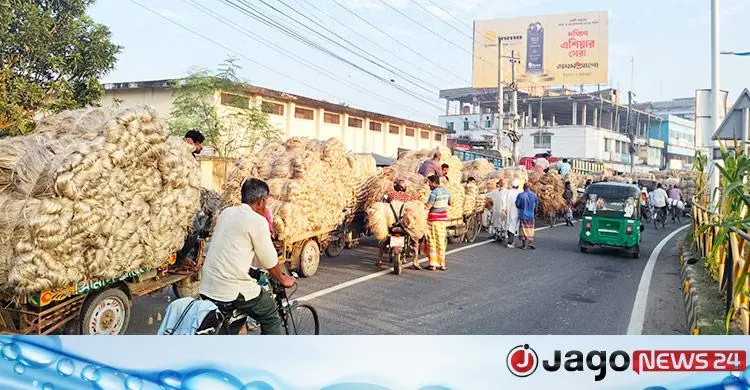
A wave of golden promise has swept the jute fields this year. Favourable weather and good market prices have created the prospect of a large harvest and brisk trade in Rajshahi, where the agriculture department expects jute worth about Tk 450 crore to be sold across the district's nine upazilas this season.
Jute has given a bumper yield across the wide fields of Mohanpur, Bagmara, Durgapur, Puthia, Paba, Tanore, Godagari, Charghat and Bagha, and prices in the market are more comfortable than in the past few years.
Plentiful monsoon rain has been an extra blessing for jute growers, also providing the water needed for retting. As a result, farmers have had less trouble than in recent years throughout the process from cutting the jute to stripping the fibre.
Across the district, farmers can be seen cutting and bundling jute, stripping fibre from retted stalks, or drying washed jute in their yards ready for market. Local markets are getting busier in step with the farmers.
More land, more jute
According to the district agriculture department, jute was grown on 18,399 hectares in Rajshahi's nine upazilas this season, with a production target of about 49,000 tonnes. Cutting, retting and stripping have been completed on about 82 per cent of the land, which has yielded about 48,200 tonnes. Once the rest is harvested and processed, production is likely to exceed the target.
Last season jute was grown on 17,305 hectares in Rajshahi, producing 48,677 tonnes. The area has grown by 1,094 hectares in a year, and production is also likely to rise.
Market prices add to the good yield. Jute is selling at Tk 3,800 to Tk 4,000 a maund in Rajshahi markets, and good-quality jute fetches up to Tk 4,500. This is putting more money in farmers' hands and increasing trade in rural markets.
Farmers' voices
Md Sujan Islam, a jute farmer from Bishalpur village in Keshorhat municipality, Mohanpur, said farmers were frustrated last year when they did not get good prices. This year both the yield and the price are good. He is able to sell jute at more than Tk 3,600 a maund and expects a good profit even after production costs.
Joynal Alam of Mohabbatpur village in Dhuroil union grew jute on two bighas. He said timely rain meant there was little trouble retting and washing the jute this time, and farmers are happy with the good market price.
The relief is even clearer in Bagmara, where jute plants have grown tall and healthy. With a good yield and the expected price, many farmers are planning to grow more next season.
Bagmara farmer Hafizur Rahman grew an early variety of jute on four bighas. He said the plants grew very well, there was enough water for timely retting and he got a fair price, selling at Tk 4,000 to Tk 4,500 a maund, Tk 800 to Tk 1,000 more per maund than before. He plans to grow jute on more land next year.
In Durgapur, farmers say production costs rose somewhat. With so much jute cut and stripped at the same time, there was a labour shortage and wages rose. Load-shedding and a fertiliser shortage also pushed up costs. Still, good market prices mean they are in profit.
Durgapur farmer Shahin Alam said the yield was good and plentiful rain meant no water problem for retting. But because everyone began cutting and stripping at once, labour was short and wages rose, and load-shedding and the fertiliser shortage raised costs. Even so, the good price has brought a profit.
The picture is similar in Puthia, Charghat and Bagha. Jute was also grown on the relatively high land of Tanore, Godagari and Paba, where favourable rain and farmers' care produced good yields, raising farmers' hopes in almost every part of the district.
Officials and an economist
Mita Sarkar, additional deputy director (crops) at the district office of the Department of Agricultural Extension (DAE), said: "Because of government incentives, timely supply of quality seed and fertiliser and favourable weather, jute cultivation and production have increased in Rajshahi this year. Good market prices are also encouraging farmers to grow jute." She added: "At Tk 3,800 to Tk 4,000 a maund, jute trade in Rajshahi this season could be worth about Tk 450 crore."
Nadim Akhter, assistant director of the Department of Jute in Rajshahi, said: "About 3,81,696 quintals of jute are expected to be produced in the district this year, which could be about 21,000 quintals more than last year. Jute is currently selling at Tk 3,800 to Tk 4,000 a maund in some areas."
Professor Dr Md Farid Uddin Khan of the Department of Economics at Rajshahi University said: "Bangladesh was once known worldwide for jute, but over time its use and importance have declined. Jute was once used to make many kinds of products, but today its use is much more limited. If we can increase production and ensure diversified use, jute can play a more important role in the economy. If new markets for jute goods are created, diversified use increased and exports raised, farmers will benefit and the country's economy will prosper."
Source: Jagonews24. First published in Bengali on The Agro News.

Comments
(0)