
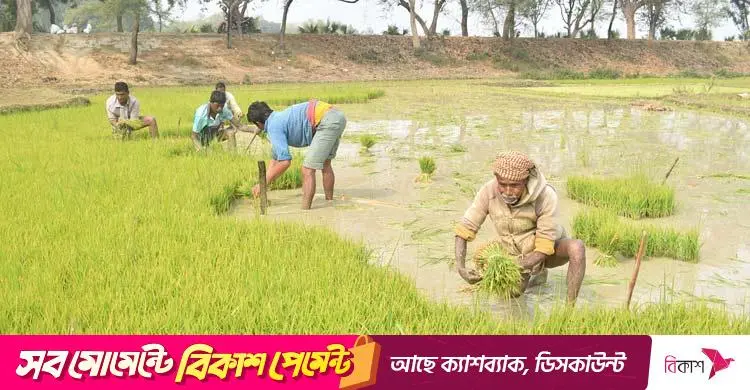
A new irrigation policy has taken effect in the Rajshahi region from this year's boro season. In its first year, more than 10,000 hectares of land could not be cultivated because of the water crisis.
Farmers say they could not grow the crop because they did not get water, so rice production in the Rajshahi region is falling. The agriculture department says that although rice cultivation has dropped, other crops are increasing.
The figures
According to the Rajshahi office of the Department of Agricultural Extension (DAE), Rajshahi, Natore, Naogaon and Chapainawabganj make up the agricultural region of Rajshahi division. In the 2023-24 fiscal year the boro target in the region was 375,165 hectares. Last year cultivation exceeded the target by 865 hectares, and in all boro rice was grown on 376,030 hectares.
In the current 2024-25 fiscal year cultivation has fallen. The target was 376,110 hectares, but because of the water crisis boro was grown on 365,830 hectares, 10,200 hectares less than last year.
Of this, the area fell by 1,905 hectares in Rajshahi district, 540 hectares in Naogaon, 3,500 hectares in Natore and 4,205 hectares in Chapainawabganj.
BMDA's new rules
According to the Barind Multipurpose Development Authority (BMDA), it has 3,588 working deep tubewells in the eight upazilas facing a water crisis. Of these, 1,960 are in areas of acute water shortage. Depending on the availability of groundwater, each tubewell can irrigate 24-40 hectares.
Under BMDA's new policy, to keep the groundwater level stable, a deep tubewell will run for a total of 1,960 hours a year. Of this, in the boro season from 15 February to 15 May, a deep tubewell will run for 980 hours. As a result, boro cultivation on land under these tubewells will be cut from half to zero.
A BMDA tubewell operator in Godagari upazila, speaking on condition of anonymity, said: "I can give water to one-fifth of the land in my area. The office has given instructions to that effect. So many people could not grow rice this time."
Farmers count the cost
Md Mamun, a farmer of Kalidighi village in Godagari upazila, said: "I prepared a seedbed two months ago to grow boro rice, but I could not plant it. Fifteen days before transplanting I heard that we could grow rice on only three of our 10 bighas. That is what we did this time."
Rafiqul Islam, a farmer of Purbhara village, said: "This time I leased 12 bighas for over Tk 1.5 lakh. After taking the lease I heard I could grow rice on two bighas. I have suffered a huge loss. What can I do now? Without water there will be no rice. So I will have to grow something else on the rest of the land."
Md Awal of Shekherpara village said the rice he gets from his one bigha of land lasts him the whole year, but now he will have to buy rice from outside.
BMDA chairman Dr Md Asad-uz-Zaman could not be reached for comment despite several calls to his mobile phone.
Dr Md Azizur Rahman, additional director of the Rajshahi divisional DAE, said: "Rice cultivation has fallen compared with last year. But more mustard has been grown this time, and that is mainly why cultivation may have dropped somewhat. I hope this will be made up in the coming aus season. But I have not heard that farmers cannot cultivate because of the water crisis. Farmers are growing what they wish. They grew less rice this time mainly because of mustard. It will be made up in future."
Source: Jagonews24. First published in Bengali on The Agro News.


Comments
(0)