
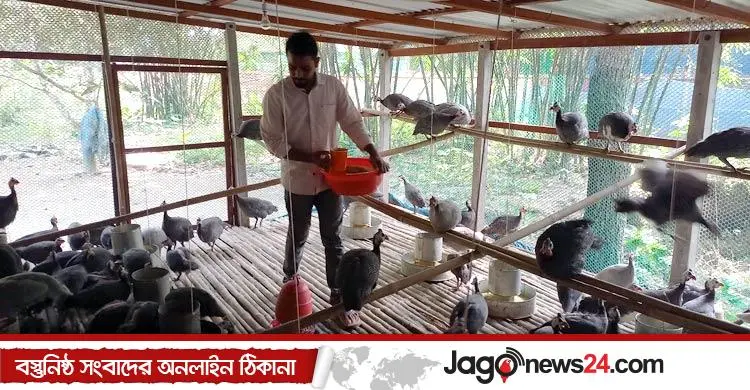
New entrepreneurs and farmers are emerging with the aim of ending unemployment and creating jobs, and many are succeeding through hard work. One of them is Raju Ahmmed Rubel, a young man from Shahid Wahabpur union in Rajbari Sadar upazila.
Three and a half years ago, as a hobby, Rubel started a farm in his yard with just 13 guinea fowl. Now it has about 900 birds, large and small. Because rearing them takes little money and effort and is profitable, he now keeps them entirely commercially. Using a machine, he hatches about 3,000 chicks a month from his own farm's eggs, which sell out immediately, and he cannot keep up with demand.
After farm costs, he now earns about Tk 70,000–80,000 a month. Seeing his success, many people nearby and elsewhere are becoming interested in rearing guinea fowl, whose tasty meat is in good demand. With government support and training, young farmers like Rubel could become self-reliant and help end unemployment by rearing the birds.
From 13 birds to 900
Rubel began rearing 13 guinea fowl as a hobby in mid-2021. His farm now has 900 birds in separate places across four sheds, of which about 400–500 are laying birds. From their eggs he hatches about 2,500 to 3,000 chicks a month with a machine.
Guinea fowl look much like chickens. They can be kept free-range or on a farm like chickens and are fed the same grain feed, so the whole family takes turns looking after the farm. A laying pair sells for Tk 3,000, a one-month-old chick for Tk 200 and a newly hatched chick for Tk 90. Running the farm costs Tk 80,000–90,000 a month in all, and income is about Tk 1 lakh 60 to 70 thousand.
As demand for guinea fowl and chicks grows, interest has risen among people nearby, and many have started on a small scale. The Rajbari district livestock office has no record of any guinea fowl farm or entrepreneur, but it is understood to be giving farmers and entrepreneurs advice, training and all kinds of support.
Calls for government support
Locals Mirajul Islam and Poran Sheikh said: "Seeing the guinea fowl farm and its success, many nearby have taken chicks from it and started rearing on a small scale. People also come from far away to buy chicks and grown birds. With government training and support for rearing this bird, unemployed youths and young entrepreneurs would benefit."
Rubel's wife Halima said: "My husband started rearing guinea fowl as a hobby, but now he does it fully commercially. All our expenses are met from the farm's income. With government support we could take the farm to a bigger scale."
Raju Ahmmed Rubel said: "Rearing this bird is very profitable and its disease resistance is very good. With government help I could expand the farm and help meet the country's demand for meat. At present the total cost is about Tk 90,000 a month, and the income is about Tk 1 lakh 60–70 thousand."
Rajbari district livestock officer Dr Prokash Ranjan Biswas said: "This is a promising sector. Guinea fowl meat is like chicken. Rearing it is more profitable than local or Sonali chickens, and its market price is higher than broiler or Sonali chicken. Many also keep it as an ornamental bird. The bird helps meet demand for eggs and meat. The livestock office has always encouraged farmers and entrepreneurs in this and supported them through training."
Source: Jagonews24. First published in Bengali on The Agro News.
Comments
(0)