

Farmers in Rajbari district are busy planting and tending murikata onion, which will take about two to three months to reach the market. This year preparing the land, buying bulb seed (guti), fertiliser, pesticide and labour are costing about Tk 50,000 to 60,000 a bigha. On their own land the cost is about Tk 20,000 to 25,000 less, because leasing a bigha costs farmers about Tk 15,000 to 25,000.
Farmers say bulb seed is somewhat cheaper this year, but the cost of leasing and preparing land, fertiliser, pesticide, irrigation and labour has risen, pushing up their expenses. They are still planting in the hope of a profit. But to keep farmers afloat given input prices, they say, the market price must be set at a minimum of Tk 2,000 a maund in the season. Barring a disaster, they expect 50 to 60 maunds a bigha this year.
Planting and targets
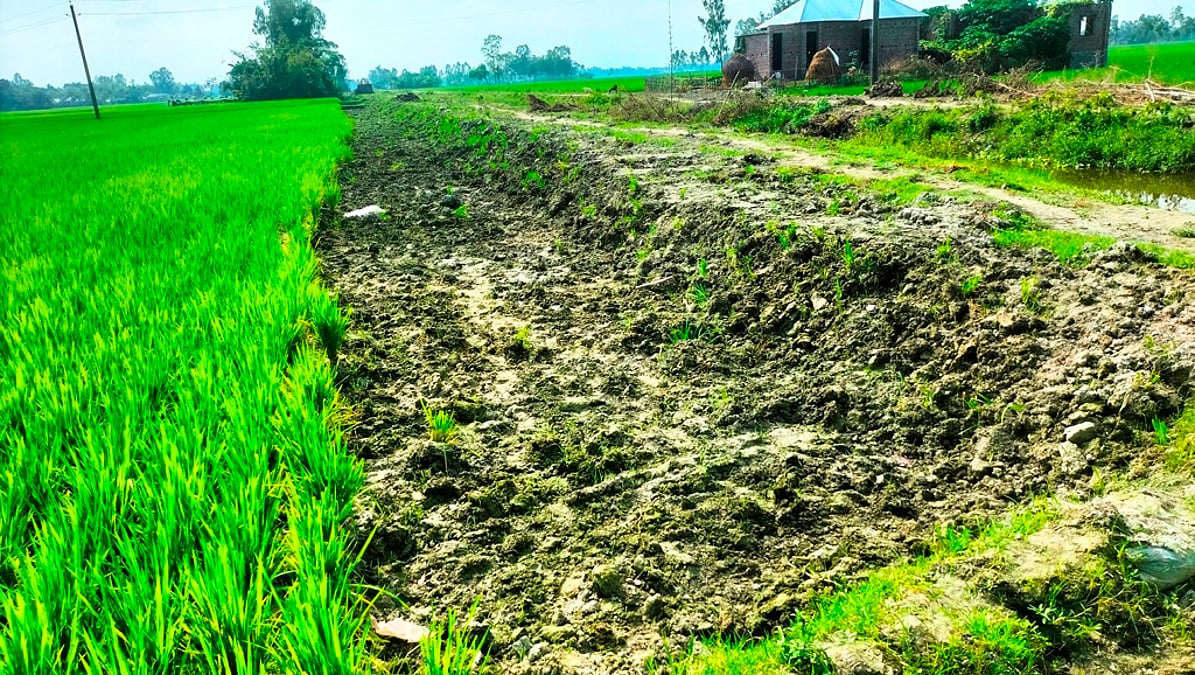
Planting began in fields across the district in the second week of this month, and about half the target area has already been planted. Most murikata onion this year is being grown in Goalanda, Kalukhali and Baliakandi, with some in Rajbari Sadar and Pangsha. Just before this crop is lifted, at the end of December or in January, planting of hali onion will begin.
Rajbari is a leading onion district, producing about 16 percent of the country's onions, and is the third-largest onion-producing district. Its output meets a large part of national demand. Murikata onion, stored for a short time at the start of winter, is followed by hali onion, which is stored for almost the whole year. Murikata accounts for one-sixth of the district's main onion cultivation. It is grown to some extent in all five upazilas but most in Goalanda, Kalukhali and Baliakandi.
According to the district Department of Agricultural Extension (DAE), the target for onion cultivation is more than about 36,000 hectares, of which 5,870 hectares is the target for murikata onion. The production target is about 95,000 tonnes. This year murikata onion is being grown on 2,230 hectares in Goalanda, 1,665 in Kalukhali, 1,200 in Baliakandi, 425 in Pangsha and 355 in Rajbari Sadar.
Farmers' costs
Farmer Halim Sheikh told Jago News: "This time I am growing murikata onion on 6 bighas. Fertiliser, pesticide, fuel, labour, everything is more expensive. It is costing me about Tk 3 lakh. If fertiliser were cheaper and I got Tk 2,000 a maund after harvest, I would make some profit. Below Tk 2,000 a maund we will make a loss."
Another farmer, Isa, said: "We feel helpless planting onion and garlic now. I bought onion bulb seed at Tk 2,500-2,600 a maund. At selling time we have to sell at Tk 1,500-2,000. With everything we have to buy at such prices, if the yield is not good we will be finished. I cannot tell what the yield will be this time. I hope it will be good. With a good yield it will be 50-60 maunds a bigha; with a bad one no more than 30-35 maunds. If prices are low then, our situation will be very bad."
Kader Molla and Hashem Ali Sheikh said: "Onion farming is costing a lot this time. Land, fertiliser, fuel, ploughing, everything is more expensive. But when we go to sell, we do not get the price. This time it is costing about Tk 50,000 to 60,000 a bigha in all."
Golam Rasul, training officer at the DAE in Rajbari, said murikata onion planting is ongoing in the district and will be completed within a week. "If the weather stays favourable, we hope the district will produce about 95,000 tonnes of onion this year," he told Jago News.
"The district has adequate fertiliser stocks. Monitoring at field level has been stepped up. Next month's fertiliser allocation will be larger, so there will be no problem with fertiliser. Wherever we get a complaint, action is taken after investigation," he said.
Source: Jagonews24. First published in Bengali on The Agro News.

Comments
(0)