
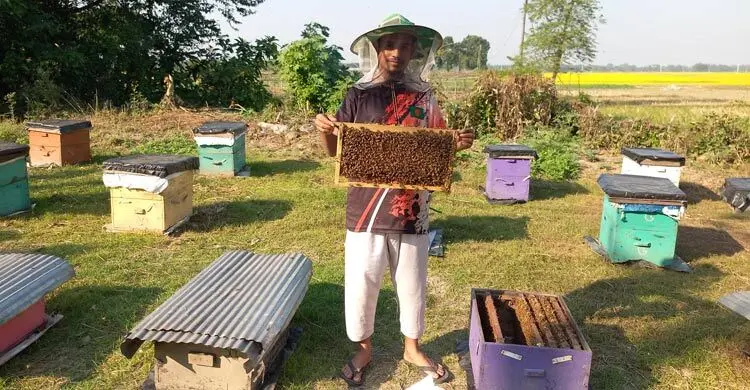
Md Masud, a beekeeper in Rajbari, hopes to earn Tk 1 lakh a month by keeping bees in boxes. Alongside his studies, he spends eight months of the year moving around the district, setting up boxes in different places to collect honey. He profits from the honey, and the farmers profit too, as the bees pollinate their crops and raise production.
Honey can be collected within 12-15 days of setting up the boxes. At the start of the season, the boxes are placed in rows beside mustard fields, and mustard honey is collected for two months. After that, honey is gathered from coriander, black cumin and other crops, filling eight months of the year. Apart from the beekeepers' own food and lodging and care of the bees, there is little extra cost, so beekeeping in boxes has become known as a profitable occupation.
Mustard has been grown over large areas of Rajbari Sadar and Goalanda, and the fields are a sea of yellow flowers. Mustard is a profitable crop with little cost, and bee boxes have been placed beside the fields to raise output through pollination. Bees buzz through the fields, settling on the flowers to collect nectar.
Farmers expect better yields
With bee boxes placed beside mustard fields in Bagmara and Ramkantapur of Rajbari Sadar, Goalanda and other places, farmers hope for better yields than in other years thanks to pollination. The beekeeper hopes to earn about Tk 90,000 a month from honey from a single site.
According to the district Department of Agricultural Extension (DAE), the target was to grow mustard on 6,500 hectares this year, but so far it has been grown on about 5,665 hectares. Mustard cultivation fell somewhat this year because of excessive rain and high onion prices. Rajbari Sadar and Goalanda grow the most mustard in the district.
Mustard farmers Khairul Islam and Khandaker Billal said: "Because of the bees, we expect a much better mustard yield this time. Last year there were no bees, so the yield was not good. Our whole field is under mustard this time. Many people come from far away and take photos, and it is nice to see."
Another farmer, Alam Mia, said: "The bees are a great help to farmers. Because of them the mustard grains will fill out and the yield will be good, which did not happen before. If it is like this every year, farmers will benefit. That is why I have kept the beekeeper's phone number, so I can call them at crop time to raise production."
Honey for eight months
Beekeeper Md Masud said: "I have set up 62 bee boxes beside this mustard field. If the mustard is well looked after and the bees pollinate it, production will rise by 20 per cent. This season, after mustard, honey collection moves in turn to coriander and black cumin in different places, going on for eight months of the year. Collection from mustard will last two months. I hope to collect Tk 80,000-90,000 worth of honey a month from these boxes. The bees cost little; they just need care and watching."
Dr Md Shahidul Islam, deputy director of the Rajbari DAE, said: "Mustard sowing was delayed by rain, so this time it was grown on somewhat less land than the target. But other rabi crops have increased. The agriculture department is beside the farmers. This season we are trying to achieve pollination through beekeeping, and beekeepers have placed boxes beside fields in several places."
Source: Jagonews24. First published in Bengali on The Agro News.

Comments
(0)