
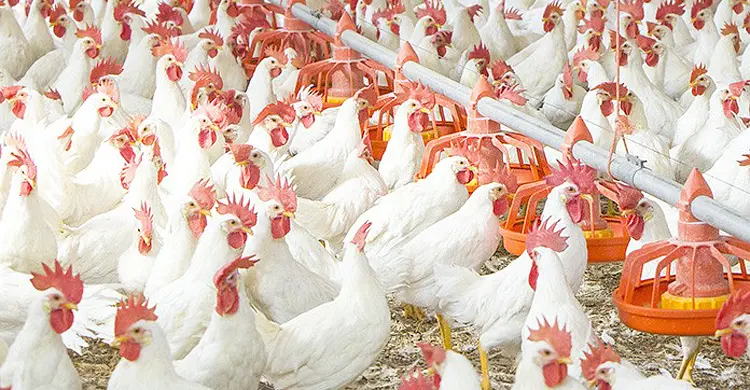
Poultry farmers are in trouble because of the lockdown the government declared amid the ongoing coronavirus (Covid-19) situation, and the dominance of syndicates has added to their problems. Small and medium-sized poultry farmers are facing heavy losses, and many farms have stopped production.
The decline began last year, when the government declared a general holiday during the coronavirus outbreak and poultry farmers suffered losses. As the situation became somewhat normal by the end of the year, they began to recover, with social events and tourist centres bringing the poultry business back to life. But this year the government declared a lockdown from 14 April to tackle the coronavirus "second wave", plunging poultry farmers into fresh crisis.
Last year, farmers hit in the livestock sector received incentives of a maximum of Tk 22,500 and a minimum of Tk 3,375 each.
Feed and chick prices
Farmers say the disruption of normal markets by the coronavirus is affecting business, and the prices of feed and chicks are rising abnormally on the pretext of the pandemic, making it hard to keep going. Small farmers had hoped the government's incentive money would help them overcome the crisis, but higher chick and feed prices have become the main obstacle, and syndicates keep causing them losses. They have called for upazila livestock offices to be more farmer-friendly and for a poultry policy.
According to the Bangladesh Poultry Khamar Rokkha Jatiya Parishad (BPKRJP), the country has more than 98,000 poultry farmers. Production has stopped at more than 28 per cent of farms because of various problems during the coronavirus period, and the number may rise.
Sources said poultry farmers are selling red (brown) eggs at Tk 6.55 each and white eggs at Tk 5.75. Broilers sell at Tk 120 a kg, red cull birds at Tk 210 a kg, white cull birds at Tk 140 a kg and Sonali chickens at Tk 195 a kg. Red layer chicks sell for Tk 35-40, white layer chicks for Tk 20-25 and broiler chicks for Tk 30-31.
'No poultry policy'
Toyeb Taher, convener of the Poultry Feed Traders Association (South Chattogram, Cox's Bazar, Bandarban), told Jago News: "My farm has 15,000 layers, 30,000 broilers and 7,000 Sonali chickens. We have been in a bad state for a long time. First of all, there is no poultry policy. There has been talk of one for a long time, but it has not happened. The current minister took an initiative after taking charge, but it stopped because of the coronavirus. The policy is supposed to set the maximum price of chicks, the maximum price of feed and the minimum price of chickens. Poultry is now in chaos. If the chicken price rises by Tk 3 in the market, companies raise the chick price by Tk 10. When chicken prices fall, they cannot sell chicks. When feed or maize prices rise in Brazil, it takes two months for that to reach this country, but here prices are raised the same day. The government once fixed the maximum chick price at Tk 35, but nobody follows it."
Toyeb Taher said losses from the coronavirus were very large and someone involved in poultry was falling into financial trouble every day. "When chicken prices rise in the market, many people think farmers are making big profits. If chicken sells at Tk 140 in the market, the farmer does not get even Tk 110, while it costs Tk 125 to produce a kilo of broiler. Today, because of the heat, if I phone a wholesaler to sell chickens, the wholesalers will immediately cut the price by Tk 10, and the farmer is forced to sell. Farmers also have to sell at low prices because of the lockdown and other reasons. So we proposed a government poultry market, so that people could buy chickens at the right price and we could get a somewhat better price," he said.
Shimul Haque Rana, a poultry farmer who monitors the poultry market, told Jago News: "The condition of poultry farms in the country is very bad. In many places chickens are dying of disease. Many layer farmers have been ruined. Just surviving is now hard for farmers. They cannot recover production costs by selling eggs, because market prices are low. The layer market is somewhat normal, but the broiler and Sonali markets have largely collapsed. The syndicates are mainly the ones creating problems. They produce huge numbers of chickens and release large quantities onto the market when it is good. Those who own big farms form this syndicate."
Farmers' association and ministry
Khandaker Mohsin, general secretary of the Bangladesh Poultry Khamar Rokkha Jatiya Parishad, told Jago News: "When the price of meat rises by Tk 10, consumers become unhappy. Almost every year, 16 to 17 per cent of the remittance fighters who return from abroad invest in this sector, and at some point their capital is gone. In the market, a few syndicates take even the last capital of small farmers through chicks and feed. There is supposed to be a monitoring cell, or a government committee to set prices, but no initiative has been taken in the last five years. Officials hold meetings with various people but not with those actually affected, so the problems cannot be conveyed to them."
He said: "During the coronavirus people cannot go out or go to market, so the market is not what it was. The mobile sales initiative of the Ministry of Fisheries and Livestock helps somewhat, but not as much as we had hoped. Grassroots farmers did receive the government's financial incentive, but leaders of the Bangladesh Poultry Industries Central Council have, you could say, taken that money back from farmers by raising feed and chick prices. There is nobody to look into this. Those who can afford it have had taxes waived; marginal farmers who get feed through dealers do not get this benefit."
Rawnak Mahmud, secretary of the Ministry of Fisheries and Livestock, told Jago News: "Initiatives to help poultry farmers have already been taken. First, banks are giving them loans. Also, duty on soybean imports for feed mills has been waived. This support is already under way. Beyond that we are taking steps for the growth of the poultry industry, and it is growing; we are now producing plenty of chickens and eggs. We are still asking the government to keep taxes on the goods they import from abroad at a tolerable level. Taxes cannot be waived 100 per cent. During the coronavirus we have also arranged mobile sales of chickens and eggs to solve their problems. If there are any other problems, those will be solved too."
Source: Jagonews24. First published in Bengali on The Agro News.

Comments
(0)