
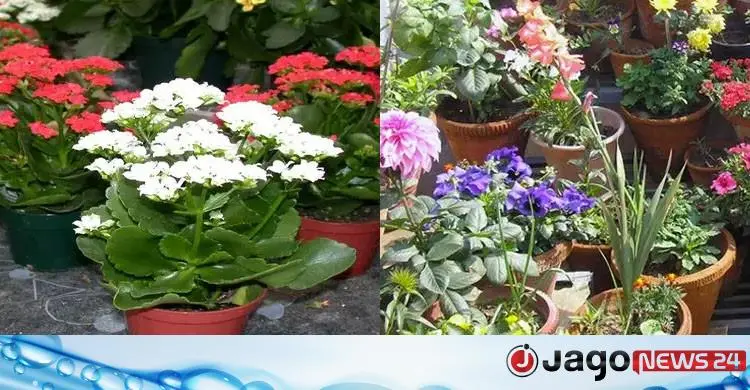
Flowers are in great demand everywhere now, and many are needed for various days and festivals. So flowering plants can be grown on the roof, in the yard, on the balcony or in the stairwell, and some can be planted to suit your space. But it is important to know that not every flowering plant does well in a pot.
Flowers suited to pots
Different flowering plants can be grown in different seasons, so plants should be chosen according to the season.
- Summer: gardenia, tuberose, sunflower, zinnia, petunia, cockscomb, balsam, monikuntala, bichitra and others.
- Monsoon: hydrangea, beli (Arabian jasmine), jui, champa, patralekha, tusharmoti, balsam, zinnia, small sunflowers, sthalpadma, malatilata and others.
- Winter: marigold, rose, nasturtium, pansy, petunia, verbena, camellia, dahlia, chrysanthemum, carnation, salvia, gerbera, azalea and others.
- All year: white kanchan, hibiscus, kamini, karabi, allamanda (alokananda), jayanti, hajarputia, periwinkle (nayantara), sandhyamalati or sandhyamoni and others.
- Long-lasting plants: beli, jui, bougainvillea, rose, hibiscus, karabi, gardenia, kanchan, kunda, champa, mussaenda, kamini, allamanda, sthalpadma, portlandia, brunfelsia, camellia, tagar, shiuli, poinsettia and others can be planted as long-lasting plants.
How to plant
First collect a pot of a size that suits the plant. A large pot for a small plant does no harm, but a small pot is not suitable for a large plant. For each pot, prepare soil by mixing loam with one third organic fertiliser or rotted cow dung. It helps to add a handful of bone meal, two teaspoons of lime and two handfuls of ash. This keeps the pot soil fertile for a long time.
Care
For seasonal flowers, seedlings about a month old should be planted in pots. For other plants it is best to plant young, healthy, fresh and sturdy seedlings or cuttings. After planting, press the soil at the base gently to firm it, then water the base. The plant needs a support to keep it upright, and this should be arranged from the seedling stage; bamboo sticks can be used.
Newly planted seedlings should be kept in the shade for a few days to harden them, while getting sun in the morning and afternoon. It is better to loosen the soil at the base in clods rather than crumbling it completely, to a depth of 3-10 centimetres, or 1 to 4 inches. This should be done once every 10 days.
Fertiliser
When the plants show signs of budding, mix 50 grams of TSP (black fertiliser), 100 grams of urea (white fertiliser) and 25 grams of MoP (red fertiliser) together and give each plant one teaspoon every 10 days. But this chemical fertiliser should not be given more than three times in a season. Take care when using chemical fertiliser that it never falls on the roots. If tablet fertiliser is used, these fertilisers are not needed.
Source: Jagonews24. First published in Bengali on The Agro News.


Comments
(0)