
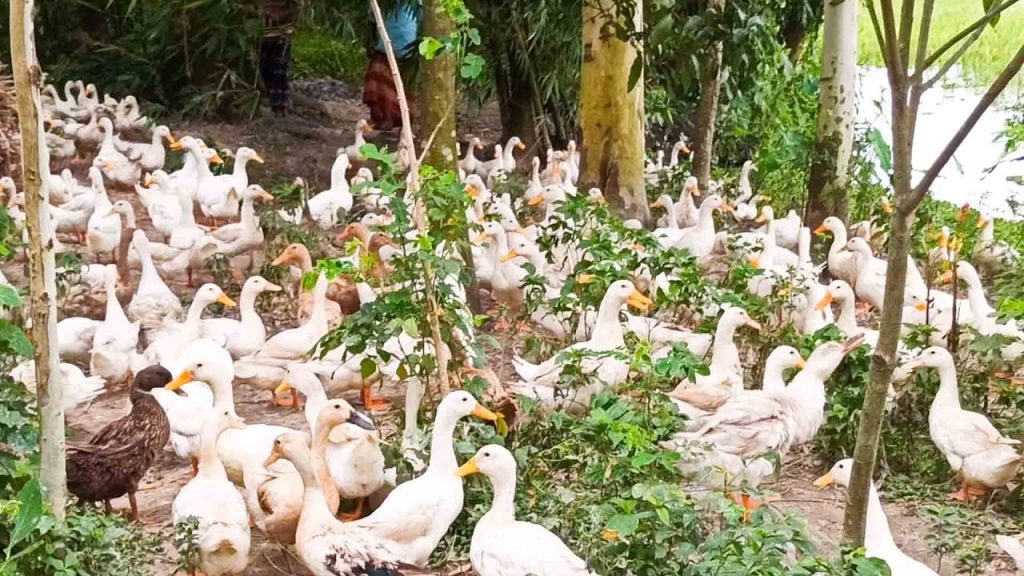
Duck rearing is a profitable business in the rural economy. It is best to start with a small farm and move to a commercial scale later. Layer ducks are kept for eggs, notably Khaki Campbell, Indian Runner and local deshi ducks, while other breeds are raised for meat.
Ducklings and water
Young ducklings should be let onto the water twice a day for at least an hour each time. Because ducks are greedy for natural food, they want to stay on the water all the time, but ducklings must not be kept in the water too long or they may catch cold. Adult ducks can swim for 8–10 hours a day.
Feeding
When feed is given dry, a water pot must always be kept alongside, because ducklings take food in the mouth and swallow it with water. This lets them grow smoothly. Later they can be fed home-made feed; with the right ingredients, ducklings grow properly. Home-made duck feed must include paddy, rice bran, broken rice, crushed wheat and wheat bran.
These should be mixed well before feeding. Crushed snails and mussels can also be given, though only in very small amounts to young ducklings. Improved breeds need little feed, usually eating 160–180 g a day. A duck's daily ration should be split into three, given in the morning, at midday and in the afternoon.
Domestic ducks come to eat when called with a set signal, and if fed at the same time each day they will turn up at exactly that time. Once ducks are fully grown, care is needed when releasing fish fry into the pond, as ducks catch and eat small fry. In that case adult ducks can be kept confined for about 15 days.
Laying ducks
Ducks of all breeds usually start laying at 22–23 weeks. They must be fed properly before laying begins, although their feed needs drop from about 15 days before they start to lay. Once laying, their feed needs rise, and if laying ducks are given nutritious food they keep laying for a long time.
Ducks usually lay very early in the morning, so they should not be let out of the house too early. Let them out a little later, or they may tend to lay in the water.
Eggs
A duck's first eggs are a little small but later reach normal size. Duck eggs are larger and heavier than hen's eggs. Feed should be given when collecting the morning's eggs, and any droppings on the eggs should be washed off with water after collection.
If a duck does not lay, she should be identified and removed from the flock, so the number of ducks and egg production must be watched regularly. Whether a duck will lay can be judged by feeling the egg sac by hand. If ducks are kept only for eggs, no drake is needed with them, but if eggs are to be hatched, one drake should be kept for every 7–8 ducks.
Source: Staff Correspondent. First published in Bengali on The Agro News.

Comments
(0)