
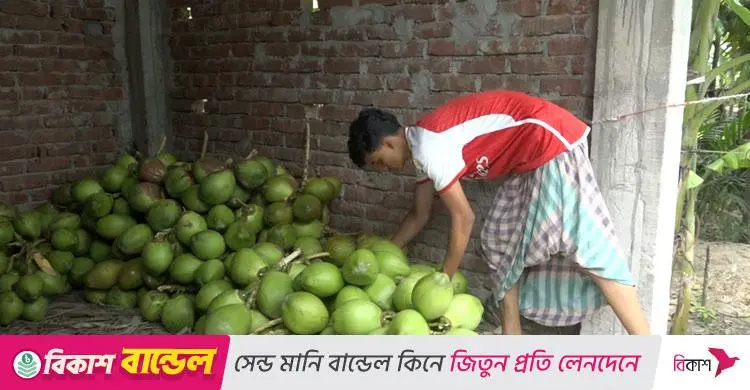
Nothing beats green coconut water for relief in the fierce heat, and demand has risen since the start of summer. As across the country, the green coconut market in Nesarabad upazila of Pirojpur is busy. Coconuts from here are valued nationwide for their sweet water, fine taste and attractive look. But people in the trade complain that although the region's coconuts sell at high prices in Dhaka and other divisional cities, they themselves do not get a fair price.
Green coconuts worth an average of Tk 5-7 lakh are traded in Nesarabad upazila every day. Local collectors, known as gachhis, go round the villages buying them. Ordinary coconuts are bought for Tk 40-45, and good-quality ones for up to Tk 60-70. The gachhis sell them to wholesalers at a profit of Tk 5-10.
Wholesalers send the coconuts by truck to Dhaka and other cities, where each sells for Tk 150-200. In other words, a coconut sold for Tk 50 in the village sells for three times as much in the city.
Middlemen at every step
People in the agriculture department say several layers of middlemen stand between production and the consumer. The gachhi, the wholesaler, the transporter and the city retailer each keep a share of the profit. Shop rent, labour costs, transport costs and higher demand in the heat also push up prices in the city.
Nesarabad coconut grower Jasim Sheikh said: "The coconuts we work hard to grow sell for Tk 200-300 in the city, yet we hand them to wholesalers for only Tk 50-60."
Md Mostafa, a gachhi by trade, said: "I go to the villages very early in the morning to buy coconuts. We pay whatever price is agreed with the owner of the coconut trees. When buying is done, they are brought to the wholesalers in the afternoon."
He said he buys coconuts from Mahmudkathi, Kuniari, Alonkarkathi, Banaripara, Raiyarhat and other places around Swarupkathi upazila.
Nuruzzaman, a coconut trader from Alonkarkathi village in the upazila, said wholesalers go from village to village buying 150 or 200 coconuts each and bring them to the wholesale market. The coconuts are then loaded on trucks and sent to Rajshahi, Chapainawabganj, Dhaka, Chattogram and other parts of the country.
Officials respond
The upazila nirbahi officer (UNO) of Nesarabad told Jagonews24 that the upazila plays a special role in meeting demand for green coconuts. The upazila administration is encouraging everyone to plant more coconut trees in their homestead yards, which will meet their own needs and make them financially self-reliant, the UNO said.
The UNO added that the Nesarabad upazila administration would give full support to anyone who sets up a coconut orchard.
Debashis Roy, assistant director of the Directorate of National Consumer Rights Protection in Pirojpur, said: "We have run drives on green coconuts before and will do so again. During the drives we will focus on how much coconuts are bought for and how much they are sold for."
Source: Jagonews24. First published in Bengali on The Agro News.


Comments
(0)