
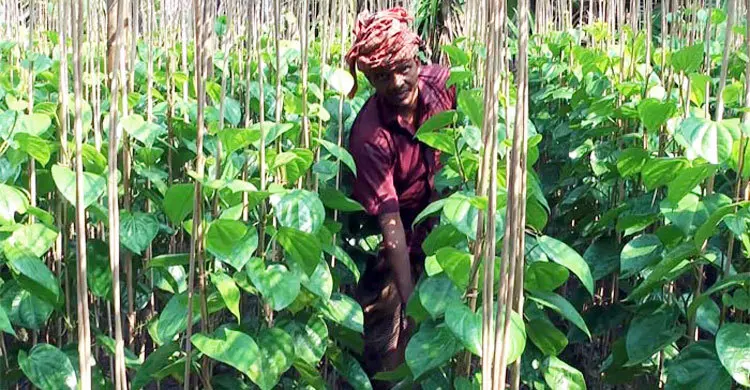
Farmers in Pirojpur are becoming self-reliant by growing betel leaf (paan). Because it costs little and pays well, interest in the crop is growing among farmers in this coastal district. Betel leaf has changed the fortunes of farmers in more than a hundred villages across three of the district's upazilas, and despite rot disease and other problems, the success has brought smiles to their faces.
Pirojpur's Bhandaria, Kawkhali and Nesarabad upazilas have been famous for betel leaf for about 30 years. Betel leaf is grown on 520 hectares in around 150 villages in these three upazilas. A kuri (20) of betel leaf sells for Tk 5,000–6,000 wholesale and retail. For three decades the leaf grown here has met local demand and then gone to the capital and other parts of the country.
Rivers and rot
Chittaranjan Halder, a grower from Kapalirhat village in Bhitabaria union of Bhandaria upazila, said they had done far better with betel leaf this year than in the previous few years. But in the peak season, water flows freely in from the district's Sandhya, Kocha and Baleswar rivers.
Chittaranjan Halder added that the currents of the three rivers submerge the betel vineyards even without any natural disaster. Although the rivers keep flowing, there are no sluice gates, so the vineyards often suffer from rot disease and other problems.
Abu Hena Md Jafar, deputy director of the district Department of Agricultural Extension (DAE), said: "In the district, farmers spend Tk 5–6 lakh an acre to grow BARI Paan-1 (Chaltha Doga) and BARI Paan-2 (Mohanoli). If there is no disease attack, the crop sells for Tk 10–12 lakh."
The district DAE expects 8,381 tonnes of betel leaf from 695 hectares this year. Farmers would profit more if the problems could be overcome, and action on that is urgently needed.
Source: Jagonews24. First published in Bengali on The Agro News.
Comments
(0)