
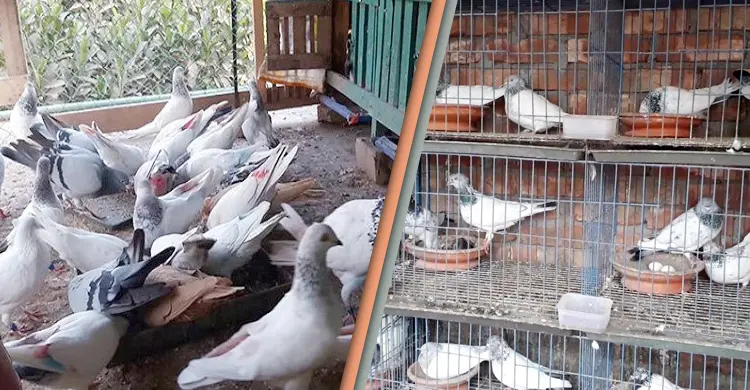
Many people keep pigeons as a hobby, and some in our country now rear them commercially. Pigeon rearing is playing a big part in reducing unemployment in particular. It does not need much space, chicks come quickly at low cost, and they fetch high prices on the market, so it is easy to earn an income from pigeons.
Rearing this profitable bird needs no special knowledge or training; a little supervision and care is enough. A pigeon produces two chicks a month, and chicks are ready for sale at 21 days. Best of all, unlike other birds, pigeons do not waste much feed. They can even be called a waste-free bird.
Breeds
There are many breeds of pigeon; it is said there are 600 breeds in the world. The Jalali pigeon is an improved local breed. Other notable breeds for meat production include White King, Texena, Silver King, Hamkachcha, Kaura, Homer, Gola, Dauka, Lakkha and Pakka.
In our country, pigeons such as Siraji, Mayurpankhi, Lahori, Fantail, Jacobin, Mukhi, Giribaj, Tumbler and Lotan are most often kept as a hobby. The Giribaj catches the eye by turning somersaults in flight.
Housing
You need to know how to build a pigeon house first. To stop predatory animals and birds from eating the pigeons, the house must be high and sturdy. It can easily be made from readily available materials such as light wood, bamboo and bamboo matting, thatch grass, polythene and straw.
One square foot of space is enough for each pair (one male and one female). Pigeon houses can be built several storeys high in the same place, which also saves money. A 5 to 6 inch veranda must be kept in front of each one-square-foot compartment so that pigeons can easily fly in from a distance to shelter and also feed. The door of each compartment should be 4 inches by 4 inches.
The house must always be kept clean and should be cleaned once a month. Straw should be kept near the house so that pigeons can easily collect it when laying eggs. The house must always be kept dry.
Feed
Pigeons' favourite foods are sorghum, maize, paddy, rice, pulses, foxtail millet, peas, grass pea, mustard and wheat. Each pigeon needs 35 to 60 grams of such feed a day.
Pigeon feed can also be bought on the market, but it must guarantee 15 to 16 percent protein. Feed should be placed in front of each compartment regularly in the morning and afternoon, along with enough water. A balanced pigeon feed can also be made at home. Per 100 grams of feed:
- broken maize 35 grams
- broken wheat 20 grams
- mustard seed 15 grams
- broken chickpea 20 grams
- broken soybean 5 grams
- rice bran 4.5 grams
- salt 0.5 grams
Diseases and treatment
Pigeons do not suffer from many diseases, but those that do occur include pox, cholera and bloody dysentery, known as coccidiosis. Worms can also attack them.
With pigeon pox, blisters appear on featherless parts of the body. Sores form inside the throat and the bird cannot eat. If the disease appears, tincture of iodine or Savlon can be applied to the affected bird's blisters. If pigeon pox vaccine is given by syringe into the breast or leg after plucking the feathers when the pigeon is four weeks old, it will not get pox.
With cholera, the pigeon's body temperature rises abnormally. It has difficulty breathing, becomes more thirsty, may pass frequent green or yellow droppings and loses weight. In the end the pigeon suddenly dies. As soon as cholera appears, an affected pigeon can be given Terramycin capsules or injection, or Cosumix Plus.
With bloody dysentery, or coccidiosis, the droppings contain blood. The bird loses its appetite and becomes weak, and finally its feathers droop. As soon as the disease appears, or if it is suspected, medicines such as ESB-3 or Embazin should be given mixed in water according to the instructions on the packet.
With worms, pigeons become weak and have diarrhoea. They become more thirsty and show anaemia. If pigeons are properly cared for, rearing them brings enjoyment as well as financial self-reliance.
Source: Jagonews24. First published in Bengali on The Agro News.

Comments
(0)