
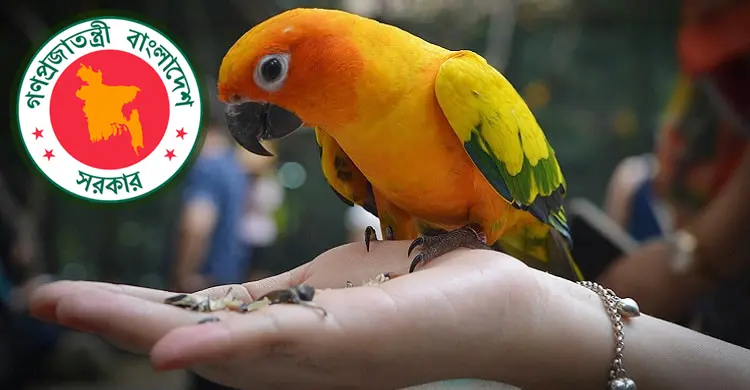
A licence will be needed to rear pet birds, set up a farm, buy and sell them, or import and export them. Anyone who does not take a licence faces up to one year in prison, a fine of up to Tk 50,000, or both.
The government has finalised the "Pet Bird Management Rules 2020" with these penalties. The Ministry of Environment, Forest and Climate Change issued the rules on 13 January.
The rules say no farmer may produce, rear, farm, buy, sell, import or export pet birds without a licence, and no pet shop may buy or sell pet birds without one.
People who keep pet birds as a hobby at home or at an institution, with no more than 10 birds, are defined in the rules as hobbyist pet bird keepers.
Asked about the rules, Md Billal Hossain, additional secretary at the Ministry of Environment, Forest and Climate Change, told Jago News: "Everyone must now follow these rules in managing pet birds. They were made after taking the views of and talking with everyone concerned."
Anyone who was rearing pet birds, running a farm, importing or exporting, or running a pet shop before the rules took effect must obtain a licence within 60 days of the rules coming into force.
Licences and possession certificates
Each licence will be valid for one year and must then be renewed. Licences will be issued by the chief warden (the chief conservator of forests) or another officer authorised by him.
On receiving a renewal application, the authority will, through a subordinate officer, verify the information given and inspect on the spot whether the space, cage size and rearing conditions are suitable for the number of birds, before renewing the licence.
After obtaining a licence through the Forest Department, a farmer must register the farm with the CITES headquarters before exporting or re-exporting pet birds listed under CITES (the Convention on International Trade in Endangered Species of Wild Fauna and Flora), the rules say.
Once licensed, a farmer may not own or hold any bird without a possession certificate (a certificate of ownership of pet birds). A fixed annual fee must be paid for each bird for the possession certificate, which will be issued for one year. The farmer's sales receipt must carry the number of an up-to-date possession certificate, and the certificate must also be renewed every year.
The government may suspend or cancel a licence at any time. If a farm's licence is cancelled, its possession certificates are automatically cancelled.
Fees
Under the rules, a pet bird farmer must pay Tk 10,000 for a licence. The renewal fee is 25 per cent of the licence fee, and the processing fee is Tk 2,000. The annual possession fee is also Tk 2,000, and the possession certificate renewal fee is 25 per cent of the possession fee.
For pet shops, the licence and processing fee is Tk 500, and the annual possession fee is Tk 2,000.
Although the draft required hobbyists to take a licence, this was dropped from the final rules, so hobbyist pet bird keepers will not need a licence.
Conditions for hobbyists and farms
Whether birds are kept as a hobby or on a farm, the cage for each pet bird species must meet the size set by the government. The rules specify the cage size for different numbers of birds.
The rules say every cage on a farm must have separate containers for enough feed, mineral salt and water, and an adequate supply of safe drinking water and balanced feed must be ensured.
Regular vaccination must be ensured to protect the health of every pet bird and every farm worker. When chicks hatch on a farm, they must be fitted with leg rings and the licensing authority informed of the ring numbers.
Pet birds may not be released into the wild under any circumstances. The remains of dead pet birds must be buried. Licensed farmers may hold pet bird shows once or more a year through the relevant registered trade association.
Import and export
To import or export pet birds not listed in the CITES appendices (birds that are not endangered), a farmer or importer must apply to the Forest Department for a no-objection certificate. The additional warden will issue the certificate after the chief warden's approval and collection of revenue and VAT.
A CITES permit must be obtained to export pet birds. Pet birds must be imported, exported or re-exported through Hazrat Shahjalal International Airport, and the licensing authority must be informed of the ring numbers of all imported birds.
Every farmer must keep a register of increases and decreases in bird numbers and of imports and exports. Likewise, every pet shop operator must keep a register of birds bought and sold and of chicks hatched. A copy of the register must be sent to the relevant warden's office by January of the following year.
When a bird is born or dies, the farmer must, within 10 days at most, submit a report with a birth or death certificate issued by a registered veterinary surgeon of the relevant warden's office.
Every licence holder must keep information in the prescribed register and show it on demand to any inspecting officer.
Any officer authorised by the Ministry of Environment, Forest and Climate Change, or the licensing authority, may inspect a pet bird farm at any time without prior notice and may take action if any rule is found to be broken.
Offences and penalties
The rules say setting up a pet bird farm or running a pet shop without a licence will be an offence, and a farm may not be run after its licence is cancelled. Failing to keep a register, or to show it to an inspecting officer, will also be treated as an offence.
Failing to take or renew a licence, keep a register or provide information to an inspecting officer carries up to one year in prison, a fine of up to Tk 50,000, or both. A repeat offence carries up to two years in prison, a fine of up to Tk 1 lakh, or both.
Source: Jagonews24. First published in Bengali on The Agro News.

Comments
(0)