
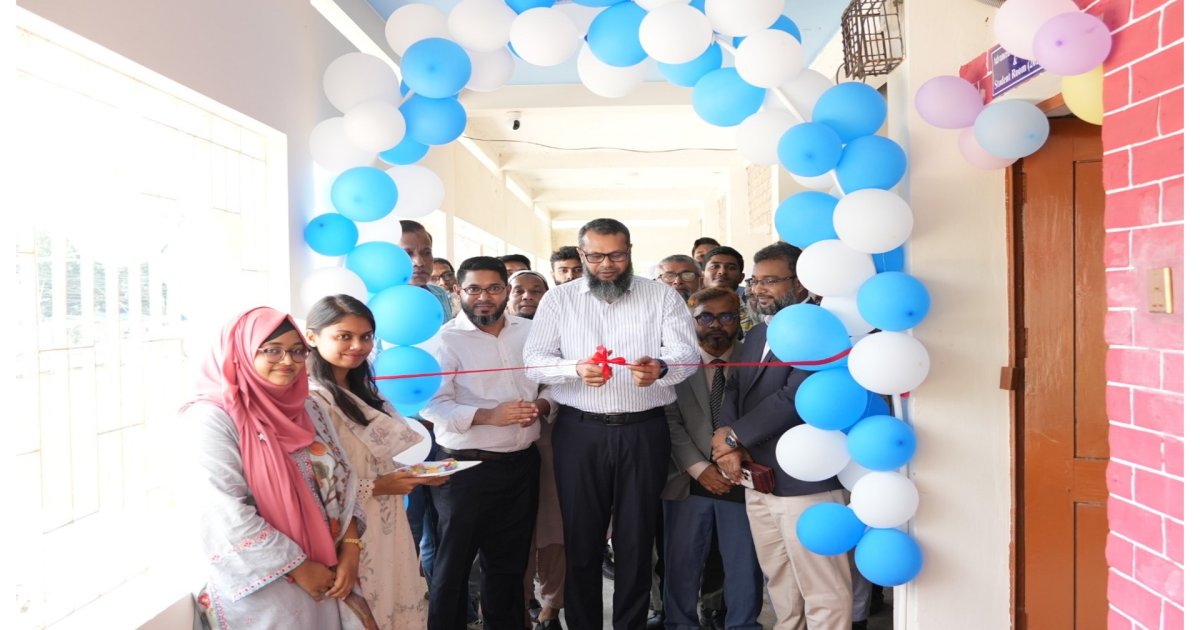
Patuakhali Science and Technology University (PSTU) has opened two modern laboratories to check the quality and safety of fish and seafood and detect adulteration quickly, using fluorescence fingerprinting and chemometrics to analyse samples in a short time.
Conventional methods of testing seafood and aquatic food quality, and of detecting microplastics, involve many steps of sample preparation and take time and labour; finding microplastics can take one to two weeks. Fingerprinting-based technology, those involved say, can analyse a sample's chemical and physical properties in seconds to minutes, and can also detect adulterants with simple sample preparation.
The new Advanced Analytical Laboratory has about 15 kinds of equipment, including a fluorescence fingerprinting instrument and Fourier-transform infrared (FTIR) spectroscopy, to assess freshness, quality, chemical change and authenticity quickly. Part of the Seafood Processing, Quality and Safety Laboratory in the Faculty of Fisheries has also been refurbished and modernised.
Vice-chancellor Professor Dr S M Hemayet Jahan opened the labs on Sunday, 27 September. The research is led by Professor Dr Md Mizanur Rahman, chairman of the Fisheries Technology department, under a HEAT sub-project jointly funded by the World Bank and the University Grants Commission of Bangladesh, and aims at a rapid, non-invasive and eco-friendly method for seafood quality and safety analysis.
Pro-vice-chancellor Professor Dr A B M Saiful Islam and treasurer Professor Dr Mohammad Atiqur Rahman attended. Guests toured the labs as Professor Mizanur Rahman explained the equipment, sample preparation and analysis.
Faster, reliable quality checks could help coastal fishers, processors and exporters guarantee the safety of fish and seafood, those involved hope. The report is by Desh Rupantor's correspondent in Dumki, Patuakhali.
Source: Desh Rupantor


Comments
(0)