
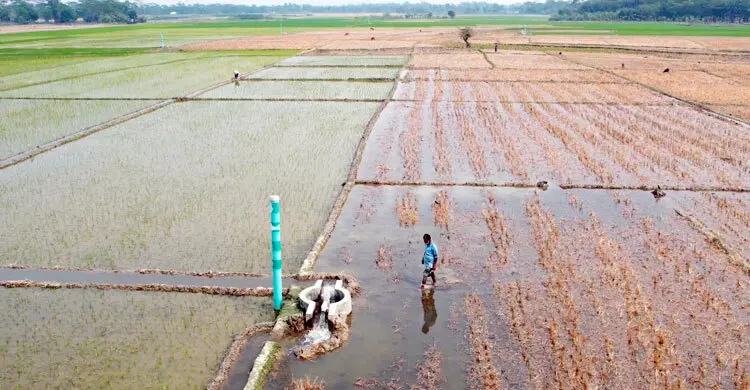
Boro rice cultivation is growing steadily in Patuakhali. With improved varieties and the necessary inputs easily available, farmers are turning to boro. The agriculture department says farmers are expanding their cultivated area because of good yields and prices, and if the trend continues, coastal farmers will prosper in rice production.
Because of global factors such as storms, tidal surges and climate change, farmers in coastal areas always live at risk. In recent years, however, they have been getting good yields by using new varieties and technology.
In Patuakhali and the rest of the south, farmers usually grow aman rice on all their land but had little interest in boro. Recently, with several salt-tolerant high-yielding rice varieties released and new irrigation opportunities, they are becoming interested. Farmers are now busy day and night transplanting seedlings.
Busy fields in Kalapara
In Kumirmara village of Nilganj union in Kalapara upazila, acre after acre of land has been planted with boro. Some farmers are ploughing, others are busy planting. As it is the last stage of boro planting, farmers barely have time to breathe.
Several farmers of the village said they did not grow boro before but do now, mainly because boro yields well and fetches a good price. Irrigation facilities and enough fresh water in the canals also allow them to irrigate their land properly.
Md Nazrul Islam, deputy director of the Department of Agricultural Extension (DAE) in Patuakhali, said boro was grown on 18,373 hectares in the district last year, and this year it could be grown on about 25,000 hectares. Rice has already been planted on 15,000 hectares.
He said farmers are mostly using HYV (ufshi) and hybrid varieties this season, especially Yuvraj and ACI seed. If they get good prices this year, they will expand boro cultivation further, he added.
The district has 203,000 hectares of cultivable land in total, but much of it has to be left fallow in the dry season because of salinity and a lack of irrigation.
Source: Jagonews24. First published in Bengali on The Agro News.
Comments
(0)