
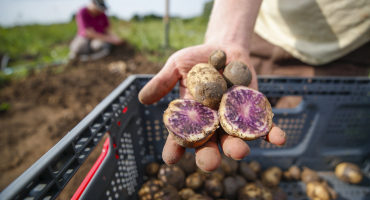
A bright purple potato bred at the University of Minnesota is winning interest from growers, chefs and shoppers in the state, though its breeders expect it to make its way through farmers markets and restaurant kitchens rather than supermarket shelves.
Paisley Purple was first developed by Christian Thill, who led the university's potato research programme. Laura Shannon, associate professor in the Department of Horticultural Science, inherited his samples when she took over the breeding programme in 2017 and kept working on the variety. Its main appeal is that it holds its purple colour after cooking, and it has shown promise for colourful crisps.
When Shannon asked Minnesota growers whether they would produce it, some liked it as food but were not ready to grow it on a large commercial scale. "We think that its future is probably with organic farmers and local restaurants," she said.
It is already in the ground and on plates around the Twin Cities: Alma restaurant and chef Maggie Whelan have used it, Tha Cha and his sister grow it on their farm in Rosemount, and it is produced by the Student Organic Farm on the St. Paul campus and the Minnesota Landscape Arboretum. In autumn it can be found at the St. Paul Farmers Market and the Student Organic Farm market.
The name nods to Minnesota; Shannon considered Purple Rain, but European breeders had taken it. The tubers are deep purple with yellowish swirls, smaller ones mostly purple and larger ones mixed with white. She describes it as "like Honeycrisp, but for potatoes", after the university's famous apple, while not expecting it to reach that scale.
The programme evaluates about 20,000 potato varieties a year for flavour, appearance, yield, disease resistance and performance. One promising line, MN19AF6945-003, is round, yellow, dense and high-yielding, resists bruising and some diseases, and has been tested in soups and as a chip by a Minneapolis restaurant.
For small farms selling direct, a distinctive variety like this offers something large grocery chains do not stock — a reason for customers to buy from the grower.
The account draws on an article by Rick Moore of the University of Minnesota.
Source: Farms.com

Comments
(0)