
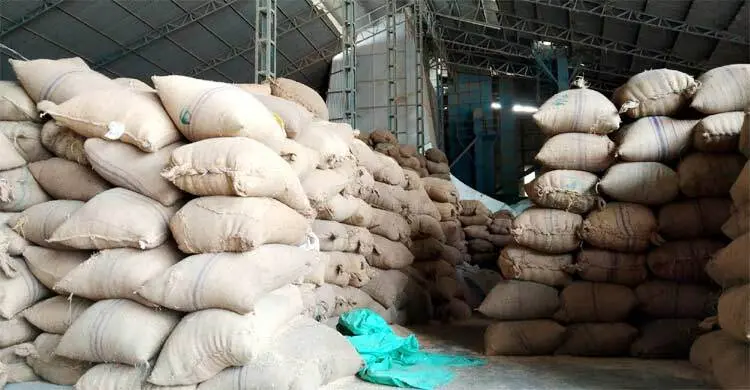
Prime Minister Sheikh Hasina has told parliament that the paddy stockholding limit for each mill has been reduced from five times to three times its fortnightly milling capacity so that dishonest business syndicates cannot control the food market by creating artificial shortages. Because of this amendment, paddy supply in the market is now normal and illegal hoarding is being prevented, she said.
She gave the information on 28 February during question time in the Jatiya Sangsad, in reply to a written question from Ali Azam, MP for Bhola-2. Speaker Dr Shirin Sharmin Chaudhury presided.
OMS sales and family cards
On rice stocks, she said the original budget for 2023-24 provides 400,000 tonnes of rice for OMS (open market sales). Every day 867 tonnes of rice and 1,097 tonnes of flour are sold across the country through OMS. Five ministries have held inter-ministerial meetings and set various strategies to control the market. Under the TCB family card programme, 50,000 tonnes of rice a month are being distributed at subsidised prices, 5 kg each to 10 million families, along with 2 kg of lentils and 2 kg of soybean oil at affordable prices. The commerce and agriculture ministries are working together on seasonal duties where needed to boost supply during lean periods without stopping imports, to keep farm product prices stable. Food-friendly programmes are also being run to ease the impact of inflation on poor and low-income people.
Sheikh Hasina said OMS rice is being sold to low-income people at Tk 15 a kg under the food-friendly programme, and at Tk 30 a kg in city corporations, municipalities and district towns. Subsidies and incentives for agriculture cut farmers' production costs and indirectly help keep farm prices down. Tk 17,000 crore has been allocated for agricultural subsidies and incentives in 2023-24.
Mill inspections and rice sack labels
On dishonest syndicates, she said the stock limit was cut to stop them creating artificial shortages. Since the amendment, paddy supply has been normal and illegal hoarding is being checked. Warehouses of rice mill owners and grain traders are being inspected regularly. It has also been decided that auto rice mills must print the paddy variety, the mill's name and address, net weight, production date and the mill-gate price on rice sacks.
She said social safety net programmes have been expanded to protect the poor, and 29 percent of the country's households are now covered. Tk 1,26,272 crore, or 16.58 percent of the total budget, has been allocated to social safety nets in 2023-24. Against the backdrop of Covid-19 and subsequent wars destabilising global supply chains, a proposal has been sent to India, Bangladesh's largest supplier of essential goods, to fix specific annual quotas for possible imports to meet any food security crisis. Work is under way on a memorandum of understanding (MoU) between the two countries. Once signed, it will ensure a fixed annual supply of essentials such as rice, wheat, sugar, lentils, onions, garlic and ginger from India.
The head of government expressed hope that these steps would bring relief to poor families, the elderly, widows, women abandoned by their husbands and other low-income people, keep inflation tolerable during the holy month of Ramadan and rein in the prices of daily essentials.
Source: Jagonews24. First published in Bengali on The Agro News.
Comments
(0)