
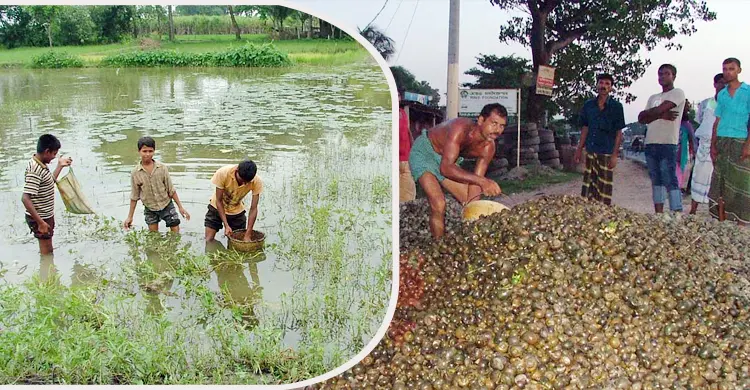
At least 10,000 people in areas of Pabna dotted with wetlands such as Chalan Beel, Beel Gajna, Beel Gyarka and Ghughudah Beel are earning extra income by collecting snails. With little work during the monsoon, the snails bring them some earnings.
The snails they collect go to shrimp farms (gher) in Khulna division. The district fisheries office says Pabna has an abundance of snails because it is a wetland area. Snails are used as feed for fish and ducks, but to protect biodiversity they should be collected in moderation rather than wiped out.
A seasonal trade
Abdul Majid of Khan Mahmudpur, a leading snail trader (mahajan) in Santhia upazila of Pabna, said he has been in the snail business for 25 years. Twenty-five years ago shrimp farm owners came from Khulna and made agreements with them, and he has run the seasonal trade ever since.
He now buys Tk 1 lakh to 1.5 lakh worth of snails a month and sends them to shrimp farms. Besides several traders like him, there are about 400 foria (small middlemen) across Pabna who collect snails and sell to them. Counting the collectors working under the forias, at least 10,000 people gather snails, he said.
Abdul Majid said large traders like him send the snails by truck to the shrimp-farming areas of the south: Satkhira, Bagerhat and Khulna. Temporary depots have been set up at Santhia, Bongram, Kuchiamora and Bagchipara in Pabna Sadar, various places in Faridpur upazila, Chatmohar, Muladuli in Ishwardi, Rajapur, Gopalpur, Chandai, Dasgram, Kadimchilan, Atgharia, Garmati, Majhgram, Kachhimpur, Ramnathpur, Maheshwar Kujipukur, Kalasnagar, Dikshi Beel in Atgharia upazila, the Bara Beel of Sonagadan in Bhangura upazila, Bheramara and elsewhere.
He said four trucks carry 1,000 sacks of snails from Pabna to the Khulna region every day, each truck holding 250 sacks. By that reckoning, Tk 4 lakh worth of snails is shipped south from Pabna daily, and at least Tk 5 to 6 crore worth over five months.
They buy each sack for Tk 250–350 depending on the size of the snails. With the cost of sacks and labour, a sack comes to Tk 400. After truck fares, labour and food, they make a profit of Tk 20–30 a sack.
Snail collection and supply run from the Bengali month of Ashar to Kartik, he said. Traders agree supply terms with the forias in advance, and the forias sign up local people, who collect snails all day and sell them to the forias.
Collectors, middlemen and van drivers
Nur Islam, a foria from Gourigram in Santhia upazila, said he has been in the snail trade for 18 years. He buys snails from the Bara Beel, Chhoto Beel and Motka Beel areas of Santhia, and 20–25 collectors work under him. Like him, every foria has bought small dinghies for the collectors.
On the banks of Beel Gyarka, several snail collectors spoke to the reporter. One of them, Abdul Kader (55), said he sets out in a dinghy at 3am and returns by midday, collecting about a sack and a half. The collectors said they have little other work at this time of year, so they earn some money this way.
Saheb Ali, a foria in the Beel Gyarka area, said he has 20–25 collectors under contract who sell snails to him. He carries the snails by van to the traders on the highway. Many people take up the work because they are partly out of work in the rainy season; he profits and so do many poor people, he said.
Rana Hossain, a van driver in Santhia, said he profits from carrying snails. More than 50 van drivers like him work in the upazila, earning Tk 25 for each sack carried. He carries 15–18 sacks a trip, and for a few months of the year they earn well.
A large snail depot has grown up at Muladuli bazar in Ishwardi upazila, where traders collect 200 to 300 sacks a day. Snail collector Ramjan Sheikh said farming stops during the rains, leaving them without work, so they collect snails with the help of local traders to survive. Each collector earns Tk 400 to 500 a day.
Sirajul Islam, a snail trader in Ishwardi, said they buy snails from the Ishwardi depot and sell them in the Khulna region, making Tk 20–30 a sack. A collector can gather Tk 400–500 worth of snails a day on average.
Local traders Abdur Rahim and Dulal Uddin said they buy snails and supply them to the shrimp-farming areas of Satkhira, Bagerhat and Khulna. Ashraf Sheikh, a snail wholesaler in Ishwardi, said people from across Ishwardi upazila and neighbouring areas sell him several hundred sacks a day, and many have taken up snail collecting as a seasonal occupation.
Traders said the snail business has been running in Ishwardi for about 12 years. Abdus Samad, a former Union Parishad member, said many people in the area now earn some extra money by collecting snails.
Call to protect biodiversity
Tozammel Hossain, associate professor of zoology at Government Edward College, Pabna, said snails and mussels breed in open waters, especially canals, beels, haors and baors. They purify water by eating insects in dirty water. Snails and mussels are the farmer's friends and quietly do us good. As the water recedes at the end of the monsoon most of them die, and then they help increase the fertility of farmland.
Pabna district fisheries officer Abul Kalam Azad said Pabna is a district of beels with plenty of snails and mussels. Nobody generally collects mussels now, only snails, and many poor people earn extra money during the monsoon months this way.
Because snails are good for the environment and for farming, everyone should be careful when collecting them, he said. Rather than stripping whole beels of snails, only small quantities should be taken; that will protect biodiversity.
Source: Jagonews24. First published in Bengali on The Agro News.

Comments
(0)