
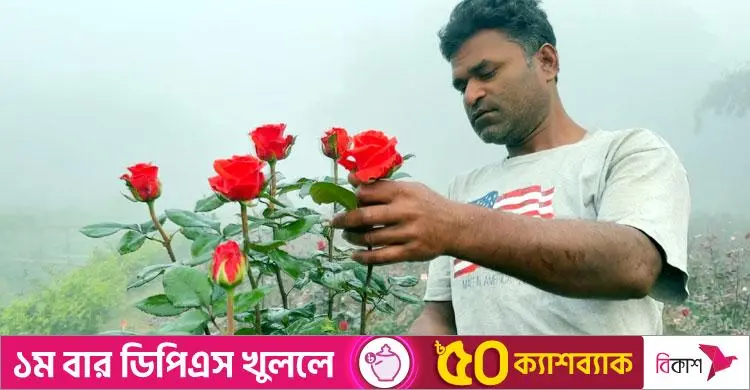
Even five years ago there were no commercial flower gardens in Pabna district; now commercial flower gardens have been set up on several hectares. Three brothers from Bhajendrapur in Tebunia, who suffered repeated losses on vegetables and other crops, have found great success with a rose garden. They hope to sell Tk 5 lakh worth of roses this month around Valentine's Day.
The three brothers are Khandaker Shariful Alam Rana, Khandaker Ashraful Haque Shahin and Jafrullah. Their ancestral land in Bhajendrapur was a bamboo grove, while vegetables and other crops were grown on their other land. They could not change their fortunes; instead, they suffered repeated losses on vegetables. The eldest brother, Shariful Alam Rana, who has long been involved with nurseries in Dhaka, then suggested a rose garden. Drawing on his experience and knowledge, the bamboo grove was cleared and one and a half bigha prepared for roses. Ten thousand seedlings were brought from India and from Jashore, Savar and other parts of the country and planted.
From one and a half bigha to three gardens
Good production and prices from the start raised the brothers' interest. With proper care, the profits and success grew and so did the garden. The one and a half bigha has become three gardens covering 4 bigha. At first they tended it themselves, but now at least five labourers work there all year round. The gardens have seven varieties of rose, including Jumulia, Beauty, Virgo and Bombom, in red, shade pink, orange, yellow and white.
Yunuf, who looks after the garden and its marketing, said there is some demand for roses all year round. In a normal month, an average of Tk 1.5 to 2 lakh worth of roses is sold, against monthly costs of Tk 70,000 to 80,000. Demand and prices start rising from late November, demand is huge from December to February, and in February it is enormous. So the garden needs extra care ahead of this month.
He said 100 roses have been selling for Tk 2,000 to 2,500 through the week. With Valentine's Day approaching, the price will rise within a day or two to Tk 3,500 to 5,000 per 100 roses. On that basis, they hope to sell Tk 4 to 5 lakh worth of flowers this month.
Sakib, son of garden owner Khandaker Shariful Alam Rana, has come to work in the garden. Alongside his studies, he regularly helps his father and uncles with the rose garden. He said: "Flowers are picked every other day. In winter, 2,500 to 4,000 stems are picked. Even in the leanest season, 1,200 to 1,500 are picked. With Valentine's Day and other special days in February, demand for flowers has risen, and so has the work in the garden."
New jobs
Because there has been no pest or disease attack so far, the garden owners are making good profits. Growing interest is expanding the gardens and creating new jobs, and the gardens have been a blessing for labourers too. Garden worker Mosharraf Hossain said: "Everything is now done by machine, so the need for labour is falling. Meanwhile, these gardens have increased our job opportunities. I work for a salary of Tk 15,000 a month. I cut roses every other day, and from time to time I loosen the soil, apply fertiliser and pesticide, irrigate, cut buds and do all the other care work in the garden."
The district agriculture department said there were hardly any commercial flower gardens in the district even about five years ago, but they have increased over the last few years. Rose gardens are most common in several upazilas, including Pabna Sadar, Sujanagar, Chatmohar and Atgharia. Inspired by their success, entrepreneurs in other upazilas are also being encouraged to set up gardens. Flower gardens now cover 12 hectares in the district, of which 2 hectares are rose gardens, and the area is growing over time.
Md Rokonuzzaman, additional deputy director of the district Department of Agricultural Extension (DAE), said: "Commercial rose cultivation has started on an initial basis in several upazilas, and growers are making good profits, about Tk 2 to 2.5 lakh an acre. That is why many are being encouraged to grow roses. The agriculture department sees this as a very positive development. Field staff have been instructed and are giving farmers the advice they need in the field. Like the three brothers of Bhajendrapur, others will also find great success with roses."
Source: Jagonews24. First published in Bengali on The Agro News.
Comments
(0)