
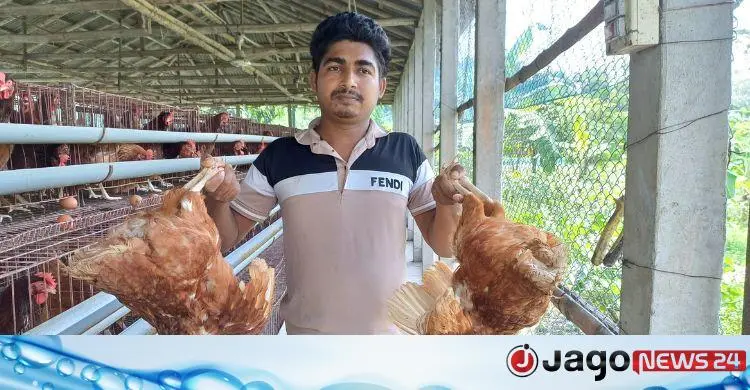
A severe heatwave, and on top of it five to seven hours of load-shedding at a stretch. With too little light and air inside the sheds, chickens weighing two and a half kilograms or more are suddenly collapsing and dying from breathing trouble, heat stroke and other causes. More than a hundred have died this way on the farm of Abu Raihan, a broiler farmer in Boroichara village of Ishwardi.
He said seven, five and six chickens died on Wednesday and the two days before it respectively in the continuous heat. Over the past eight to 10 days, a total of 120 chickens on his farm died from heat stroke and heat. With about 300 kg of birds averaging two and a half kilograms lost, he suffered a loss of Tk 46,500 at a stroke.
Raihan said: "Seeing deaths like this every day, I panicked and was forced to sell all the remaining chickens on the farm last Thursday. Unless the power supply returns to normal, I cannot stock new chickens."
A crisis across the district
His plight is not an isolated case; the same distress is found among poultry farmers across Pabna district. Farmers were already struggling with runaway feed and medicine prices and one infectious disease after another. Severe load-shedding, the new blow, threatens to ruin them completely.
People in the livestock and poultry sector say the prices of poultry feed, chicks, essential medicines and vaccines have risen several times over in the past two to three years. Feed that cost Tk 2,400 two or three years ago now costs Tk 3,400, and medicine costs have risen by a similar amount.
Even as production costs rise, outbreaks of Ranikhet (Newcastle disease) and other infectious diseases are frequent. Just as farmers try to recover from these setbacks, continuous load-shedding is taking away what little they have left.
Generators push up costs
Those in the poultry trade say uninterrupted electricity is essential for supplying feed and water to broilers and layers, keeping the right temperature and ensuring enough light and ventilation. Without it, chickens suffer breathing trouble from lack of oxygen and die of sudden heat stroke. Using generators or IPS units as an alternative has pushed farmers' production costs up several times.
Md Akmal, general secretary of the Pabna District Poultry Association, said running a generator costs Tk 200 an hour, an extra Tk 800 to 1,000 a day. As a result, many small farmers are forced to sell birds early at low prices, and some are shutting their farms altogether.
At layer farmer Wasim's farm at Mahmudpur Bazar in Maligachha union of Pabna Sadar upazila, only about a thousand of 3,300 hens now survive. Nazmul, who runs the farm, said the hens are eating less because of load-shedding, disease is rising and egg production has fallen sharply. A thousand hens used to give 32 to 35 khanchi (trays) of eggs a day; now it is 24 to 26. To avoid losses the owner was forced to sell 2,200 to 2,400 birds cheaply, getting only Tk 350 to 400 for birds worth Tk 500 to 550.
Nazma Begum of Shanikdiar in Hemayetpur union said that in 28 days, 100 of her 360 grown chickens died from heat and disease, costing her Tk 30,000 to 40,000. To pay off debts she has had to take one loan instalment on top of another.
Two-thirds of farms closed
According to the district livestock department, Pabna now has 1,421 layer farms, 1,018 broiler farms and 604 Sonali chicken farms, registered and unregistered, a total of 3,043 poultry farms in operation. Only five years ago the number was close to 10,000. About two-thirds of the farms have already closed after continuous losses from various crises.
Farmers say that to save the poultry sector, the power supply must be given special priority now. Without government oversight to control feed and medicine prices and loans on easy terms, they warn, the country's egg and meat market will face disaster.
Abdullah Al Amin Chowdhury, general manager of Pabna Palli Bidyut Samity-1, said demand during the recent hot days was 70 to 75 megawatts, against which 25 to 30 per cent load-shedding had to be imposed. But he said the crisis has eased since Thursday as an equivalent amount of power has been allocated.
Pabna District Livestock Officer Dr Zahurul Islam said farmers are being advised to use saline and betaine-type medicines to protect chickens from heat stroke. The government is planning to subsidise electricity for the poultry sector, and recommendations for subsidies on feed and medicine have been sent to higher authorities. If this support is implemented quickly, he hoped, farmers will be able to recover.
Source: Jagonews24. First published in Bengali on The Agro News.
Comments
(0)