
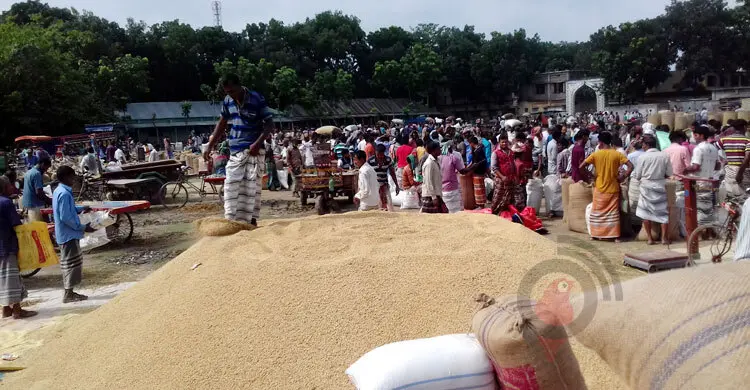
Farmers in Pabna are frustrated with the price paddy is selling for now, because after production costs they are left with no profit. Many farmers are turning away from rice, and those involved fear paddy production in Pabna will fall in the coming years.
District food department officials say they were able to buy very little paddy at the government rate, because farmers could sell it in the market for more than the government price.
Boro area shrinking since 2016
Boro cultivation in Pabna has been falling since 2016 as profits from rice have declined. According to the district Department of Agricultural Extension (DAE), boro was grown on 60,355 hectares in 2016-17, falling to 58,055 hectares in 2017-18. The target for 2019-20 was set at 58,270 hectares, and in the latest year, 2021-22, boro was grown on 53,975 hectares.
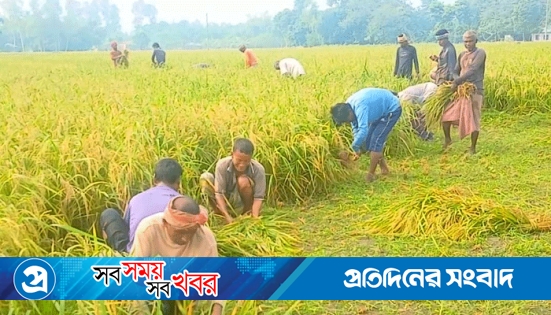
Farmers in the "Boro Bil" area of Pabna's Faridpur upazila, known as a kingdom of paddy, say water shortages in recent years have left more empty grains in the crop, cutting yields. Growing paddy with irrigation has also raised costs and pushed them into losses.
Malek Biswas, a farmer in the Boro Bil area, said they are not getting the yield per bigha their land should give, nor a price at the market in line with their costs, so they are losing on both counts.
Sagor Hossain, a farmer on the banks of Bil Garka in Santhia, said he will not grow paddy next year and will plant chillies if necessary. After spending so much money and effort, he said, growers are not even recovering their outlay.
Prices at Bongram hat
On Saturday (17 September), at Bongram hat, one of Pabna's biggest markets, boro paddy was selling at Tk 1,300 to Tk 1,350 a maund, and the slightly finer BRRI dhan28 and 29 at Tk 1,450 a maund.
Hasen Ali of Chinakhara, who came to sell paddy, said Tk 50 goes on transport and market toll just to bring one maund to the hat. "Selling paddy does not even pay for salt. Diesel, fertiliser and pesticide prices have gone up, and labour costs have risen. How will we survive?"
Another farmer, Rafiqul Sekh, said the government's fuel price rise has increased cultivation costs, along with fertiliser, pesticide and labour. "Selling paddy at Tk 1,200 a maund leaves no profit. It costs Tk 1,200 just to produce a maund. I cannot explain how hard it was to bring this paddy from the bil."
A Rashid, a farmer from Bamondanga in Santhia upazila, said growing paddy on one bigha now costs Tk 10,000, and a sharecropper pays the owner another Tk 7,000. By his reckoning it costs about Tk 1,200 to grow a maund, while the government is paying Tk 1,040 a maund. Selling at that price means a loss for the farmer.
Hafizur Rahman Kalu of Padmabila village said he used to grow paddy on 10 bighas of his own land every transplanted aman season. This time, with the rise in fuel, fertiliser and pesticide prices and labour wages, he did not grow paddy at all.
Siddiqur Rahman Moyej, a farmer from Boroichara village in Ishwardi upazila, claimed that farmers are getting neither easy access to diesel, fertiliser and pesticide, nor uninterrupted electricity, nor favourable weather. As a result, costs are rising and yields falling, yet farmers are getting low prices.
Procurement target missed
Pabna district food controller Tanvir Rahman said the food ministry had decided to buy boro paddy at Tk 27 a kg, with a procurement target of 7,774 tonnes. They managed to buy only 524 tonnes. He said the government rate was good, but farmers sold in the market because they got an even better price there.
Source: Jagonews24. First published in Bengali on The Agro News.
Comments
(0)