
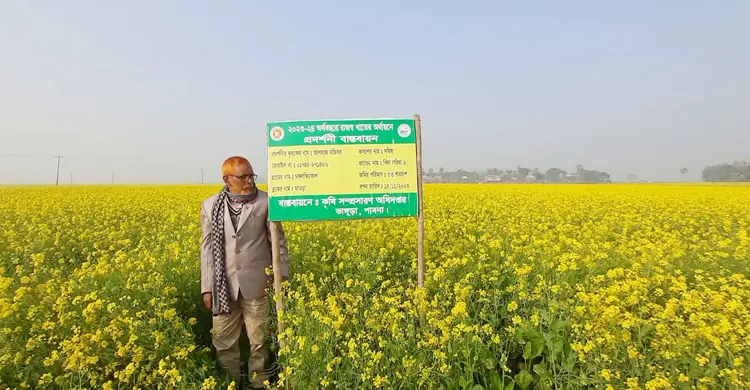
A change in cropping pattern in three upazilas of Pabna in the Chalan Beel area has brought fallow land under mustard. Farmers have profited from an extra crop grown in a short time, and honey and edible oil production are also rising. The agriculture department says farmers are being given proper advice and guidance on crop care.
Chatmohar, Bhangura and Faridpur are the three Pabna upazilas in the Chalan Beel area. Land along the beels and beside roads here used to lie idle in the gap between two crops. This year local people have made a striking change by growing mustard on that uncultivated or fallow land. Agriculture officials advised them to grow improved mustard varieties as a short-duration crop.
The Department of Agricultural Extension (DAE) says mustard was grown on 45,000 hectares across Pabna's nine upazilas this year, against 35,000 hectares last year, a rise of 10,000 hectares or 70,000 bigha in one year. Many demonstration plots were set up to encourage mustard cultivation, and farmers were given support with various inputs.
Filling the gap before boro
Local people said that on most of the low-lying beel land, boro rice is transplanted after the monsoon water recedes. Before that, the land lies uncultivated for about two to three months. Agriculture officials advised farmers not to leave the land fallow but to grow a crop that can be harvested quickly, and encouraged them to grow improved mustard. To make up for losses on aman and to gain an extra crop, farmers grew the high-yielding varieties BARI-14, BARI-18 and BINA-9. This year mustard was grown over a wide area stretching from Ershadnagar in Faridpur upazila to Koidanga in Bhangura upazila.
Jahangir Alam, a farmer from Nimaichara village in Chatmohar upazila, said they used to farm in the traditional way. Agriculture workers advised them to change their method and to grow a quick-maturing mustard variety between the retreat of the monsoon water and the planting of boro. Following this method, they have made a good profit.
Mofazzal Hossain of Sonahara village in Faridpur upazila said the crop is ready within just 80 to 85 days of sowing. Because it pays, mustard cultivation has taken off in a big way, he said.
Sharmin Jahan, agriculture officer of Bhangura upazila, said mustard has given the beel landscape a new look. Mustard is being grown as an extra crop in the Chalan Beel area by changing the cropping pattern, and they are expecting good production.
Dr Md Jamal Uddin, deputy director of the DAE in Pabna, said the Ministry of Agriculture has set a target to increase mustard cultivation. To achieve it, through the efforts of the district's agriculture department, mustard has been grown after the transplanted aman harvest on wide stretches of beel land and on fallow land by the roads. If farmers get good yields and prices, they will become even more interested, he said.
Source: Jagonews24. First published in Bengali on The Agro News.


Comments
(0)