
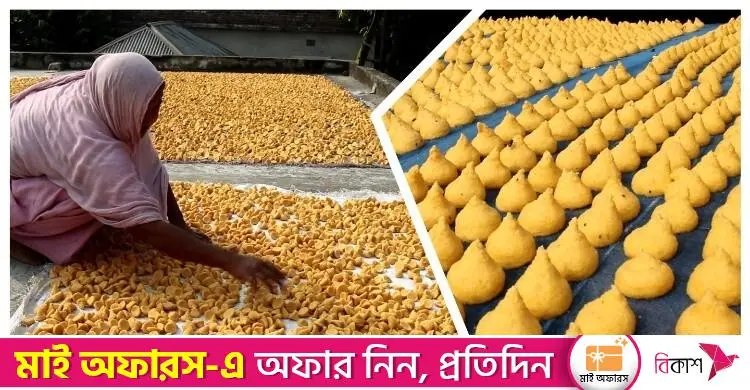
In the early morning chill of winter, while others sleep under their quilts, housewives in Pabna are busy grinding lentils on a stone slab or making lentil paste in a machine. They then mix it with ripe ash gourd (chal kumra), black cumin and other ingredients to make kumra bori.
With its unique taste, kumra bori is a favourite ingredient in curries. A few bori added to fish curry or mixed vegetable labra make the dish several times tastier, and the bori has become part of Bengali food heritage.
With good market demand, prices are good too. So at the start of every winter, Pabna's villages get busy making kumra bori, and this year is no exception. Many make it commercially for extra income at low cost and effort, with men helping. Kumra bori making is quietly growing in the district's villages, creating stories of new prosperity and self-reliance and widening commercial prospects.
Where the bori is made
Kumra bori is made to some extent in villages in all nine upazilas of Pabna, but most of it comes from Chatmohar, Faridpur, Santhia and Sujanagar upazilas. More than a thousand families in Chatmohar's Foiljana, Dolong, Ramnagar, Mathurapur, Bonthar, Kumargara, Handial and the municipal area are involved in making and selling it.
Bori is also made in most villages of Faridpur upazila, including Demra, Demra Madhyapara, Ratanpur and Pathar. Likewise, villages in Santhia, Sujanagar and Sadar upazilas get busy making bori from the start of winter.
Visits to these areas and talks with those involved show that housewives make kumra bori at home throughout the winter, with everyone in the household lending a hand. In good weather, makers produce bori for sale almost every day. Starting very early, three to five people working four to four and a half hours can make about a maund of bori a day, and some make more. One kilogram of kumra bori is made from 800-900 grams of lentils, some black cumin and a little ripe ash gourd. The bori are set out on cloth and dried for two to three days, after which they are ready to sell.
Costs, prices and markets
This year it costs Tk 60-70 to make a kilogram of bori with anchor dal; grinding the lentils by machine adds Tk 10. Makers sell the bori wholesale for Tk 90-110. Bori made in Pabna goes beyond the district to Dhaka, Chattogram and other districts, and is sent to relatives living abroad. In this way the ingredient is spreading, and the extra income is improving rural households' circumstances.
Usha Rani of Dolong village in Chatmohar said: "Quite a few families in this village have been making bori for 50 years. We used to grind the lentils on a stone slab; now many people do it by machine. It is hard work, but we earn well from it."
Abu Sayeed of Demra Madhyapara in Faridpur upazila said: "If you get up at 3am and work until 7am, you can make about a maund of bori. We make them in the morning and sell them wholesale in the markets at Tk 100 a kg. We make a profit of Tk 20-30 a kg. With this extra income on top of our normal earnings, we are doing well."
Masura Begum of Ratanpur said: "We make bori all winter. We soak the anchor dal the day before and make the bori the next day. After they dry in the sun, the men of the house sell them. In some households the men also make them."
Shamim Hossain, deputy general manager of BSCIC in Pabna, said: "The extra income entrepreneurs earn from making bori is contributing to the economy. If entrepreneurs seek our help to keep this industry going, we will certainly provide it. If needed, we will help them get low-interest loans on easy terms. Along with help in sales and marketing, we will also arrange training."
Source: Jagonews24. First published in Bengali on The Agro News.
Comments
(0)