
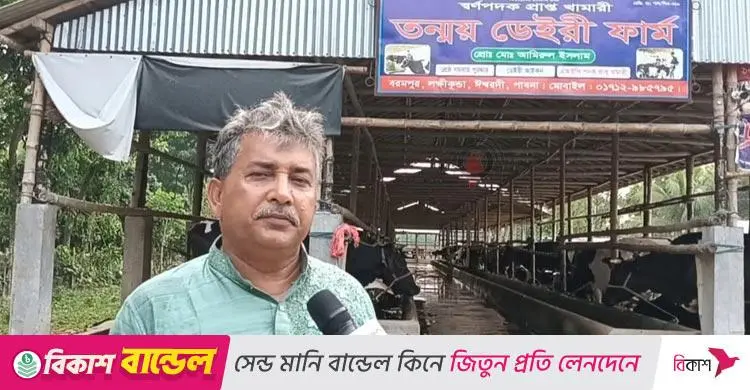
On his mother's instruction he bought a cow for Tk 14,600. From that one cow he now owns more than a hundred. His farm produces 450 to 500 litres of milk a day, and he has earned lakhs of taka every year from selling milk and calves. Besides milk, he produces biogas, vermicompost and Trichoderma organic fertiliser from cow dung, and he also keeps buffaloes, garole sheep and chickens.
In recognition of his hard work and skill, he has been awarded as the best farmer in the country. He has also won the Agriculture Important Person (AIP) award, the country's highest honour for farmers.
Former US ambassador Dan W Mozena, overwhelmed after visiting his farm, patted him on the back and said: "I am overwhelmed and charmed to see your farm. Keep going on the road to success."
This is the success story of Aminul Islam, a farmer in Ishwardi upazila, Pabna. The road was not smooth; through hard work, skill and intelligence he overcame many crises to establish himself as a successful farmer.
Starting out
Aminul Islam is the son of the late Nabir Uddin and the late Amena Khatun of Barompur village in Lakshmikunda union. His father died in 1990 while Aminul was studying for a BSc at Ishwardi Government College. He was the only son among seven siblings, so after his father's death he had to take charge of the family while still a student and give up his studies.
With savings from selling the milk and calves of the cow bought on his mother's instruction, and some more money from his mother, he built a shed for a farm. So began his commercial farm. The number of cows grew every year and the farm expanded. Over 30 years the farm's success story has come a long way.
His Tonmoy Dairy Farm, on 22 bighas of land, is now a model for farmers across the country. Hundreds of farmers attending government training on setting up dairy farms visit it and take his advice, and students from agricultural universities also come to gain practical experience.
Describing how he built the farm, Aminul said: "In 1990, when I was a BSc examinee, my father died of cancer. After his death our farming stopped for a while, and we sold the cattle and goats at home. In 1994 my mother said, 'We are not used to throwing away rice starch and vegetable scraps. I have fed these to cattle and goats all my life. Arrange to buy a cow.' On her instruction, in 1994 I bought a crossbred cow from the next village for Tk 14,600. Every year I kept the female calves, and so the number of cattle grew one by one. At one point I decided to start a cattle farm."
Though he started with one cow, the farm now has more than a hundred, and it employs eight workers, he said.
Building a community of farmers
"One cannot develop oneself or the area by farming alone," Aminul said. "So besides building my own farm, I encouraged more than a hundred people in the village to start farms, and many have become financially solvent. I sell calves from my farm to farmers in my village so they can develop their farms quickly by raising improved breeds."
He said he formed a cooperative with more than a hundred farmers in the village, the Pakuria Primary Milk Producers' Cooperative Society Ltd. Founded in 2006, it has over a hundred members. Its milk goes to Milk Vita, and some is also sold in local markets.
On the 22-bigha farm, he said, he produces biogas from cow dung alongside milk. The gas runs his two generators and meets cooking needs in his own and neighbouring homes. Vermicompost and Trichoderma organic fertiliser are made from the dung and sold. A large part of the farm is given over to grass. "There is no alternative to growing grass if you rear cattle," he said. The farm also keeps buffaloes, garole sheep and chickens, which meet the family's need for meat and eggs, with some sold.
Advice for farmers
Asked how a farm can be profitable, he said farmers cannot depend on milk alone. They must produce biogas and organic fertiliser from dung and have their own grass cultivation, the main ingredient of cattle feed. A farmer with his own grass will certainly succeed. Other feed should be given too, but the farmer must understand grass is the main food. Farmers should not be emotional: a farm started by buying milking cows will struggle to be sustainable. They should start with calves, so that by the time the calves grow into full cows the farmer has full knowledge and experience.
He said his farm produces 450 to 500 litres of milk a day, with a market value of Tk 22,000 to 26,000. Calves, garole sheep, eggs and organic fertiliser are also sold. "Farmers like me can earn Tk 30 lakh even after workers' wages and other costs. Anyone building a dairy farm must do other work like mine alongside rearing cattle. Only then will the farm be profitable and the farmer succeed."
Awards and dreams
Asked about his achievements, he said: "I am an ordinary man from a remote village in the Padma-washed char area. I thank Almighty Allah for the honour and dignity I have received through dairy farming. Former US ambassador Dan W Mozena visited my farm. Various government secretaries and senior officials, vice-chancellors of agricultural universities, scientists and researchers, and hundreds of farmers and students have come. I consider this the great reward of my life."
For the farm he received the National Farm Bronze Medal in 2012, the National Cooperative Award in 2013, the Prothom Alo Agriculture Award, honours from a Mymensingh agricultural institution and from Bogura RDA, the Dairy Icon Gold Medal in 2021, the National Agriculture Gold Medal in 2022 and the Agriculture Important Person (AIP) award in 2024.
His dream, he said, is to build a large-scale milk village in the area, not only producing milk but also making and marketing nutritious, tasty dairy foods.
Idris Ali, a farmer from his village of Barompur, said hundreds of small and large farms have grown up in Barompur and nearby villages following Aminul's example. "Every one of our farms has a biogas plant. Many produce organic fertiliser from dung for their own land and for sale. If any farmer or cow has a problem, Aminul bhai rushes over at once, and with his help many problems are solved quickly. He is a very big-hearted man. The government has honoured him with various awards as a model farmer. Barompur and the whole upazila are proud of his success."
Ishwardi Upazila Livestock Officer Aklima Khatun said Aminul Islam is a successful farmer who has won various national awards in recognition of his success, and her office has been helping him as far as it can.
Source: Jagonews24. First published in Bengali on The Agro News.

Comments
(0)