
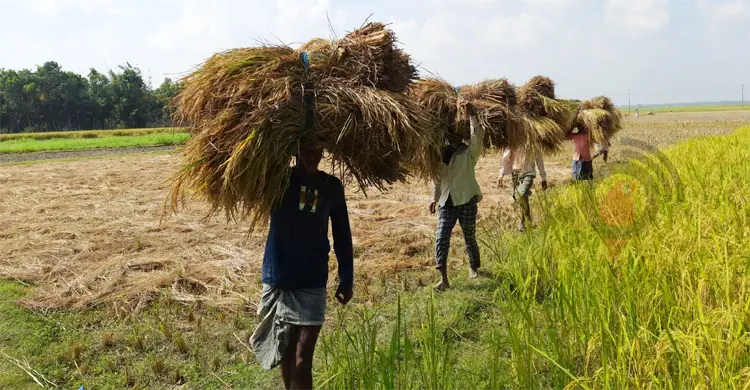
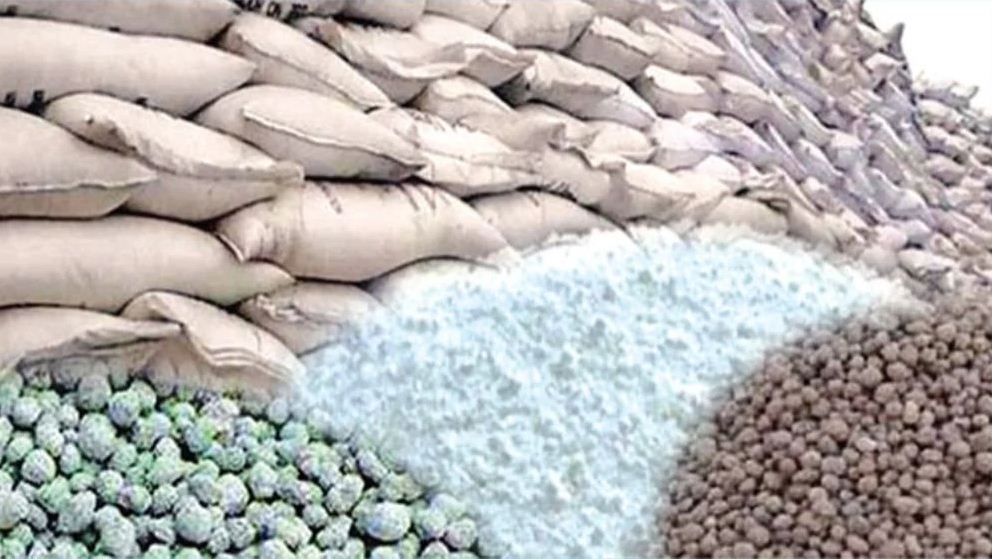
Aman paddy has started coming into farmers' homes. Farmers began cutting their paddy with high hopes, but they are disappointed with the price. They say that a fertiliser shortage and too little rain during the monsoon have cut yields this year, and on top of that they are not getting a price that matches their production costs.
They say those concerned should calculate the cost of production before calculating the price at which paddy is selling, and they are demanding a realistic increase in the government's procurement price for paddy.
According to the Department of Agricultural Extension (DAE), transplanted paddy has been grown on a total of 54,770 hectares in Pabna this season, and the rice production target has been set at 11,250 tonnes. The DAE expects the target to be met. Farmers, however, say yields are lower because of the fertiliser shortage and insufficient rainfall this season, and that there is a lot of chaff in the paddy.
Costs up, price barely moved
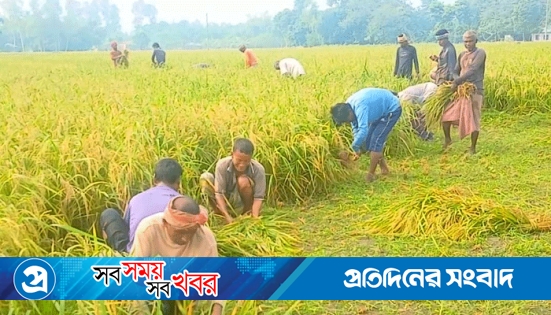
Transplanted aman harvesting has begun in different upazilas of Pabna, and new paddy has started reaching the market. Transplanted aman is selling at Tk 1,200-1,350 a maund, with fine or aromatic varieties a little higher.
Even at these prices, farmers are not making the profit they hoped for. They say the price of diesel has almost doubled, so the cost of ploughing has gone up. Fertiliser, labour and pesticide prices have risen, and because threshing machines run on diesel, threshing costs more too. The price of paddy has not risen in proportion to farmers' costs, so they are seeing very little profit.
Farmers say the market price of paddy has risen by Tk 100-200 a maund from last time, but production costs have nearly doubled. Farmers who lease land face even higher costs, as they must pay the landowner Tk 15,000 a bigha every year.
By the agriculture department's calculation, the average yield is 15 maunds a bigha, at a cost of about Tk 10,000 a bigha. At Tk 1,200-1,350 a maund, a landowner who farms his own land keeps a profit of Tk 3,000-4,000 a bigha. But for those who farm leased land, nothing is left once the payment to the landowner is deducted.
Farmers plan to grow less
Talking to farmers in different parts of the district, it emerged that they are not happy with the price paddy is fetching in Pabna now, because nothing is left after production costs. Many say they will give up growing paddy commercially and will cultivate only as much land as their own households need, because the more they grow, the more they lose. Those concerned fear paddy production in Pabna will fall as a result.
Abdul Majid, a paddy farmer in Bamondanga village of Santhia upazila, said growing paddy cost much more this year. Ploughing costs rose because of higher fuel prices, fertiliser, pesticide and labour were dearer, and even the charge for threshing machines went up. They also did not get fertiliser properly this year, so yields were lower, he said.
Sharecropper Ansar Ali said he had grown paddy on sharecropped land but lost money as production costs rose, so he has given the land up.
Joynal Abedin, a farmer in Padmabila village under Ataikula police station, said the profit from growing paddy had fallen sharply. Costs had gone up for everything, but the price of paddy had not risen in proportion.
Threshing machine owner Delowar Sekh said that last year they took two and a half kilos of paddy for every maund they threshed; this year they take four kilos a maund. Even that does not cover their costs, he said, because the price of fuel has nearly doubled.
Farm labourer Saheb Ali said they had come from another village to cut paddy in Bamondanga. The seven of them are working for Tk 700 a day.
Prices at Bongram haat
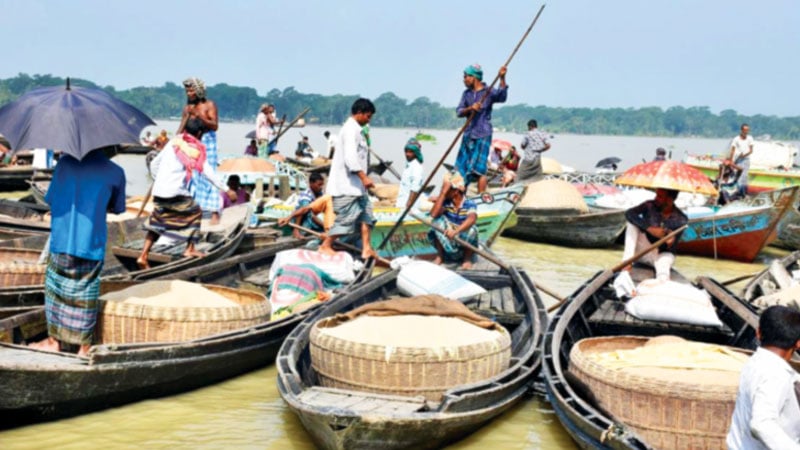
A visit on 14 November to Bongram haat, one of Pabna's biggest markets, found aman paddy selling at Tk 1,200 to 1,350 a maund, and slightly finer paddy at Tk 1,450 a maund.
Farmers said that at this time last year coarse paddy sold for Tk 1,100-1,150 a maund and moderately fine varieties for Tk 1,200-1,300 a maund, but prices had not risen in line with the increase in farming costs over the year.
Many people think the price of paddy has shot up to Tk 1,200 or 1,400 a maund, they said, but they do not count how much it costs to grow paddy on a bigha of land.
Aziz Sekh of Bhadrakola village, who had come to Bongram haat to sell paddy, said he sold at Tk 1,250 a maund. Ploughing, fertiliser and labour all cost more, so they cannot make a profit from paddy, he said. From now on he will grow paddy only on as much land as his family needs, and will no longer grow more for sale.
Abdul Thalek, who farms leased land, said he sold paddy at Tk 1,200 a maund, which does not cover their costs. They have to pay the landowner Tk 15,000 a year, and all other costs have risen, so a price of Tk 2,000 a maund would make it worthwhile, he said.
Shahjahan, a well-known farmer in Ishwardi and central president of the Bangladesh Farmers Association (BFA), said the cost of producing paddy was rising and yields were falling, yet farmers were getting low prices. The government should set a higher procurement price for paddy in light of the reality, he said.
Saiful Islam, district training officer at the Pabna district DAE office, said yields in the fields were fairly good this year. Because it was the rainy season, less irrigation was needed. What farmers described as using less fertiliser was in fact applying fertiliser in measured amounts, which cut waste and saved them money. Farmers are getting more in the market than the government's procurement price (Tk 27 a kg), he said.
Source: Jagonews24. First published in Bengali on The Agro News.
Comments
(0)